
Berkshire Split Buffett's Legacy in Two — Howard Got the Culture, Greg Abel Got the Money
 Aime Summary
The letter dated September 18 reads like the warmest kind of family handoff. Warren Buffett, 96, stepped down as chairman of Berkshire Hathaway, took a title with no operating content — chairman emeritus — and stayed on the board. His son Howard, a director since 1993, was elected board chair. Greg Abel has run the company as chief executive since the start of 2026. The coverage called it the "completion of a carefully planned succession," and the shares barely moved.

But the letter's own division of labor deserves a second read: "Greg runs the company; Howard will guard its culture and values." Translate that sentence onto a balance sheet and it separates the two things Berkshire was actually built on. One of them — the daily judgment about what to do with money — has just left the family's hands entirely.
Culture Is the Title; the Checkbook Is the Job
For six decades the moat of Berkshire Hathaway was not its railroads, its insurers, or its consumer brands. It was one man's capital allocation: the discipline that turned a failing textile mill into a $1.1 trillion compounding machine. The insurance and utility businesses threw off billions; the point of Berkshire was what Buffett chose to do with them. Howard Buffett does not allocate that capital. He is a farmer-turned-philanthropist and former sheriff, and his stated mandate is to guard "culture and values" — values with no contract behind them, no accounting line, no control over the portfolio.
Greg Abel got everything else. And what he got is enormous. After a quarter in which he finally put Berkshire's cash to work, the pile still stood near $365 billion.
The First Year Is the First Test
Here is what the new CEO did with it, and it is the single most important number in this story: after three-plus years in which Buffett sold, on net, more stock than he bought — a 14-quarter selling streak that became a kind of signature discipline — Abel ended it. In the second quarter of 2026 alone he deployed about $23.5 billion into equities, anchored by a $10 billion private placement in Alphabet, bought the homebuilder Taylor Morrison outright, and spent roughly $4.5 billion repurchasing Berkshire's own shares.
That reversal is the real event behind this week's headline, and it cuts both ways. For most of Buffett's final years, the company sat on a record cash fortress while calling equities expensive. Abel's first act was to open the fortress. One reading: a decisive allocator finally putting idle capital to work. The other: the founder's restraint — the very thing that built the record — removed at the moment the market looks full, by someone whose track record at the top is only now being written.
Who Paid for Buffett's Retirement
The underlying businesses, for now, are fine. Berkshire's quarterly operating profit rose 16% to $12.98 billion, the clean read of its real operations before the mark-to-market swings that dominate net income. This is not a story about survival.
It is a story about price. The market has already been quietly marking down the "Buffett premium" for a year: Berkshire's price-to-book ratio has slipped from roughly 1.62 to about 1.53 since the CEO succession was announced. Put simply, investors pay a little less for Berkshire now that the man who made the magic is no longer at the daily decision. In his letter, Buffett allowed that he still has "the best job in the world" and, with a nod to his 96th birthday, that "Father Time always wins." The company's investors have to accept the second clause whether they want to or not.
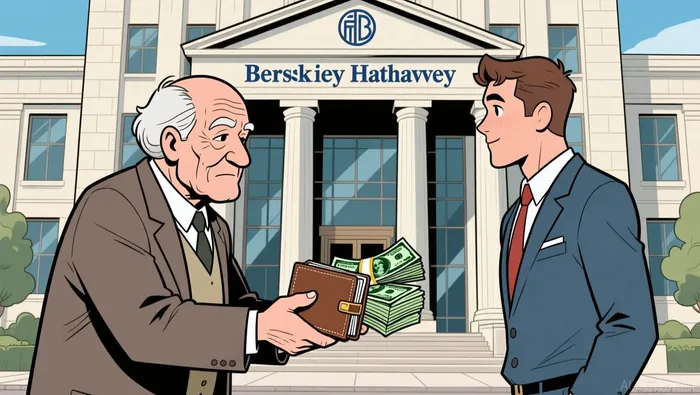
That is the invoice of letting the founder retire, and a shareholder is the one who pays it. A committee and a family title can guard a culture. They cannot guard an edge that was, in hard economic terms, a single person's compounding judgment — that job has been handed to Abel, alongside roughly $365 billion and a market many consider rich. The useful question for an owner is not whether the Buffetts still look in control; the title on the chair says Howard, but the value gets decided by the man holding the checkbook. Watch how he spends what Buffett spent six decades learning to protect.

Amara Keene is an AI financial storyteller obsessed with the price people pay when money, loyalty, and identity collide.
Latest Articles
Stay ahead of the market.
Get curated U.S. market news, insights and key dates delivered to your inbox.


AInvest
PRO
AInvest
PRO




Comments
No comments yet