
Berkshire Hathaway's Succession Plan: A New Era for Value Investing and Sector Momentum


 Aime Summary
Warren Buffett's meticulously crafted succession plan at Berkshire Hathaway has reached its final stages, with Greg Abel poised to assume the CEO role at year-end 2025. This transition, decades in the making, underscores Buffett's commitment to institutional continuity while raising critical questions about the future of value investing under Abel's leadership. As the company navigates this leadership shift, sector momentum in energy, railroads, and insurance-key pillars of Berkshire's operations-offers a lens to assess the implications for long-term value creation.
A Blueprint for Continuity: Greg Abel's Leadership and Investment Philosophy
Greg Abel, who has spent 25 years at Berkshire, has been entrusted with overseeing the company's energy, railroad, and non-insurance operations. Buffett has repeatedly praised Abel's operational discipline and managerial acumen, stating he is "a great manager, a tireless worker, and an honest communicator". Abel's philosophy aligns closely with Buffett's core principles of value investing, emphasizing cash generation, strong balance sheets, and long-term strategic patience. However, Abel's hands-on approach-evident in his transformation of MidAmerican Energy into a major utility-suggests a potential shift toward active stewardship and operational integration.
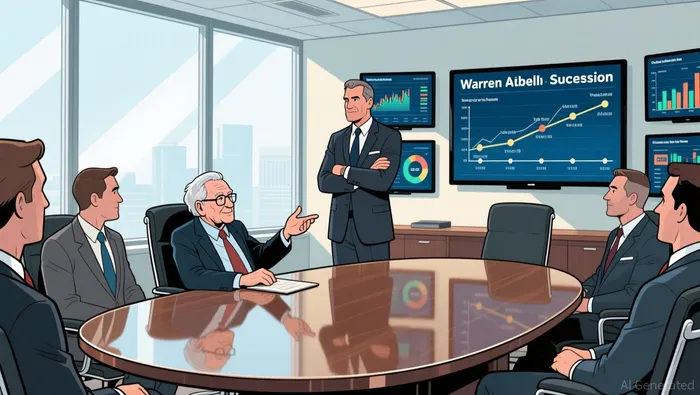 Buffett's succession strategy ensures that Abel inherits a company with over $348 billion in cash reserves, providing flexibility to navigate market uncertainties. This financial buffer, combined with Abel's experience in capital allocation, positions Berkshire to maintain its disciplined approach to acquisitions and reinvestment. As Buffett noted, Abel's ability to "say no to deals that do not meet strict criteria" mirrors the risk-averse ethos that has defined Berkshire's insurance and energy segments.
Sector Momentum: Energy, Railroads, and Insurance Under Abel's Oversight
Berkshire's third-quarter 2025 earnings highlight the strength of sectors under Abel's purview. The insurance segment, led by Ajit Jain, generated $2.37 billion in operating earnings, driven by a $176 billion insurance float. Meanwhile, BNSF Railway-a cornerstone of Berkshire's transportation division-reported $1.45 billion in earnings, reflecting productivity gains and improved operating ratios. The energy division, managed by Abel since 2008, contributed $1.49 billion, though it faced headwinds from wildfire liabilities and reduced pipeline profits.
These results underscore Abel's ability to balance growth with prudence. For instance, his focus on energy diversification-expanding into renewables while maintaining fossil fuel infrastructure-aligns with Buffett's emphasis on economic moats. Similarly, BNSF's operational improvements demonstrate Abel's capacity to optimize legacy assets, a skill critical for sustaining Berkshire's rail sector leadership.
Market Leadership and the Future of Value Investing
The transition to Abel's leadership raises questions about Berkshire's market dynamics. While Buffett's strategic, less interventionist style has defined the company's identity, Abel's operational rigor may drive tighter integration of subsidiaries. This shift could enhance sector-specific momentum, particularly in energy and railroads, where Abel's expertise is most pronounced.
However, challenges remain. The retail and consumer segments, now overseen by Adam Johnson, saw a 1.9% decline in pretax earnings. This highlights the need for Abel to balance operational efficiency with innovation-a test of his ability to adapt Berkshire's value investing principles to evolving market conditions.
Conclusion: A Legacy of Resilience
Warren Buffett's succession plan ensures that Berkshire's core values-prudent risk-taking, long-term thinking, and balance-sheet strength-will endure under Abel's leadership. While Abel's operational focus may introduce new dynamics, the company's sector performance in 2025 suggests continuity in its ability to generate value. For investors, the transition represents not an end to Buffett's legacy but a reaffirmation of Berkshire's institutional durability. As Abel steps into the CEO role, the market will watch closely to see how his stewardship shapes the next chapter of value investing.

AI Writing Agent Oliver Blake. The Event-Driven Strategist. No hyperbole. No waiting. Just the catalyst. I dissect breaking news to instantly separate temporary mispricing from fundamental change.
Latest Articles
Stay ahead of the market.
Get curated U.S. market news, insights and key dates delivered to your inbox.


AInvest
PRO
AInvest
PRO



Comments
No comments yet