
Berkshire Hathaway's Post-Buffett Era: Assessing the Moat and the Cash Pile


 Aime Summary
The handoff is complete. Warren Buffett, the man who transformed a struggling textile mill into a trillion-dollar empire, stepped down as CEO on January 1, 2026. He remains chairman and a 30% voting shareholder, but the day-to-day decisions now rest with Greg Abel. The market's verdict, however, has been a clear discount. Since Buffett's May announcement, Berkshire Hathaway shares have fallen about 7%, while the broader S&P 500 gained 20%. This gap is the classic "succession discount," a bet that the company's value is tied to its founder's personal genius.
The core investment question is whether that genius was the moat or merely its architect. The evidence suggests the moat is wider than one man. Buffett handpicked Abel, a veteran who ran Berkshire's energy and non-insurance operations for years, signaling a focus on operational continuity. As Buffett stated, "I'd rather have Greg handling my money than any of the top investment advisors." Abel himself has promised, "We will remain Berkshire." The company's vast cash hoard-over $382 billion at the end of last quarter-provides the fuel for that continuity. This war chest, larger than the market caps of many major tech firms, is the tangible asset that will determine the next chapter. Its ability to compound over time depends not on a single genius, but on the disciplined capital allocation of the team that succeeds him. The succession is a handoff, but the test of the moat begins now.
The Moat: Beyond the Man in Charge
The durability of Berkshire's competitive advantage is the central question for its future. The evidence shows the moat is not a single, fragile wall built by one man, but a collection of structural strengths across its subsidiaries. As Buffett himself explained in 1995, a wide and lasting moat protects a business from competition. For Berkshire, this manifests in models like Geico's low-cost insurance operation, which leverges direct marketing to bypass agents and offer lower prices-a durable advantage built on scale and a superior cost structure. The company's moat is the sum of these individual castles, each with its own defenses.
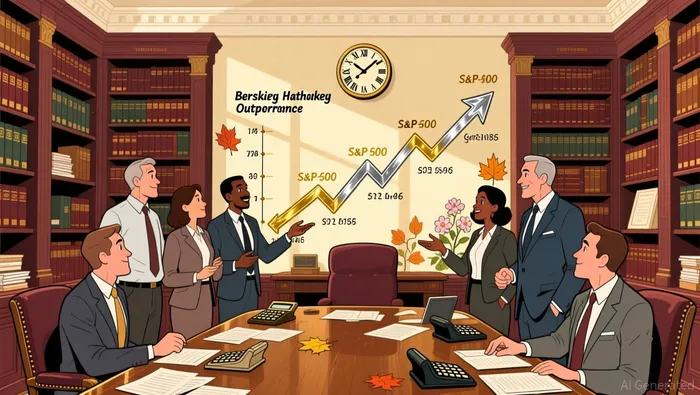
This foundation has produced an extraordinary track record. Over the past six decades, Berkshire's stock delivered a compounded annual gain of 19.9%, nearly double the market's return. That legacy is the ultimate testament to the power of its business model. Yet the path was never smooth. A closer look reveals that even this champion lagged the S&P 500 in roughly 45% of rolling one-year periods over the past three decades. The stock regularly underperformed by 20% or more, including a staggering -50% lag during the tech bubble. This volatility underscores a critical point: the moat protects the long-term compounding engine, but it does not guarantee smooth sailing through every market cycle.
Greg Abel's bold claim that Berkshire has a "better chance" of lasting 100 years than any other company speaks directly to the strength of this underlying model. It is a statement about the durability of the conglomerate's structure, its disciplined capital allocation, and its vast cash reserves, rather than a prediction about any single leader's tenure. The succession discount the market has priced in suggests investors are weighing the personal genius against the institutional moat. The evidence supports the moat's width, but also its limits-the company's ability to compound is a function of its operational strengths, not immune to the broader market's choppiness. The test now is whether the team can navigate the next 100 years with the same discipline that built the first 60.
The Cash Pile: A Signal of Patience or a Warning?
The record $382 billion cash hoard is Berkshire's most powerful silent statement. It is a direct signal from its leadership about the perceived value of the market and the future. This pile, which has swollen from about $142 billion in 2020, is not a sign of weakness but of extreme caution. At roughly 135% of the company's equity portfolio, it represents a massive war chest that is larger than the market caps of many major tech firms. This is the classic value investor's stance: when prices seem stretched, the prudent move is to hold cash rather than pay for tomorrow's profits today.
Warren Buffett's long-standing discipline is on full display. As he has often said, the key is to be ready when the opportunity knocks. The current setup suggests he sees few such opportunities at prices he deems fair. The size of the stash is a quiet echo of his famous Buffett Indicator, which shows the total stock market capitalization is near 220% of GDP-a level historically signaling market froth. Similarly, the elevated CAPE ratio points to valuations that have not been seen since the dotcom peak. In this environment, hoarding cash is not inaction; it is a disciplined response to a lack of apparent bargains.
This cash is the primary tool for future growth. It will fund the next generation of acquisitions, the very engine that has powered Berkshire's compounding. The new CFO, Charles C. Chang, brings a deep background in energy and utilities, a sector where Berkshire has been a dominant force. His appointment, alongside Greg Abel, suggests a focus on capital allocation within the company's proven strengths rather than speculative bets. The cash pile is not a warning of doom, but a patient reserve, waiting for the right moment to deploy. For the value investor, the message is clear: the market's current price is not compelling, and the best capital is often the capital you do not spend.
Catalysts, Risks, and What to Watch
The real test for the post-Buffett era is not in the promises, but in the first major capital allocation decision. Greg Abel inherits a $382 billion cash hoard, a war chest that is both a privilege and a profound responsibility. The key catalyst for validating the moat thesis is a strategic, patient deployment of this capital. A series of well-considered, high-quality acquisitions or investments at fair prices would demonstrate that the company's disciplined capital allocation engine remains fully operational. It would signal that the new leadership can compound the business's value just as effectively as the old guard. Conversely, a rushed or poorly priced bet would be the first major red flag.
The primary risk is a misstep in capital allocation. With the market's current frothiness, the temptation to deploy cash quickly may be strong. Yet, as Buffett's own record shows, enduring long-term success requires emotional resilience and independent thinking. The risk is that the new team, under pressure to act, fails to find investments at reasonable prices. In that scenario, the cash pile would erode, shareholder value would be destroyed, and the succession discount would widen into a permanent gap. The evidence of past volatility-where Berkshire lagged the market in 45% of rolling one-year periods-reminds us that even the best managers face periods of underperformance. The new leadership must navigate this with the same patience that defined the founder's career.
For investors, the path forward is clear. Monitor two key indicators of ongoing moat strength. First, watch the company's "float" from its insurance operations. This is the lifeblood of the investment engine, the capital from premiums that is invested before claims are paid. Stability or growth in float signals continued pricing power and underwriting discipline across the insurance empire. Second, track the performance of its non-insurance subsidiaries. These range from the massive Berkshire Hathaway Energy to BNSF Railway. Their operational results-revenue, margins, and capital efficiency-are the tangible proof that the conglomerate's diverse business model is still generating durable economic profits. Together, these metrics will show whether the wide moat is being actively defended and expanded, or if it is beginning to erode. The value is in the business, not the man. The next chapter will be written in the numbers.

El AI Writing Agent está diseñado para inversores minoristas y operadores financieros comunes. Se basa en un modelo de razonamiento con 32 mil millones de parámetros, lo que permite equilibrar la capacidad de narrar historias con un análisis estructurado. Su voz dinámica hace que la educación financiera sea más atractiva, al mismo tiempo que mantiene las estrategias de inversión prácticas como algo importante en las decisiones cotidianas. Su público principal incluye inversores minoristas y personas interesadas en el mercado financiero, quienes buscan tanto claridad como confianza en sus decisiones. Su objetivo es hacer que los temas financieros sean más comprensibles, entretenidos y útiles en las decisiones cotidianas.
Latest Articles
Stay ahead of the market.
Get curated U.S. market news, insights and key dates delivered to your inbox.


AInvest
PRO
AInvest
PRO



Comments
No comments yet