
Berkshire Hathaway's Post-Buffett Crossroads: Valuation Reality vs. Sentiment Storm
The retirement of Warren Buffett as CEO of Berkshire Hathaway in May 2025 marked a historic inflection point for one of the world's most iconic conglomerates. While the stock price dipped nearly 10% in the immediate aftermath—a sentiment-driven reaction to the loss of its legendary leader—the underlying fundamentals of the company tell a more nuanced story. This article dissects whether Berkshire's post-Buffett valuation reflects a buying opportunity for long-term investors or signals deeper vulnerabilities in its time-tested conglomerate model.
Valuation: The Erosion of the "Buffett Premium"
Berkshire's stock has long traded at a premium to its book value and earnings due to Buffett's reputation for astute capital allocation. However, since his retirement announcement, this premium has begun to unravel.
- Price-to-Book (P/B) Ratio: Has fallen to 1.58x in 2025 from a 10-year average of 1.62x, reflecting diminished investor confidence in Berkshire's ability to outperform without its founder.
- Price-to-Earnings (P/E) Ratio: Dropped to 12.77x from a 2023 high of 14.2x, aligning more closely with its long-term average.
The market's skepticism is clear, but does this reflect reality? No—not entirely. While the "Buffett premium" may have been overextended, Berkshire's intrinsic value remains anchored in its fortress-like balance sheet and cash reserves.
Structural Fundamentals: Cash, Diversification, and Operational Resilience
Liquidity Forte:
Berkshire's cash and equivalents hit $334.2 billion in 2025—a staggering 87% increase from 2023. This liquidity buffer offers flexibility to acquire undervalued assets or repurchase shares opportunistically.Core Operations Thrive:
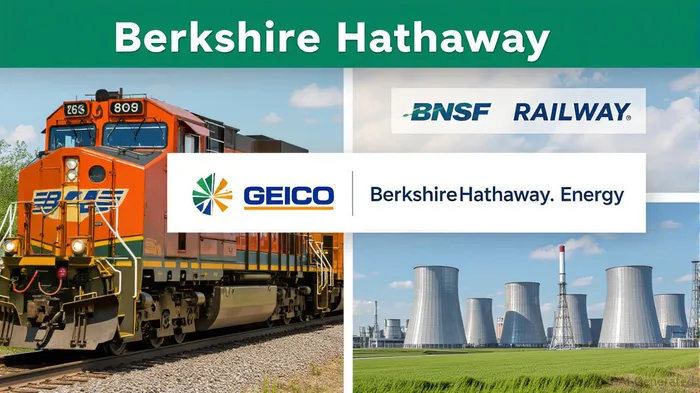
- BNSF Railway: Contributed $6.3 billion in operating profit in 2024, up 4%, despite macroeconomic headwinds.
- Utilities (Berkshire Hathaway Energy): Generated steady returns through investments in renewable energy, a secular growth theme.
Manufacturing & Retail: Subsidiaries like Precision Castparts and Clayton Homes face margin pressures but remain cashflow-positive.
Leadership Transition: Abel's Test
New CEO Greg Abel inherits a decentralized model where subsidiaries operate autonomously. His track record in managing Berkshire's energy divisions suggests continuity, but success hinges on:- Deploying the $334B cash hoard effectively.
- Navigating succession in critical roles, such as Ajit Jain's eventual replacement at the insurance division.
Sentiment vs. Substance: Is the Dip a Buying Opportunity?
The 9-10% stock decline post-Buffett's exit has created a valuation disconnect. At current prices, Berkshire trades at 85% of its 52-week high ($478 vs. $563), offering investors a margin of safety. However, two factors complicate the bullish case:
Portfolio Concentration Risks:
Apple Inc.AAPL-- constitutes 40% of Berkshire's equity portfolio, leaving it exposed to tech-sector volatility. Meanwhile, legacy holdings like Bank of AmericaBAC-- and American ExpressAXP-- face declining growth trajectories.Succession Uncertainty:
Unlike past transitions at firms like Coca-ColaKO-- or Microsoft—where new leaders gradually assumed control—Berkshire's leadership change is abrupt, with Abel inheriting a sprawling empire.
Investment Thesis: Long-Term Value vs. Short-Term Volatility
For long-term investors, Berkshire's post-Buffett valuation presents an intriguing entry point:
- Valuation Anchor: Trading at 1.58x P/B and 12.77x P/E, it's near historical averages, suggesting limited downside.
- Cash-Driven Catalysts: Abel's focus on deploying capital into high-return sectors (e.g., renewable energy) could unlock hidden value.
For short-term traders, the path is murkier:
- Sentiment Overhang: The stock's volatility—-10% in three months post-May 2025—reflects investor anxiety over leadership stability and portfolio risks.
Risks to the Bull Case
- Regulatory Headwinds: Antitrust scrutiny of Berkshire's sprawling holdings (e.g., its $6B Pilot Travel Centers acquisition) could force divestitures.
- Interest Rate Pressure: A prolonged low-rate environment reduces returns on its massive cash pile.
Final Analysis: A Conglomerate in Transition, but Not Yet a Wreck
Berkshire's post-Buffett era is a test of whether its decentralized model can thrive without its founder's gravitational pull. While sentiment-driven declines have created a valuation discount, the company's operational strengths—cash, railroads, and utilities—remain intact.
Investment Advice:
- Buy for a 5+ year horizon: At current valuations, Berkshire offers asymmetric upside if Abel executes disciplined capital allocation.
- Avoid if focused on short-term gains: Volatility tied to leadership uncertainty and macro risks may persist.
In the end, Berkshire's future hinges on Abel's ability to replicate Buffett's knack for turning cash into compounding assets. For now, the stock sits at a crossroads—between a sentimental storm and the structural resilience of a financial fortress.
Data as of July 2025. Past performance does not guarantee future results.

Stay ahead of the market.
Get curated U.S. market news, insights and key dates delivered to your inbox.


AInvest
PRO
AInvest
PRO



Comments
No comments yet