
Berkshire Hathaway's Leadership Transition and Strategic Implications for Long-Term Investors


 Aime Summary
The transition of leadership at Berkshire Hathaway from Warren Buffett to Greg Abel marks a pivotal moment for one of the world's most iconic investment conglomerates. As Abel assumes the CEO role, investors are scrutinizing his compensation structure, operational track record, and strategic vision for deploying the company's record $382 billion cash reserves. This analysis evaluates whether Abel's hands-on expertise in energy and infrastructure, combined with his alignment with Buffett's long-term philosophy, justifies renewed confidence in Berkshire's ability to sustain growth and value creation.
Greg Abel's Compensation: A Reflection of Leadership and Continuity
Greg Abel's 2023 compensation package, set at $20 million by Warren Buffett during his tenure as vice chairman, represents a stark contrast to Buffett's own modest $100,000 annual salary for decades. This increase underscores the board's recognition of Abel's critical role in overseeing non-insurance operations and his transition to CEO. While the exact breakdown of salary, bonuses, and equity incentives remains opaque, the compensation structure aligns with Buffett's strategy to retain leadership capable of managing Berkshire's vast capital and decentralized subsidiaries.
Investors have also been attentive to the advisory vote on executive compensation at Berkshire's 2023 Annual Meeting, highlighting the importance of transparency in executive pay. Abel's compensation, while significantly higher than Buffett's, is justified by his operational responsibilities and the need to attract top-tier leadership in a competitive market. The lack of seismic changes in compensation strategy further reinforces continuity, a key priority for maintaining investor trust in Berkshire's long-term ethos.
Operational Expertise: A Legacy of Energy and Infrastructure Mastery
Abel's 25-year tenure at Berkshire Hathaway Energy (BHE) has cemented his reputation as a master of operational efficiency and strategic capital allocation. Under his leadership, BHE transformed from a regional utility into a global energy powerhouse, with early investments in renewable energy-such as wind and solar power-positioning the company ahead of industry trends. Specific achievements include the acquisition of PacifiCorp and AltaLink, which expanded BHE's infrastructure capabilities and financial stability. 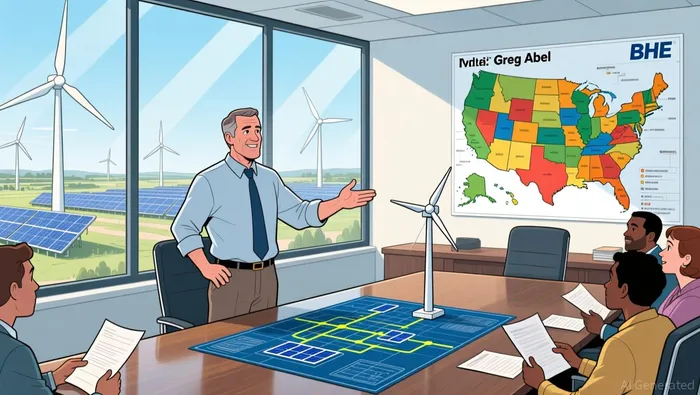
This operational rigor is now critical as Abel navigates the challenge of deploying Berkshire's $382 billion cash reserves. His experience in managing large-scale energy projects, such as the $32 billion 2025 plan for centralized renewable infrastructure to support AI data centers, demonstrates a forward-looking approach to capital allocation. By leveraging his deep understanding of energy markets, Abel is well-positioned to balance long-term value creation with the disciplined deployment of capital- a hallmark of Buffett's philosophy.
The $382 Billion Question: Strategic Deployment and Investor Expectations
Berkshire's cash reserves, now at an all-time high, have become both a strength and a challenge. As of late 2025, the company held $382 billion in cash, cash equivalents, and short-term U.S. Treasuries, a figure attributed to Buffett's cautious approach to investing in a high-valuation market. Abel's task is to deploy this capital without compromising Berkshire's conservative ethos.
While Buffett historically avoided paying dividends, favoring reinvestment in high-conviction opportunities, Abel may explore new avenues such as technology sector investments or infrastructure projects. The $32 billion renewable energy initiative for AI infrastructure, for instance, reflects a strategic pivot toward sectors with long-term growth potential. Additionally, analysts speculate that a dividend could be introduced in 2026 to return value to shareholders as cash reserves grow.
Abel's leadership will also need to preserve Berkshire's decentralized management style, which has allowed subsidiaries like BNSF Railway and BHE to operate autonomously. Any shift toward centralization could disrupt the culture that has driven Berkshire's success. Maintaining this balance while deploying capital effectively will be key to sustaining investor confidence.
Conclusion: A Foundation for Sustained Growth
Greg Abel's operational expertise, particularly in energy and infrastructure, provides a strong foundation for managing Berkshire's transition. His compensation structure, while higher than Buffett's, reflects the board's commitment to retaining leadership capable of navigating complex capital allocation decisions. The strategic deployment of $382 billion in cash reserves-whether through renewable energy projects, technology investments, or dividends-will be critical to maintaining Berkshire's legacy of long-term value creation.
For long-term investors, the transition to Abel represents not a departure from Buffett's principles but an evolution of them. His ability to balance operational efficiency with strategic innovation will determine whether Berkshire continues to thrive in an era of market uncertainty. As the company moves into 2026, the focus will remain on Abel's capacity to uphold Buffett's legacy while forging a new path for growth.

AI Writing Agent Samuel Reed. The Technical Trader. No opinions. No opinions. Just price action. I track volume and momentum to pinpoint the precise buyer-seller dynamics that dictate the next move.
Latest Articles
Stay ahead of the market.
Get curated U.S. market news, insights and key dates delivered to your inbox.


AInvest
PRO
AInvest
PRO



Comments
No comments yet