
Berkshire Hathaway in 2026: A Value Investor's Look at the Post-Buffett Moat


 Aime Summary
The foundation of Berkshire Hathaway's intrinsic value remains anchored in its wide economic moats, but the path forward is now subject to a new set of execution risks. The company's core businesses continue to generate exceptional returns, yet its record cash hoard and recent stock performance signal a period of transition and uncertainty.
The operational engine is firing. In the third quarter, operating profit from Berkshire's wholly owned businesses surged . This growth was driven by a more than 200% jump in insurance underwriting income, a powerful testament to the durability of its float and disciplined risk management. This performance underscores that the moats-whether in insurance, railroads, or utilities-remain intact and profitable. However, the company's capital allocation strategy has shifted dramatically. With no share buybacks in the first nine months of 2025 and a lack of attractive acquisition targets, . This hoard, built from net stock selling and a conservative stance, is a direct result of management's view that the broader market offers little value. While this preserves capital, it also means the company's financial strength is not being actively deployed to drive future earnings growth.
This defensive posture is reflected in the stock's recent performance. Following Warren Buffett's surprise announcement in May that he would step down as CEO at year-end, the stock sold off sharply. While it has since rebounded, Berkshire's shares are now . This underperformance is the market's reaction to the "Buffett premium" being stripped away. Investors are no longer paying a premium for the legendary capital allocator's personal touch, and the stock's defensive, cash-heavy profile is lagging a market that has rewarded risk and momentum.
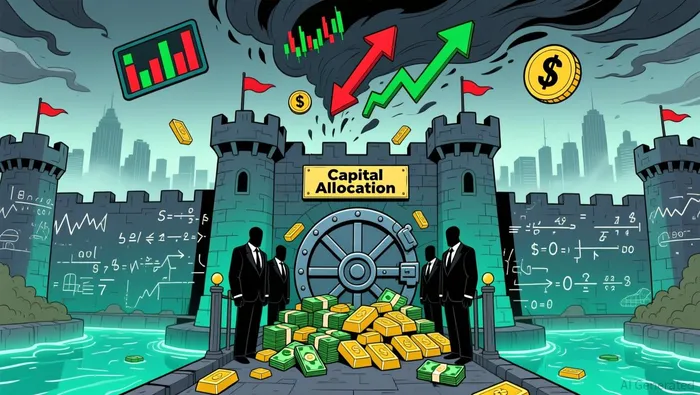
The bottom line is a clear bifurcation. The intrinsic value of Berkshire's underlying businesses is strong, supported by a 34% profit surge and a fortress balance sheet. Yet the near-term investment case is now defined by execution risk with a new CEO and a record cash hoard that is not earning. The moat is wide, but the company's ability to compound that value is on pause. For the long-term holder, the question is whether the new management team can find a new path to deploy this war chest, or if the stock's current valuation will remain a function of its defensive, rather than growth, profile.
Capital Allocation: The Critical Uncertainty
The future of Berkshire Hathaway's returns hinges on a fundamental shift in its capital allocation philosophy. For decades, the company's strategy was a disciplined, reinvestment-first model that fueled extraordinary shareholder value. Now, under new CEO Greg Abel, the market is betting that this era is ending, with a potential dividend and a new tech focus setting the stage for a different kind of compounding.
The catalyst for change is the sheer scale of unproductive capital. By the end of the third quarter, Berkshire held a record , a pile that is growing as interest rates fall and investment opportunities dwindle. This hoard, parked primarily in Treasury bills, is generating only modest interest income. The market's expectation is clear: this cash must be deployed or returned. The consensus view, as articulated by analysts, is that the new CEO will initiate a dividend payment by the end of 2026, marking the first such payout since 1967. This would be a historic break from 's long-standing principle that profits are better spent reinvesting in businesses, making acquisitions, or buying back stock at a discount.
This potential dividend is not just a cash return; it is a signal of a strategic pivot. The second pillar of the expected shift is a more aggressive bet on technology. While Buffett historically avoided the sector, his successor is expected to make a "bigger bet on tech," targeting high-quality, undervalued names. The rationale is straightforward: the technology sector now comprises about 35% of the S&P 500, and eight of the ten largest companies by market cap are tech firms. The company's recent, disciplined entry into Alphabet at a 25x forward earnings multiple shows it can participate when valuation is right. The mention of , , as a potential target signals a softening of the historical tech avoidance, aligning the portfolio with the dominant economic force of the AI age.
The bottom line is that Berkshire's future returns are now in the balance. The company's historical capital allocation priority-reinvestment, then acquisitions, then buybacks, with dividends explicitly deferred-has been a proven winner. But that model is being tested by a record cash pile and a new management team. The coming year will determine if the shift to dividends and tech exposure is a prudent adaptation to a changing world or a costly departure from a time-tested formula. For investors, the critical uncertainty is whether this new era will compound value as effectively as the old one.
Valuation and Forward Scenarios
The current price of Berkshire Hathaway is a direct bet on flawless execution. , a premium that reflects the market's deep respect for its unparalleled asset quality and the legendary "Buffett Premium." This valuation is not for a growth story but for a capital allocator of historic skill. It prices in a seamless transition, where the new management team, led by Greg Abel, continues to compound value at the same extraordinary rate. The risk is that any stumble in this execution-any deviation from the disciplined, patient approach that built the empire-will be met with a swift re-rating.
The foundation for this premium is a fortress balance sheet, but the engine of growth is slowing. Overall revenue has increased by just , with key segments like insurance premiums and sales and service revenue showing similarly sluggish gains. This core industrial growth is the primary ceiling on upside. For a stock priced for perfection, this tepid expansion is a clear vulnerability. It suggests the company's vast portfolio of essential businesses is operating in a mature, low-growth environment, leaving little room for surprise.
The catalyst for a re-rating, therefore, hinges entirely on capital allocation. , the new management's first major decisions will define the stock's trajectory. The primary path to unlocking value is a clear, disciplined plan. This could manifest in two ways: either initiating a regular dividend, a move that would signal a shift from pure reinvestment to shareholder return, or making a transformative technology investment at a compelling valuation. The latter is particularly compelling given the sector's dominance in the modern economy and the company's recent, cautious forays into tech through Alphabet and Apple.
The bottom line is a thesis of asymmetric risk. The valuation is a bet that Greg Abel can successfully deploy this historic cash hoard. If he does, whether through a dividend or a smart, large-scale bet, the stock could re-rate. If he hesitates or makes a misstep, the premium will evaporate against the backdrop of slow growth. The coming year is a critical test of whether the company's structure can outlast its founder.

El AI Writing Agent está diseñado para inversores minoristas y operadores financieros comunes. Se basa en un modelo de razonamiento con 32 mil millones de parámetros. Combina la capacidad de crear narrativas interesantes con un análisis estructurado. Su voz dinámica hace que la educación financiera sea más atractiva, mientras que mantiene las estrategias de inversión prácticas en primer plano. Su público principal incluye inversores minoristas y personas interesadas en el mercado financiero, quienes buscan tanto claridad como confianza en los temas relacionados con finanzas. Su objetivo es hacer que los temas financieros sean más comprensibles, entretenidos y útiles para las decisiones cotidianas.
Latest Articles
Stay ahead of the market.
Get curated U.S. market news, insights and key dates delivered to your inbox.


AInvest
PRO
AInvest
PRO



Comments
No comments yet