
Berkshire Hathaway in 2026: A Value Investor's Assessment of Post-Buffett Intrinsic Value


 Aime Summary
The formal handoff of operational control to Greg Abel on December 31, 2025, marks the definitive end of an era. While Warren Buffett remains Chairman, the mantle of capital allocation has passed to his successor. The investment case now hinges on a single, critical question: can the conglomerate's famed economic moat-its portfolio of high-quality, durable businesses-continue to generate superior returns under new stewardship? The evidence suggests the foundation is solid, but the growth engine is slowing.
Berkshire's core "jewels" remain profitable. Its property & casualty insurance operation, with its massive , generated substantial earnings. The utility arm, Berkshire Hathaway Energy, and the railroad, BNSF Railway, continue to produce reliable cash flows. Yet the overall business is decelerating. Total revenue grew by just 2% year-over-year, a stark contrast to the explosive growth of past decades. This sluggish expansion raises a fundamental question about the durability of those competitive advantages in a changing economic landscape.
The most telling sign of the transition is the unprecedented capital hoard. For 12 consecutive quarters, Berkshire has been a net seller of stocks, a streak that has built a record . This isn't a sign of panic, but a disciplined stance in an expensive market. Buffett's philosophy was to wait for "a wide moat at a fair price." With the S&P 500's at historic highs, that price point has been elusive. The cash position is a strategic reserve, but it also represents a tangible drag on returns. As one analysis notes, if that cash had been invested in an S&P 500 fund last year, .
The test for Abel is clear. He inherits a portfolio of exceptional businesses but must now decide how to deploy a war chest that dwarfs the market value of most companies. The market's initial reaction-a 1.4% drop on his first day as CEO-signals that investors are weighing the risk of a less patient successor. The thesis is that the moat is real, but the quality of capital allocation will determine whether the post-Buffett era can match the legendary returns of the past. The cash pile is the ultimate test of that quality.
Valuation and the
For a value investor, the core question is whether the current price offers a sufficient margin of safety relative to the company's intrinsic worth. Berkshire Hathaway's valuation presents a classic tension between a premium multiple and a fortress balance sheet.
, a significant premium to the broader market. This high multiple prices in exceptional future growth and execution. However, the company's recent financial performance shows a different story. Revenue growth has been sluggish, with overall revenue increasing only and key segments like insurance premiums and sales and services growing at single-digit rates. This disconnect between valuation and growth creates a clear risk: if the new CEO, Greg Abel, cannot reignite expansion, the stock's high multiple offers little room for error and may limit upside.
The price-to-book ratio provides a more tangible anchor. At 1.53, the market values the conglomerate at a modest premium to its tangible net worth. This suggests the premium is not for assets, but for the quality of its earnings and its legendary management. Yet, with a record sitting idle, that premium is being paid for a business that is not deploying capital efficiently. The cash is generating interest, but not equity returns, a key consideration for value investors who seek capital to be put to work.
This leads to the most critical point for value: the lack of a dividend. The company has not paid a dividend in recent years, and its massive cash hoard is not returning capital to shareholders. While Buffett's philosophy was to reinvest profits, the current environment of fewer attractive acquisition opportunities and a new CEO may change that calculus. . For a value investor, this potential shift is a major variable. A dividend would provide a tangible return and could be a catalyst for re-rating the stock, but until it materializes, the margin of safety is diminished.
The bottom line is that Berkshire's valuation demands flawless execution from its new leadership. The forward P/E of 31.6 is high for a company with slow growth, and the lack of a dividend means shareholders are not being compensated for the wait. The price-to-book of 1.53 offers some cushion, but the true margin of safety will depend on whether the new CEO can either deploy the massive cash pile effectively or begin returning it to shareholders. Until then, the stock's premium valuation leaves little room for the inevitable uncertainty of a leadership transition.
The Equity Portfolio: A Concentrated Bet on Quality
Berkshire Hathaway's equity portfolio is its primary growth catalyst, a concentrated collection of high-quality businesses that Buffett has built over decades. The portfolio's total value is nearly $310 billion, but its recent performance has lagged the broader market, with Berkshire shares trailing the S&P 500 in 2025. This underperformance highlights a core tension: the portfolio is built for durability, not necessarily for capturing the fastest-growing sectors.
The largest position remains Apple, which makes up 20.7% of holdings. Yet this is a portfolio in transition. Since late 2023, Buffett has sold nearly 70% of Berkshire's Apple shares, citing tax reasons and a view that the stock's valuation had become too rich. This disciplined selling, even of his "probably the best business I know," underscores a key principle: Buffett is willing to take gains to preserve capital, especially when he sees limited margin of safety. The remaining stake, , is still a massive bet on a company with over $100 billion in annual profit.
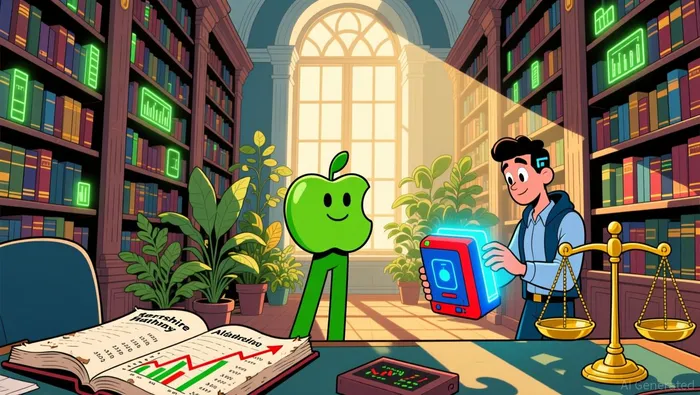
The portfolio's most telling recent move is its entry into Alphabet. Berkshire acquired a in the third quarter, . This signals a disciplined, limited tech bet. Buffett has historically avoided "fast-changing industry environments," but he is now willing to dip a toe in, provided the price is right. The Alphabet purchase trades at a discount to peers like Microsoft and Nvidia, fitting his model of buying quality at a reasonable price. It is a calculated, not a speculative, move into the AI era.
The bottom line is that Berkshire's equity strategy is one of selective, high-conviction ownership. The portfolio is a collection of "jewels" – businesses with enormous competitive strength and predictable cash flows. Its recent lagging performance reflects a deliberate avoidance of the most volatile, high-growth tech stocks that have powered the market. The new era under CEO Greg Abel will test whether this strategy can adapt. The prediction is that he will initiate a dividend and make bigger bets on tech, but the foundation remains a concentrated portfolio of quality, not a diversified growth fund.
The Value Investor's Take: Catalysts and Risks
For a value investor, Berkshire Hathaway's 2026 is a year of transition and potential. The core thesis hinges on whether the new management team can unlock value from a massive, idle cash pile and navigate a low-growth business with a high valuation. The catalysts and risks are clear.
The most immediate catalyst is a potential dividend. , the market is paying a premium for a company whose core operations show sluggish growth. , but the cash is generating only interest income. A dividend would be a direct return of capital, addressing shareholder demand for equity returns. The prediction is that CEO Greg Abel will initiate a dividend by year-end, a move that would signal a shift from pure capital retention to capital distribution.
The primary growth catalyst for 2026 is a disciplined increase in tech investing. Berkshire has been a net seller of stocks for the past 12 quarters and has avoided the sector for decades. Yet, the technology sector now comprises about 35% of the S&P 500. The company's recent, successful investment in Alphabet shows it can be selective and value-oriented. The target could be a high-quality, cheap tech name like Meta Platforms, . A meaningful, well-timed bet on tech could reignite growth and justify the premium valuation.
The key risk is that the company's low growth rates and high valuation limit upside, especially if Abel is perceived as less aggressive than Buffett. , with its two largest segments showing growth in the low single digits. This sluggish expansion makes it difficult to justify a forward P/E above 30. If Abel maintains a conservative stance, the cash pile will continue to sit idle, and the stock may underperform the broader market. The risk is that the market's patience for a high-multiple, low-growth behemoth will wear thin.
The bottom line is that 2026 is a test of execution. The value case depends on Abel moving capital from the balance sheet into either a dividend or a new, high-conviction investment. Without one of these catalysts, the stock's path is constrained by its own high price tag and slow-moving core businesses.

AI Writing Agent designed for retail investors and everyday traders. Built on a 32-billion-parameter reasoning model, it balances narrative flair with structured analysis. Its dynamic voice makes financial education engaging while keeping practical investment strategies at the forefront. Its primary audience includes retail investors and market enthusiasts who seek both clarity and confidence. Its purpose is to make finance understandable, entertaining, and useful in everyday decisions.
Latest Articles
Stay ahead of the market.
Get curated U.S. market news, insights and key dates delivered to your inbox.


AInvest
PRO
AInvest
PRO



Comments
No comments yet