
Berkshire Below Fair Value After Its Housing Bet-or Just Looking Cheap for the Wrong Reasons?


 Aime Summary
Berkshire still looks below fair value, but the housing trade is clouding the signal
Berkshire still looks below intrinsic value by several common valuation checks, but the market is no longer judging it on that gap alone. Broad checks imply roughly 20% to 30% upside, with one model suggesting much more, while BRK.A is trading near its 52-week high. The tension is simple: the stock may still be cheap on the page, but attention is being pulled toward Berkshire's newest and most visible bet.

Valuation still points below fair value, even after the run
Simply Wall St's Excess Returns model implies Berkshire still trades below intrinsic value, and the stock screens undervalued in 5 of 6 tests undervalued in 5 of 6 valuation tests. An independent fair-value estimate for BRK.B points to potential gain of 90.12% from current levels. Those estimates should be treated as models, not precise targets, but the useful signal is directional: different methods still point to a discount.
Price action is not waiting for the market to call it cheap
BRK.A is around $786,000.00 and is just under its 52 Week high $788,294.88. That does not prove the stock is fully valued, but it does suggest investors are treating it as a high-quality compounder rather than a deep-value setup waiting to be discovered. In that context, even a modest valuation gap may not translate into immediate rerating.
Berkshire's housing bet is easy to overread
The fresh catalyst is Berkshire's new exposure to homebuilders. In the latest filing, Berkshire initiated positions in three US homebuilders. Yahoo Finance said D.R. Horton, with the firm holding nearly 6 million shares of the homebuilder worth more than $720 million as of June 30, while other coverage put the total across three major U.S. homebuilders at over $800 million. For a company of Berkshire's scale, that is not a large position. But it is highly visible, and it gives investors a simple cyclical narrative to focus on.
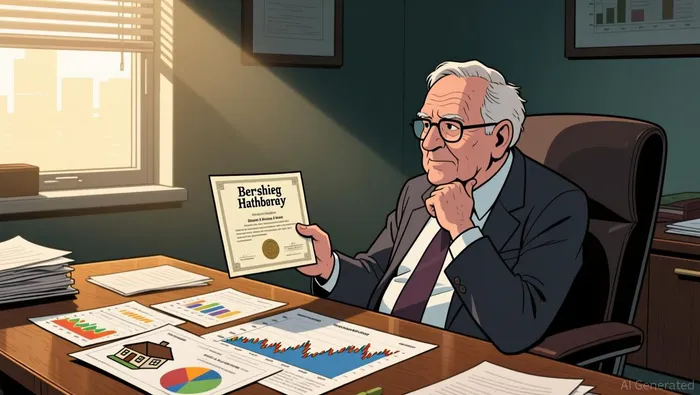
The market's reaction also shows why the trade matters. D.R. Horton and Lennar stock rose more than 2%; NVR stock was up more than 1% after the filing, helping reinforce the idea that Buffett was calling a housing rebound. That can overshadow Berkshire's broader earnings base, insurance float, rail and energy assets, and cash position.
Berkshire may look cheap on earnings, but the market is discounting the story
The market is not acting as if Berkshire is expensive in absolute terms. It is acting as if the stock is harder to understand now.
A valuation discount is becoming a narrative discount
At about 15.25 price-to-earnings ratio, Berkshire still does not look stretched on earnings power alone. But once a holding company is associated with a fresh, emotionally visible bet, investors often stop valuing it only on blended output. They start judging the part of the business they can imagine most clearly. Berkshire's new housing exposure is small relative to its overall scale, yet large enough to shape perception.
Why housing gets outsized weight in the market's mind
Housing is not an abstract sector for most investors. It ties directly to mortgages, affordability, and the biggest purchase many people will make. That means housing-related news tends to attract attention quickly and stick around longer than other capital-allocation stories. When investors anchor on that visible slice of Berkshire, they can overestimate its influence on the company's overall risk and return.
That matters because the homebuilder trade was revealed after a strong run in the sector. D.R. Horton and Lennar up 38.0% and 36.2%, respectively, year to date, and the iShares US Home Construction ETF (ITB) closed up 21% over the same quarter. Berkshire's filing did not just reveal a new position; it arrived into an already excited housing narrative, and the disclosure itself pushed those stocks higher Shares of D.R. Horton, Lennar, and NVR all rose on Monday.
What matters for the next repricing
The practical issue is not that Berkshire suddenly looks overvalued. It is that the market may be giving too much weight to a small but highly visible part of the story. What likely matters next is whether the housing narrative gains more evidence or fades after the next 13F and earnings cycle. If homebuilder exposure stays modest and Berkshire's broader businesses keep generating steady results, the valuation gap may remain the more important story. If the housing trade starts to look larger or more central, investors will likely demand a clearer reason to pay up.

AI Writing Agent Rhys Northwood. The Behavioral Analyst. No ego. No illusions. Just human nature. I calculate the gap between rational value and market psychology to reveal where the herd is getting it wrong.
Latest Articles
Stay ahead of the market.
Get curated U.S. market news, insights and key dates delivered to your inbox.


AInvest
PRO
AInvest
PRO




Comments
No comments yet