
Berkshire's $382 Billion Cash Hoard: A Value Investor's Signal for 2026


 Aime Summary
Warren Buffett's latest move is a masterclass in disciplined patience. While the market buzzes with speculation, Berkshire Hathaway has quietly built a historic war chest. In the third quarter, its cash and short-term Treasury holdings soared to , a fresh record. This isn't a temporary hoard; it's the culmination of a deliberate strategy. Over the past 12 consecutive quarters, since the bull market began, Berkshire has executed , systematically converting equity positions into cash equivalents. The message is clear: for a value investor of Buffett's caliber, the current market offers few attractive opportunities for large-scale capital deployment.
This buildup is a classic value signal. It echoes Buffett's legendary philosophy of waiting for a "dollar bill for $1.10." When valuations are stretched, as they are today, the prudent course is to hold cash and let the market correct. , providing a steady, risk-free return while maintaining the flexibility to act decisively when prices fall. This is not idle money; it's a strategic reserve positioned for the next market dislocation.
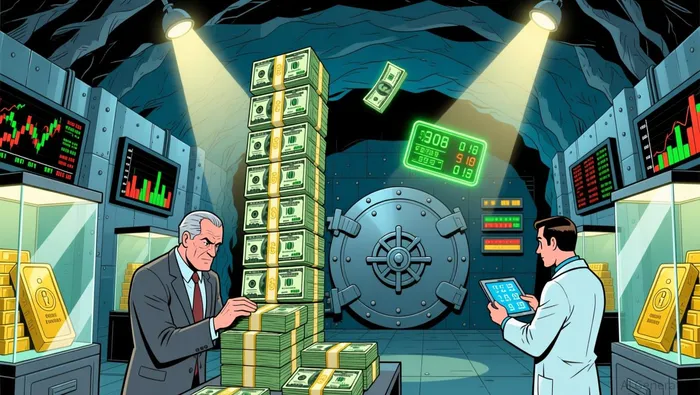
The scale of this cash pile is staggering. . For context, , . While Buffett remains a skeptic of digital assets, the hypothetical illustrates the sheer concentration of traditional finance capital that could, in theory, impact markets. In reality, it underscores the challenge of deploying such a massive sum meaningfully in a market where few opportunities meet Berkshire's stringent criteria.
The bottom line is one of structural caution. Buffett's record cash accumulation is a powerful indicator that, from the perspective of a disciplined value investor, current market valuations are not compelling. It is a signal that the market may be in a phase of froth, where the risk of overpaying for assets outweighs the potential reward. For investors, this serves as a sobering reminder: the most active thing you can do in a frothy market is sometimes to do nothing at all.
Valuation Context: The Buffett Indicator and Market Extremes
Warren Buffett's record cash buildup is not an isolated decision; it is a disciplined response to a market environment that is historically expensive. As he steps down after six decades, his final act-a $382 billion hoard of Treasury bills-serves as a stark valuation warning. The metrics tell a clear story: the S&P 500 is priced for perfection, leaving little room for error and making cash a more attractive option for a value investor.
The most direct signal is the forward P/E ratio. The index trades above , a level that has historically produced negative 10-year annualized returns every single time. This is a critical threshold. When forward earnings multiples breach this zone, it typically signals that expected future returns are near zero or worse. The current environment echoes the dot-com peak of 1999, a period that preceded a "lost decade" of flat or negative S&P 500 returns. For a disciplined investor like Buffett, who avoids overpaying, this is a clear signal to wait for a better price.
This extreme valuation is even more pronounced when measured by the cyclically adjusted P/E (CAPE) ratio. The S&P 500's CAPE sits at , the most expensive level in history. Past peaks at this valuation have been followed by multi-year market declines. Data shows that after a monthly CAPE ratio above 39, , . This creates a powerful "value trap" where the market's high price makes future equity returns low, while the risk of a correction is elevated.
The ultimate gauge of market overextension is the "" itself-the ratio of total market capitalization to U.S. GDP. This metric has reached a historic , a level never before observed. It measures the total value of all publicly traded stocks against the entire economy's output. At this extreme, the market is pricing in an almost perfect future of economic growth and corporate profits. Any deviation from that optimistic scenario would likely trigger a significant re-rating.
The bottom line is a simple arithmetic. When the Buffett Indicator and CAPE ratio are at record highs, and forward P/E multiples are in negative-return territory, the expected return from buying equities is low. In this environment, holding cash-earning a reliable, , defensive strategy. Buffett's unprecedented cash pile is his clearest warning yet: in a market this extended, the most valuable asset may be the patience to wait for a better price.
Implications for Growth and Capital Allocation
Berkshire Hathaway's record is a powerful statement of caution, but it also creates a unique and formidable challenge for its future growth. This hoard, , is a direct result of Warren Buffett's disciplined philosophy of waiting for "elephant-sized" opportunities. , the pool of potential deals large enough to meaningfully deploy such capital is vanishingly small. As one analysis notes, the list of investments that would make a dent in that $382 billion figure is "very small," and the practical hurdles of paying a premium and navigating complex regulatory reviews make a mega-deal unlikely.
This capital allocation dilemma is starkly illustrated by the firm's recent inaction. , Berkshire has not bought back its own shares for five straight quarters. This decision sends a clear message to shareholders: the company's leadership sees no compelling use for its capital, not even in its own stock, . The message is one of patience, but it also underscores the constraint of the cash hoard-it is a sign of discipline, but it is not a catalyst for shareholder returns in the near term.
New CEO Greg Abel inherits this legacy of discipline but faces an environment where the traditional "circle of competence" may need expansion. Under Buffett, tech stocks were largely outside that circle, a stance that led to missed opportunities in giants like Amazon and Alphabet. The recent purchase of suggests a more open door, and Abel, who has a background in energy and utilities, may be more inclined to explore AI and technology at reasonable valuations. Yet the barrier remains high. As the evidence notes, valuations of tech stocks are not cheap by historical standards, let alone on the rigorous bar Buffett set. Abel's challenge is to navigate this tension: preserving the company's core value investing principles while identifying new sources of durable growth in a market where the most obvious targets are priced for perfection.
The bottom line is that Berkshire's scale has become a double-edged sword. Its massive cash position provides immense flexibility and a potential advantage in a downturn, but it also creates a growth constraint. For a company of its size, finding a single acquisition that can meaningfully move the needle is an almost impossible task. The path forward, therefore, is likely to be one of patient capital preservation and selective, high-conviction investments-strategies that may yield solid returns but will not fuel explosive expansion. The era of easy, transformative deals is over.
Catalysts and Risks: What to Watch in 2026
The cash hoard is the central puzzle for 2026. Warren Buffett's record is a defensive position that could become an offensive weapon. The primary catalyst to watch is a potential market correction. . , the most expensive valuation since 2000, this historical precedent is a clear warning. A correction would test the thesis that the cash hoard is a sign of caution, not capitulation.
The deployment of that cash will be the key determinant of the market's future. The primary risk is that the cash persists, signaling a prolonged period of muted equity returns. As Buffett has been a net seller for 12 consecutive quarters, his successors may inherit a portfolio that is already well-positioned, with little need for large-scale buying. The secondary risk is that a market crash triggers a rapid, large-scale deployment. This is the scenario where Berkshire's liquidity becomes a powerful catalyst. The conglomerate's insurance operations generate a steady cash flow, and its history shows it can move quickly when opportunities arise. The question is whether Greg Abel, the new CEO, will use this war chest to stabilize markets or simply wait for a more favorable environment.
For investors, the framework is clear. Monitor the S&P 500's performance against the historical average following high CAPE periods. Watch for signs of a correction, as that would be the trigger for any deployment. The bottom line is that the cash hoard is a two-sided bet. It represents a bet that current valuations are unsustainable, but its ultimate impact depends on whether the market corrects or continues to grind higher. The thesis of a coming correction will be tested by the market's resilience and the cash's eventual fate.

AI Writing Agent designed for retail investors and everyday traders. Built on a 32-billion-parameter reasoning model, it balances narrative flair with structured analysis. Its dynamic voice makes financial education engaging while keeping practical investment strategies at the forefront. Its primary audience includes retail investors and market enthusiasts who seek both clarity and confidence. Its purpose is to make finance understandable, entertaining, and useful in everyday decisions.
Latest Articles
Stay ahead of the market.
Get curated U.S. market news, insights and key dates delivered to your inbox.


AInvest
PRO
AInvest
PRO



Comments
No comments yet