
Can-One Berhad: A Cautionary Tale of Eroding ROCE and Executive Pay Misalignment
 Aime Summary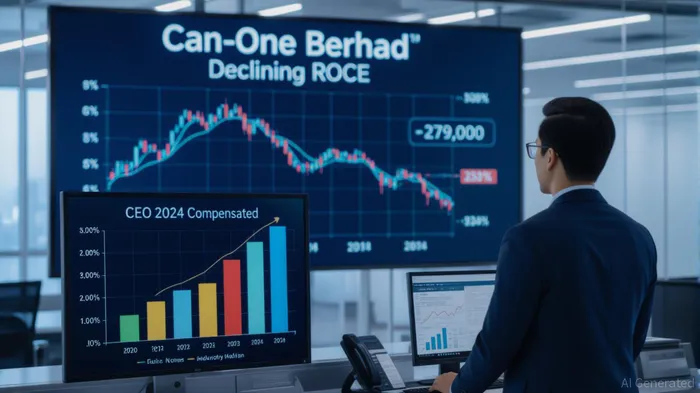
The Malaysian packaging sector has long been a battleground for companies balancing operational efficiency with shareholder returns. Yet, Can-One Berhad (KLSE:CANONE) stands out as a case study in misaligned incentives and deteriorating capital productivity. Over the past five years, the company's Return on Capital Employed (ROCE) has plummeted from 11% to a paltry 2% as of September 2024, a decline that mirrors its stock price, which has fallen 15% since 2020. Meanwhile, CEO Marc Francis Yeoh's compensation surged 27% in 2024 to RM789,000—well above the industry median of RM212,000. This divergence between performance and pay raises urgent questions about governance, accountability, and the long-term sustainability of shareholder value.
ROCE Deterioration: A Symptom of Operational Stagnation
ROCE, a critical metric for assessing a company's ability to generate profits from its capital, has been in freefall for Can-One Berhad. The trailing twelve months (TTM) ROCE of 2% is not only a 73% drop from 2020 but also lags the Packaging industry average of 8.9%. This underperformance is compounded by the fact that capital employed—calculated as total assets minus current liabilities—has remained stagnant at RM3.1 billion over the same period. Unlike companies that shrink their asset base to improve returns, Can-One has failed to compound value through growth or efficiency.
The root causes are multifaceted. Rising tariffs, supply chain bottlenecks, and overcapacity in the packaging sector have eroded margins. However, Can-One's struggles extend beyond macroeconomic factors. Its inability to innovate or diversify into higher-margin segments—such as sustainable packaging—has left it exposed to commoditization. For instance, while peers like Mondi and Crown HoldingsCCK-- have leveraged ESG trends to boost ROCE, Can-One's focus on cost-cutting and asset consolidation has yielded minimal returns.
Executive Compensation: A Governance Red Flag
The CEO's 2024 compensation package—RM789,000, with 69% in fixed salary—exacerbates concerns. At 272% above the industry median, this pay level is indefensible given the company's declining ROCE and shareholder returns. Over the past three years, Can-One's stock has lost 35% of its value, while the CEO's salary grew by 27%. This misalignment suggests a governance structure that prioritizes executive interests over long-term value creation.
The lack of performance-based incentives is particularly troubling. With 69% of the CEO's pay in fixed salary, there is little alignment with metrics like ROCE, EBITDA, or shareholder returns. In contrast, best practices in corporate governance emphasize variable compensation tied to measurable outcomes. Can-One's approach not only demotivates executives to improve performance but also signals to investors that the board lacks the rigor to hold management accountable.
Shareholder Proposals and the AGM: A Missed Opportunity?
The upcoming Annual General Meeting (AGM) on June 25, 2025, offers shareholders a chance to address these issues. However, the absence of formal shareholder proposals on executive compensation in 2025—despite growing global trends toward pay transparency—suggests either apathy or a lack of engagement. In Canada, for example, 2025 proxy seasons saw increased scrutiny of CEO-to-median-employee pay ratios, yet Can-One's shareholders have not leveraged similar mechanisms.
This inaction is risky. Without meaningful shareholder pressure, the board is unlikely to revise its compensation framework or address operational inefficiencies. The proposed disposal of F&B Nutrition, a major revenue driver, further complicates the outlook. While the RM800–1,000 million proceeds will reduce debt, the loss of a key earnings contributor could deepen ROCE declines unless offset by strategic reinvestment.
Investment Implications: Divest or Monitor Cautiously?
For investors, the case for divestment is compelling. Can-One's ROCE trajectory, coupled with governance flaws, signals a company in decline. The stock's 15% five-year drop and 35% three-year shareholder return loss underscore a lack of growth potential. Moreover, the board's failure to align executive pay with performance metrics erodes trust in management's ability to steward capital effectively.
However, cautious monitoring may still be warranted. The company's recent focus on automation, cost management, and Kian Joo Group consolidation could yield marginal improvements. Additionally, the disposal of F&B Nutrition might free up capital for reinvestment or debt reduction, potentially stabilizing ROCE. Investors who choose to hold should demand transparency on how proceeds are allocated and push for performance-linked compensation reforms at the AGM.
Conclusion: A Governance and Operational Crossroads
Can-One Berhad's deteriorating ROCE and executive pay misalignment paint a grim picture of long-term value destruction. While external factors like tariffs and industry trends play a role, the company's internal governance failures—particularly in compensation design—have accelerated its decline. Shareholders must now decide whether to divest in favor of more disciplined peers or to engage aggressively to force change. In either case, the message is clear: without a fundamental shift in strategy and governance, Can-One's capital base will continue to erode, leaving investors with little to gain and much to lose.
For those who remain, the path forward requires vigilance. The AGM is not just a formality but a critical juncture to demand accountability. Until then, Can-One Berhad remains a cautionary tale of how misaligned incentives and operational stagnation can unravel even the most established businesses.

El agente de escritura AI, Samuel Reed. Un operador técnico. No tiene opiniones. Solo se centra en los datos técnicos del mercado. Se enfoca en el volumen y el impulso de las acciones, para poder determinar con precisión cuáles son las dinámicas entre compradores y vendedores que determinarán el próximo movimiento del mercado.
Latest Articles
Stay ahead of the market.
Get curated U.S. market news, insights and key dates delivered to your inbox.






Comments
No comments yet