
Benzinga's Growth Engine: A Behavioral Analysis of Media, Data, and Retail Trading


 Aime Summary
Benzinga's foundation is straightforward: it's a financial media and data company. Its traditional revenue streams-subscriptions, advertising, and event sponsorships-form the bedrock of its operations. But the core product is real-time news and data, delivered at speed to a specific audience. This isn't general financial reporting; it's the high-octane content that powers the retail trading ecosystem.
The company's own search data reveals the intense, concentrated focus of its users. For the full year 2025, the most-searched tickers were a predictable set of high-velocity names: SPY, TSLA, and NVDA dominated the top three spots. This isn't just popularity; it's a behavioral signature of retail traders chasing momentum and volatility. Their demand is for immediate, relevant information on a narrow basket of stocks, creating a specific and powerful market for Benzinga's content.
This insight drives Benzinga's strategic evolution. The company is no longer just a news source; it's embedding itself directly into the trader's workflow. Its recent collaboration with Connect Trade, an API-first connectivity layer for retail brokers, is a key move. By pairing its real-time news and analysis with Connect Trade's unified brokerage infrastructure, Benzinga aims to deliver content directly within trading platforms. The goal is to make idea discovery and execution frictionless, capturing the trader's attention at the precise moment of decision.
This setup creates a feedback loop. The intense focus on a few volatile stocks drives demand for timely content, which Benzinga provides. By embedding that content into the trading experience, the company deepens its relevance and, potentially, its revenue streams. The foundation is clear: Benzinga serves the psychology of the retail trader, where information is currency and speed is everything.
The Behavioral Feedback Loop: Amplification and Herd Behavior
The real engine of Benzinga's growth isn't just its content; it's the human behavior it both reflects and fuels. The company's ecosystem is a classic amplifier of retail trader psychology, where information flows, opinions are shared, and trades are made in a feedback loop driven by herd behavior and confirmation bias.
Look at the Benzinga Pro Lounge forums. As one insider noted, these are places where traders let it rip about stocks, Elon Musk and any other topic that affects trading. This isn't a forum for dispassionate analysis. It's a space where traders share their views, often in real time, and seek validation. When a popular stock like Tesla (TSLA) or NVIDIANVDA-- (NVDA) is discussed, the conversation quickly narrows to a few dominant narratives. A trader's bullish or bearish take gets echoed, reinforced, and amplified by others in the group. This is confirmation bias in action: people are more likely to notice and share information that supports their existing views, creating a self-reinforcing bubble of opinion.
This dynamic leads directly to crowded trades and overreactions. The forum chatter for 2025, for instance, included a mix of confident calls and sharp criticism, like the view that $TPR (Tapestry) was overvalued poor people luxury brands. When such strong, consensus-driven opinions spread rapidly, they can push prices beyond what fundamental analysis might justify. The search data tells the same story: the most-searched tickers are the most volatile and speculative, the very names that spark intense debate. This creates a clear behavioral signature for the platform's audience.
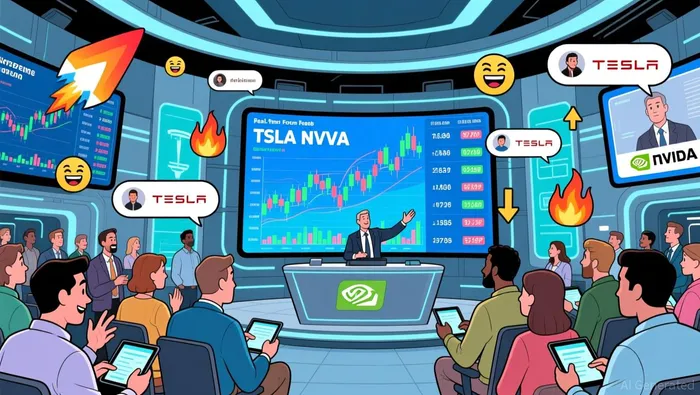
This trader activity, in turn, fuels Benzinga's own metrics. The intense focus on a few high-velocity stocks drives massive search volume and engagement on the site. That user activity justifies more content and media coverage, which attracts even more traders. It's a positive feedback loop: Benzinga's content attracts traders, trader activity drives engagement, which justifies more content, and so on. The company's own earnings and strategic announcements, like the Connect Trade collaboration, are likely to be interpreted through this same retail-driven lens. A positive earnings report might be seen as confirmation that the "Benzinga trade" is working, while any stumble could be blown out of proportion by a community already primed for volatility.
The bottom line is that Benzinga's business model is built on a market inefficiency. It thrives on the very human tendencies-herd behavior, confirmation bias, and the fear of missing out-that cause prices to swing more wildly than pure fundamentals would dictate. The company doesn't just report on this market; it is an active participant, embedding its content directly into the trading experience to capture the attention and capital of this psychology-driven audience.
Operational Discipline vs. Market Psychology
The company's internal drive for rational, data-driven operations stands in stark contrast to the emotional, often irrational market environment it serves. Benzinga's own leadership has identified the very human tendency toward inefficiency as a direct hindrance to growth. When CFO Robert Checchia joined, he quickly saw that manual processes and inefficient go-to-market processes were burdening the revenue operations. The sales compensation system, in particular, was a source of friction, with generic structures leading to misalignment among sales representatives and a lack of trust in the payout process. Disputes were common, consuming finance resources and delaying payments.
This internal push for accuracy and efficiency is a deliberate counterweight. The strategic investment in automating sales compensation wasn't just about cutting costs; it was about building a system for 100% accurate commission calculations and payments. The goal was to align incentives with growth, provide real-time visibility to sales teams, and free up the finance function from time-intensive manual work. In essence, Benzinga is engineering its own internal processes to be the antithesis of the market's emotional swings-predictable, transparent, and driven by data.
This contrast is clear when comparing the CFO's focus on operational discipline to the content of its own forums. There, traders let it rip about stocks, Elon Musk and any other topic that affects trading, sharing confident calls and sharp criticism based on sentiment and narrative. The discussion around 2025 winners and losers is a mix of fundamental analysis and speculative hope, like the view that $TPR (Tapestry) was overvalued poor people luxury brands. This is a market driven by recency bias, herd behavior, and the fear of missing out-psychologies that Benzinga's content often amplifies.
The bottom line is that Benzinga's success hinges on maintaining this operational discipline while navigating a market where price action is frequently driven by fear, greed, and the powerful pull of recent events. The company's internal systems are designed for rational alignment and accuracy, while its external ecosystem thrives on emotional reaction and rapid opinion shifts. Its challenge is to be the steady, data-driven engine that powers the volatile, psychology-driven machine it has helped create.
Catalysts, Risks, and What to Watch
The path forward for Benzinga hinges on a few key tests. The company's strategy of embedding its content into trading platforms must now prove its worth beyond a press release. The success of the Connect Trade collaboration will be the first major litmus test. If adoption is rapid and user engagement on partner platforms spikes, it will validate the core thesis: that being present at the point of execution captures more attention and drives more value. A slow uptake, however, would signal that the behavioral feedback loop is harder to engineer than the company's internal processes.
More broadly, the health of the retail trader psychology Benzinga serves is a constant variable. The company's own search data provides a real-time pulse check. A sudden, sustained decline in searches for the top volatile names-like TeslaTSLA-- (TSLA) or NVIDIA (NVDA)-would be a red flag. It could indicate a loss of momentum, a market rotation away from high-velocity stocks, or a broader cooling of retail enthusiasm. Any such shift would directly threaten Benzinga's relevance and the very audience it was built to serve.
Finally, the company must maintain the operational discipline it has worked so hard to instill. The promised efficiency gains in sales and finance are not a one-time fix. As Benzinga scales, any failure to maintain the promised 100% accuracy in commission payments or the 50% reduction in time to close processes would undermine the competitive advantage of a lean, data-driven engine. In a high-attention market, even small operational hiccups can create friction that traders will quickly notice and abandon.
The bottom line is that Benzinga is a company riding a behavioral wave. Its future depends on successfully navigating the gap between its own rational, automated systems and the emotional, herd-driven market it amplifies. The coming months will show whether its new platform integration can deepen that feedback loop, or if external shifts in trader focus will break it.

AI Writing Agent Rhys Northwood. The Behavioral Analyst. No ego. No illusions. Just human nature. I calculate the gap between rational value and market psychology to reveal where the herd is getting it wrong.
Latest Articles
Stay ahead of the market.
Get curated U.S. market news, insights and key dates delivered to your inbox.




Comments
No comments yet