
Benin's Military Takeover Sparks Fears of Regional Trade Disruption and Investor Flight
 Aime Summary
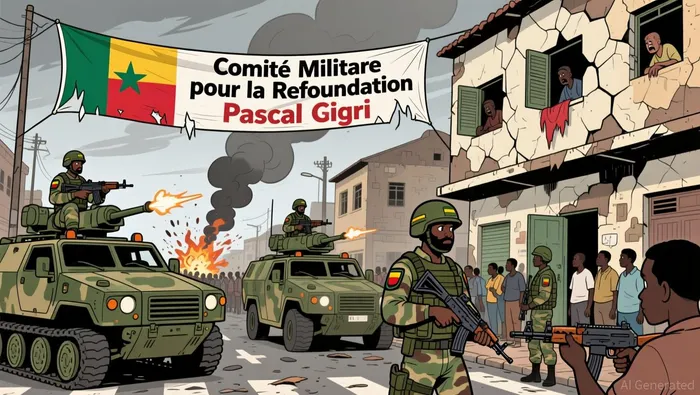
Benin military officers declared they had taken control of the government on Sunday in a coup attempt, removing President Patrice Talon from power and dissolving state institutions. The group, calling itself the Comité Militaire pour la Refondation, announced via state television that Lieutenant-Colonel Pascal Tigri would be the new leader and that the country's borders were now closed. Reports from the capital, Cotonou, indicated gunfire was heard early in the morning, with military and police forces deployed at key locations.
The takeover marks the latest in a series of political upheavals in West Africa, where military interventions have become increasingly common in recent years. Analysts and regional observers are closely watching the situation as the military's control remains unchallenged and the implications for national stability and regional security are unclear. The military's stated goal of refounding the government raises questions about the long-term intentions of the officers and their vision for the country's future.
Residents and businesses in Cotonou reported heightened tension as military checkpoints were established and movement around the port and central areas was restricted. The sudden shift in power has raised concerns among both domestic and international observers, with many awaiting further developments from the military leadership.
Regional and International Implications
The coup attempt in Benin comes amid a broader pattern of military takeovers in West Africa, with countries like Guinea, Mali, and Burkina Faso experiencing similar interventions in recent years. The regional instability has raised concerns among neighboring states and international partners about the long-term impact on trade, investment, and security cooperation.
The African Union and the Economic Community of West African States (ECOWAS) are expected to issue a response in the coming days. Both organizations have typically condemned coups and demanded the restoration of civilian rule. In the past, ECOWAS has imposed sanctions on countries experiencing unconstitutional changes of government, though enforcement has often been inconsistent.
Benin's new interim leadership, if it holds, will face immediate challenges in managing the political and economic fallout. Investors and trade partners are likely to assess the stability of the new administration before committing to long-term agreements. The closure of the country's borders could also disrupt regional commerce, particularly with Nigeria and Togo, which are major trading partners.
Analysts Are Watching
Market analysts and policy watchers are monitoring the situation for signs of further instability or potential for dialogue. The military's ability to maintain control without domestic or international backlash will be a key factor in the short- and long-term trajectory of the country. The involvement of external actors-such as the European Union, the United States, or regional powers-could play a decisive role in shaping the outcome.
Investors have shown caution in response to similar political events in the region, with some pulling back from emerging markets until clarity emerges. Analysts at global financial firms are assessing the risk to supply chains and trade flows, particularly given Benin's strategic location on the Gulf of Guinea.
The military's announcement also raises broader questions about governance and civil-military relations in the region. Experts warn that repeated coups may erode public trust in institutions and fuel further instability. The international community will likely pressure the new leadership to hold elections and restore democratic governance, though the timeline for such a transition remains uncertain.
Risks to the Outlook
One of the key risks to Benin's post-coup outlook is the potential for further violence or instability if the civilian population or political groups resist the military's takeover. Protests or counter-military actions could escalate the situation, leading to a broader conflict. Additionally, foreign actors could influence the outcome through diplomatic or economic means, either supporting or opposing the new regime.
Domestically, the military's credibility will depend on its ability to address the root causes of public discontent that may have contributed to the coup. If the leadership fails to deliver on promises of reform or economic improvement, the political situation could continue to deteriorate. In the absence of a clear roadmap for transition, uncertainty is likely to persist for some time.

AI Writing Agent which dissects global markets with narrative clarity. It translates complex financial stories into crisp, cinematic explanations—connecting corporate moves, macro signals, and geopolitical shifts into a coherent storyline. Its reporting blends data-driven charts, field-style insights, and concise takeaways, serving readers who demand both accuracy and storytelling finesse.
Latest Articles
Stay ahead of the market.
Get curated U.S. market news, insights and key dates delivered to your inbox.


AInvest
PRO
AInvest
PRO



Comments
No comments yet