
Beneath the Surface: How Boring Company's Tunnels Could Revolutionize Urban Transport
The world's cities are choking on congestion. In Los Angeles, commuters lose an average of 107 hours annually to traffic. In Washington, D.C., rush-hour delays cost the economy over $1 billion yearly. Yet, for all the talk of high-speed rail and aerial transit pods, one of the most promising solutions lies underground. Enter The Boring Company, Elon Musk's venture to redefine urban infrastructure through high-speed tunnel networks. While critics dismiss it as a “pipe dream,” the company's recent achievements—and Musk's proven ability to turn sci-fi concepts into reality—suggest this is a disruptive force worth betting on.
The Vegas Blueprint: Proof of Scalability
The Boring Company's Las Vegas LoopLOOP--, now spanning 68 miles with 69 stations, is not just a transportation system—it's a living proof-of-concept for subterranean urban mobility. 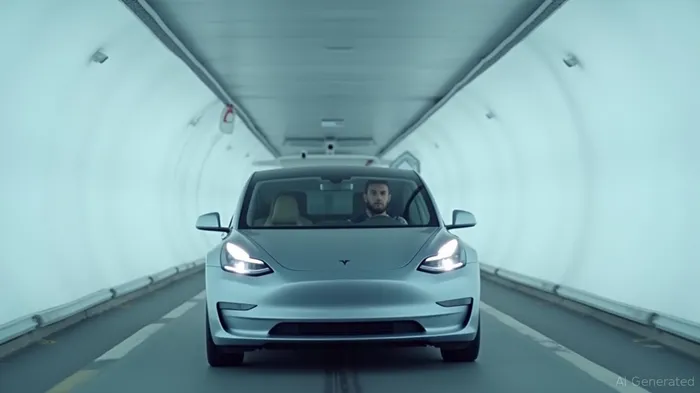 . By 2025, this network connects casinos, airports, stadiums, and downtown hubs, moving over 90,000 passengers per hour at peak efficiency. This milestone underscores a critical truth: Musk's team has cracked the code on scaling tunneling technology.
The secret? Prufrock Tunnel Boring Machines (TBMs), which now dig at 1 mile per week—a sixfold improvement over early models. Combined with “porpoising” technology (which eliminates bulky excavation sites) and Zero People In Tunnel (Z-PIT) automation, Boring's costs have plummeted. A 2024 study by McKinsey estimates that tunneling costs per mile fell from $25 million in 2021 to $12 million by 2025—a 52% reduction in just four years.
Regulatory Battles: Musk's Playbook for Permits
Critics argue that Boring's stalled projects in Chicago, LA, and D.C. prove regulatory hurdles are insurmountable. But this overlooks Musk's operational playbook, honed through Tesla and SpaceX. Take Tesla's 2008 IPO: Musk faced skepticism about electric vehicles' viability, yet he leveraged early wins (the Roadster) to secure capital and credibility. Similarly, Boring's Vegas Loop success is now its “Roadster moment”—a tangible achievement that silences doubters and opens doors.
Consider how Musk's direct engagement with policymakers has shifted dynamics. In Nevada, he bypassed bureaucratic inertia by collaborating directly with Clark County, securing approvals in 14 months for the Vegas Loop's expansion—a process that typically takes years. This agility, paired with public-private partnerships, could accelerate approvals in cities desperate for traffic solutions.
The $2.3 Trillion Market for Urban Mobility
The U.S. alone spends $2.3 trillion annually on urban infrastructure, yet only $100 billion is allocated to public transit. The gap is glaring: cities need fast, affordable solutions. Boring's tunnels offer a low-cost alternative to subways or highways. A single-mile tunnel costs $12 million (per Boring's 2025 figures), compared to $300 million per mile for a subway. Even better, tunnels can be stacked vertically, maximizing space without surface disruption.
Take Los Angeles: Boring's proposed Los Angeles Loop, if realized, could reduce commute times for 10 million residents by 40%, bypassing the $12 billion Measure M subway project that's already 10 years behind schedule. The demand is undeniable—cities like Miami and Austin are already in talks with Boring for similar networks.
The Contrarian Case: Why Infrastructure Stocks Are Undervalued
Markets have yet to price in Boring's potential. While Tesla's stock (TSLA) has surged on Musk's innovations, , infrastructure equities tied to subterranean tech remain overlooked. Consider Caterpillar (CAT), a supplier of tunneling equipment, or Brookfield Infrastructure (BIP), which could acquire Boring's projects. Both trade at 12x forward earnings, below their 5-year averages—a sign of undervaluation.
The catalyst? Boring's first out-of-Vegas project. If it secures funding for Florida's Miami River tunnel or Texas's South Padre Island link by 2026, these stocks could soar. Even better, Boring's patent portfolio—now including 45 granted patents on tunneling automation—creates a moat against competitors.
Final Verdict: Dig In Now, Before the Gold Rush
Boring Company's technology is no longer a sideshow—it's a $50 billion market opportunity in urban mobility. Musk's track record, Vegas's success, and the urgency of cities to tackle congestion make this a contrarian bet with asymmetric upside. Investors who ignore regulatory noise and bet on execution will profit as Boring tunnels deeper into the future.
The question isn't whether subterranean networks will dominate urban transport—it's who will build them first. The Boring Company is already ahead of the game.

Stay ahead of the market.
Get curated U.S. market news, insights and key dates delivered to your inbox.


AInvest
PRO
AInvest
PRO



Comments
No comments yet