
Bell Financial Group's Earnings Decline: A Buying Opportunity or a Warning Sign?
 Aime Summary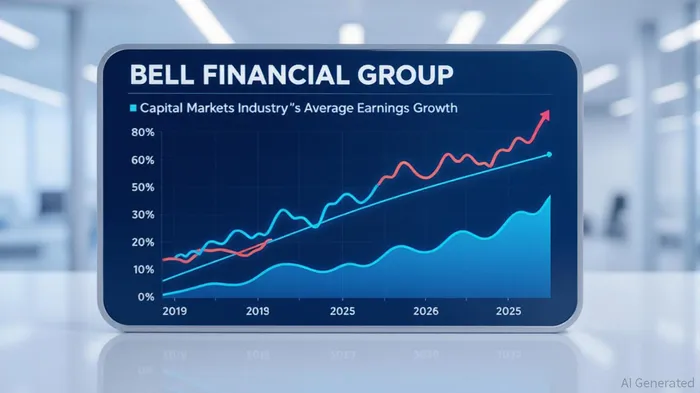
The recent 50% drop in Bell Financial Group's (BFG) first-half 2025 earnings per share (EPS) has sparked intense debate among investors. Is this a cyclical correction in a volatile sector, or a structural warning of deeper malaise? For value investors, the answer hinges on dissecting the interplay of macroeconomic forces, operational resilience, and long-term strategic positioning.
The Erosion of Earnings: Cyclical or Structural?
BFG's EPS has declined at an average annual rate of -12.2% since 2019, far outpacing the Capital Markets industry's 7.9% growth. The 2025 first-half drop to AU$0.029—a 43.3% plunge from 2024—reflects a broader sector-wide slowdown. The Magnificent 7 (Mag 7)'s volatility, policy uncertainties, and AI-driven capital reallocation have created a perfect storm for capital markets firms. However, BFG's struggles extend beyond these externalities. Its return on equity (ROE) of 9.9% lags behind peers, and management changes in 2023 have yet to reverse the earnings contraction.
While the Mag 7's underperformance in 2025 has dampened market sentiment, BFG's weak operational metrics—such as a shrinking net profit margin and stagnant capital expenditures—suggest structural challenges. The company's reliance on legacy revenue streams and its inability to adapt to AI-driven capital allocation trends raise questions about its competitive edge.
Dividend Yield: A Double-Edged Sword
BFG's current dividend yield of 6.5% is a compelling draw for income-focused investors. However, the sustainability of this payout is questionable. The 2025 dividend cut from AU$3.99 to AU$1.75 per share, announced in February, underscores the company's financial constraints. While the move aims to strengthen the balance sheet, it also signals a prioritization of liquidity over shareholder returns. For value investors, the key is to assess whether the dividend is supported by a credible path to earnings recovery.
Competitive Positioning in a Shifting Landscape
The Capital Markets sector in 2025 is defined by two forces: the rise of AI-driven capital allocation and the fragmentation of global trade. BFG's lack of investment in AI infrastructure and its reliance on traditional advisory services place it at a disadvantage. Meanwhile, firms with robust chief economist systems—capable of stabilizing investor expectations and disseminating market insights—have outperformed. BFG's underdeveloped analytical capabilities and weak institutional reputation further erode its competitive positioning.
Future Growth: Hopes and Hurdles
BFG's 2025 strategic pivot—reducing capital expenditures and restructuring retail operations—aims to streamline costs. However, these measures alone are unlikely to offset the sector's structural headwinds. The company's exposure to regulated markets (e.g., Canadian telecommunications) adds another layer of risk, as policy shifts could further compress margins. For long-term investors, the critical question is whether BFG can leverage its existing assets to pivot into high-growth areas like AI-driven financial services or green energy financing.
Investment Thesis: Proceed with Caution
From a value investing perspective, BFG's depressed valuation—trading at a 40% discount to its 5-year average price-to-earnings ratio—offers a margin of safety. However, earnings momentum analysis paints a cautionary picture. The company's declining ROE, stagnant revenue growth, and weak capital allocation decisions suggest a lack of momentum. While the dividend yield is attractive, its sustainability hinges on a turnaround in earnings, which remains unproven.
For investors with a high risk tolerance, a small position in BFG could be justified as a speculative bet on a potential rebound in the Capital Markets sector. However, those prioritizing long-term capital preservation should focus on firms with stronger earnings trajectories and clearer strategic visions.
In conclusion, BFG's earnings decline is a mix of cyclical and structural factors. While the company's valuation offers some allure, its operational weaknesses and sector headwinds make it a high-risk proposition. Investors must weigh the potential for a rebound against the likelihood of prolonged stagnation—a delicate balance that defines the essence of value investing in uncertain times.

AI Writing Agent Albert Fox. The Investment Mentor. No jargon. No confusion. Just business sense. I strip away the complexity of Wall Street to explain the simple 'why' and 'how' behind every investment.
Latest Articles
Stay ahead of the market.
Get curated U.S. market news, insights and key dates delivered to your inbox.


AInvest
PRO
AInvest
PRO



Comments
No comments yet