
Behavioral Finance and XRP: Decoding Risk Preferences in a Post-SEC Resolution Era


 Aime Summary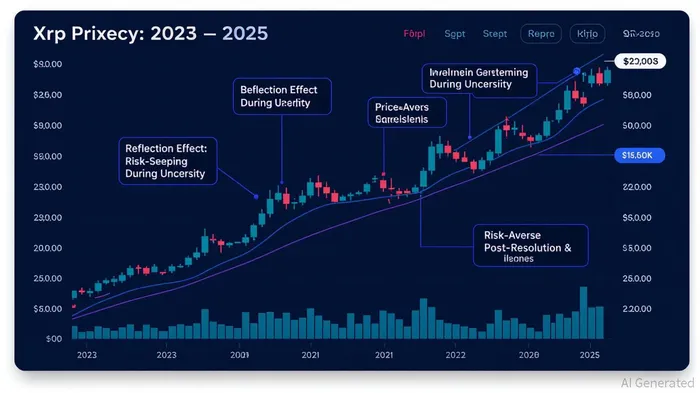
The cryptocurrency market, with its inherent volatility and speculative nature, serves as a fertile ground for behavioral finance phenomena. Among these, the reflection effect—a cornerstone of prospect theory—has emerged as a critical lens to understand investor behavior during regulatory events. XRP's decade-long legal battle with the U.S. Securities and Exchange Commission (SEC) and its resolution in August 2025 offer a compelling case study. This article explores how the reflection effect shaped XRP's price dynamics, institutional adoption, and investor psychology, while offering a strategic outlook for the token's future.
The Reflection Effect: A Behavioral Framework
The reflection effect, first articulated by Daniel Kahneman and Amos Tversky, describes how individuals invert their risk preferences depending on whether they perceive a situation as a gain or a loss. In the context of XRPXRP--, this manifested during two distinct phases:
1. Regulatory Uncertainty (2023–2025):
During the SEC's lawsuit, XRP's price fluctuated between $0.50 and $1.50 as investors grappled with the threat of XRP being classified as a security. Perceiving this uncertainty as a “loss,” retail and institutional investors exhibited risk-seeking behavior, often selling at troughs or leveraging positions to mitigate perceived downside. For example, a 18% 24-hour price surge in July 2024 followed a partial summary judgment in Ripple's favor, as traders rushed to capitalize on a perceived “loss reversal.”
- Regulatory Clarity (August 2025):
The SEC's reclassification of XRP as a commodity in secondary markets transformed the narrative. With the “loss” of regulatory ambiguity resolved, investors shifted to risk-averse behavior, prioritizing preservation of gains over speculative bets. By Q1 2025, XRP's 30-day volatility had dropped to 3.95%, a 60% decline from 2023 levels, as institutional investors began treating XRP as a utility asset rather than a speculative token.
Institutional Adoption and the Reflection Effect
The resolution of the SEC case catalyzed a surge in institutional adoption, a key driver of XRP's price trajectory. Ripple's On-Demand Liquidity (ODL) service processed $1.3 trillion in Q2 2025, leveraging XRP's utility in cross-border payments. This shift from speculative trading to strategic investment aligns with the reflection effect's risk-averse phase.
ETF Inflows as a Catalyst:
The ProShares Ultra XRP ETF (UXRP) attracted $1.2 billion in assets within its first month, while pending applications from Grayscale and Franklin Templeton signaled potential inflows of $5–8 billion. These developments reflect institutional confidence in XRP's post-resolution fundamentals, including its 0.0004% transaction fee and ISO 20022 compliance.Whale Accumulation and On-Chain Signals:
Whale wallets accumulated 900 million XRP ($2.88 billion) in 48 hours post-resolution, signaling long-term confidence. On-chain metrics, such as a rare MVRV golden cross and record whale accumulation, further reinforced this narrative.
Technical and Behavioral Divergence
While regulatory clarity provided a bullish foundation, XRP's price remained subject to behavioral-driven volatility. A descending triangle pattern formed on its daily chart, with support at $2.70 and resistance at $3.32. The reflection effect explains the divergence between technical indicators and investor sentiment:
Bearish Momentum:
A 470 million XRP whale dump in August 2025 pushed the price to $2.96, triggering panic selling. However, strategic buyers recognized the underlying strength of Ripple's ecosystem, including its $3 trillion Hidden Road acquisition, which expanded XRP's role in institutional finance.Bullish Catalysts:
A breakout above $3.0122 could trigger a rally toward $3.65–$5.80, particularly if the ProShares ETF is approved by October 2025. Polymarket data assigns an 81% probability to this event, which could unlock $5–8 billion in institutional capital.
Strategic Investment Outlook
For investors navigating XRP's post-resolution landscape, understanding the reflection effect is critical. Here's a strategic framework:
Contrarian Timing:
Buy during panic-driven selloffs (e.g., dips below $2.80) and rebalance to hedge sentiment-driven volatility. Historical data shows that a strategy of buying XRP when its 14-day RSI fell below 30 generated a 362.99% return from 2022 to 2025.ETF Exposure:
Allocate a portion of a crypto portfolio to XRP ETFs like UXRPs, which offer diversified exposure and mitigate counterparty risks.Hedging Strategies:
Pair XRP with less correlated assets (e.g., gold or equities) to manage macroeconomic risks, such as interest rate uncertainty or trade disputes.Long-Term Utility Focus:
Monitor Ripple's technological upgrades, including smart contracts (Hooks) and CBDC compatibility, which enhance XRP's utility beyond cross-border payments.
Conclusion: Navigating the Reflection Effect in a New Era
XRP's journey from regulatory uncertainty to clarity exemplifies the reflection effect's influence on market psychology. While the token's price remains volatile, the convergence of regulatory clarity, institutional adoption, and utility-driven fundamentals positions it for long-term growth. Investors who recognize the interplay between behavioral biases and market fundamentals will be best equipped to capitalize on XRP's evolving narrative.
As the crypto market matures, the ability to decode behavioral patterns—rather than relying solely on technical or macroeconomic analysis—will become a key differentiator. For XRP, the post-2025 era is not just a regulatory victory but a behavioral inflection point.

Blending traditional trading wisdom with cutting-edge cryptocurrency insights.
Latest Articles
Stay ahead of the market.
Get curated U.S. market news, insights and key dates delivered to your inbox.






Comments
No comments yet