
Behavioral Economics and Ethereum: Decoding the Psychology Behind Price Volatility and Trading Strategies


 Aime Summary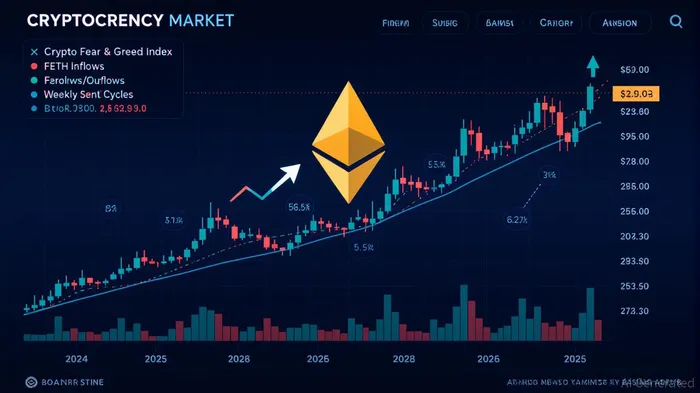
Ethereum's price action in 2025 has become a textbook case study in behavioral economics, revealing how psychological biases like loss aversion, probability weighting, and the reflection effect shape trading patterns and risk preferences in real time. These dynamics are not just theoretical—they are embedded in the daily decisions of retail and institutional investors, creating self-reinforcing cycles of panic and euphoria that amplify volatility. For investors, understanding these behavioral undercurrents offers a roadmap to navigate Ethereum's turbulence, whether through contrarian strategies or disciplined trend-following.
The Reflection Effect: Panic and Euphoria in Motion
The reflection effect, a cornerstone of prospect theory, explains how investors reverse their risk preferences depending on whether outcomes are framed as gains or losses. In Ethereum's case, this manifests as risk-seeking behavior during losses and risk-averse behavior during gains. For example, during Ethereum's 10.8% price correction in late July 2025, Fidelity's EthereumETH-- ETP (FETH) saw a $156 million outflow as investors sold to mitigate downside risk. Conversely, during a 44.2% rebound in May 2025, FETH attracted a surge in buying activity as investors locked in profits.
This duality creates self-reinforcing feedback loops. When prices fall, loss-averse investors sell, exacerbating the decline. When prices rise, risk-averse investors sell to secure gains, capping further upside. The result is a market that oscillates between extremes, driven not by fundamentals but by collective psychology.
Probability Weighting and the Illusion of Control
Investors also overweight small probabilities and underweight large ones, a phenomenon known as probability weighting. This bias is evident in Ethereum's price divergences from its underlying fundamentals. For instance, in February 2025, FETH's -33.3% monthly return outpaced Ethereum's decline, reflecting heightened risk aversion as investors overestimated the likelihood of further losses.
Fidelity's ETP structure—offering Ethereum exposure on traditional exchanges with institutional-grade custody—exacerbates this bias. By reducing cognitive load (e.g., no need for crypto wallets), FETH enables emotion-driven trading that outpaces Ethereum's price movements. This structural simplicity amplifies behavioral tendencies, making FETH a barometer of investor sentiment.
Weekly Sentiment Cycles: A Clockwork of Emotion
Academic studies reveal predictable weekly patterns in Ethereum trading, driven by the reflection effect. Mondays often see higher returns as compounded weekend sentiment drives buying or selling. Fridays act as emotional reset points, with institutional investors stabilizing the market. Tuesdays and Wednesdays, however, experience heightened volatility as delayed reactions to weekend news take effect.
These cycles suggest that Ethereum's price is influenced as much by investor psychology as by supply-demand fundamentals. For example, during the 2025 pandemic and Russian-Ukrainian conflict, smaller cryptocurrencies like DogecoinDOGE-- and TRON influenced Ethereum's price, underscoring the interconnectedness of behavioral dynamics across the crypto ecosystem.
Contrarian and Trend-Following Strategies: Exploiting Behavioral Biases
For investors, the key lies in leveraging these psychological patterns. Contrarian strategies thrive during periods of extreme fear or greed. When the Crypto Fear & Greed Index drops below 40, FETH often becomes undervalued, presenting buying opportunities. In March 2025, as Ethereum fell 15%, FETH attracted $300 million in inflows from risk-seeking investors. Conversely, when the index exceeds 80, locking in profits or hedging becomes prudent, as seen in April 2025 when Ethereum rebounded 20% and FETH saw $250 million in outflows.
Trend-followers, meanwhile, can capitalize on herd behavior. During periods of high volatility, Ethereum's price often mirrors Bitcoin's trends, driven by statistical arbitrage and herd behavior. Smaller cryptocurrencies like Dogecoin and TRON also act as sentiment indicators during crises, offering early signals for Ethereum's direction.
The Roadmap: Balancing Psychology and Fundamentals
To succeed in Ethereum's volatile landscape, investors must combine behavioral insights with traditional metrics. Monitor FETH inflows/outflows, the Fear & Greed Index, and Bitcoin's price action. Use these signals to time entries and exits counter-cyclically. For example:
- Buy the dip: When fear dominates (Fear & Greed Index <40), accumulate Ethereum or FETH.
- Sell the rally: When greed peaks (Index >80), lock in gains or hedge with derivatives.
- Weekly timing: Buy on Mondays during bullish sentiment or sell on Fridays to capitalize on institutional resets.
Conclusion: The Human Element in Market Dynamics
Ethereum's price action is not just a function of code or capital—it is a reflection of human psychology. By understanding the reflection effect, probability weighting, and weekly sentiment cycles, investors can navigate the market's emotional extremes with discipline and foresight. Whether adopting contrarian or trend-following strategies, the goal is to outthink the crowd, using behavioral economics as a lens to decode the invisible forces shaping Ethereum's future.


Blending traditional trading wisdom with cutting-edge cryptocurrency insights.
Latest Articles
Stay ahead of the market.
Get curated U.S. market news, insights and key dates delivered to your inbox.


AInvest
PRO
AInvest
PRO



Comments
No comments yet