
Behavioral Economics and the ETH ETF Surge: How Investor Psychology Drives Institutional Adoption


 Aime Summary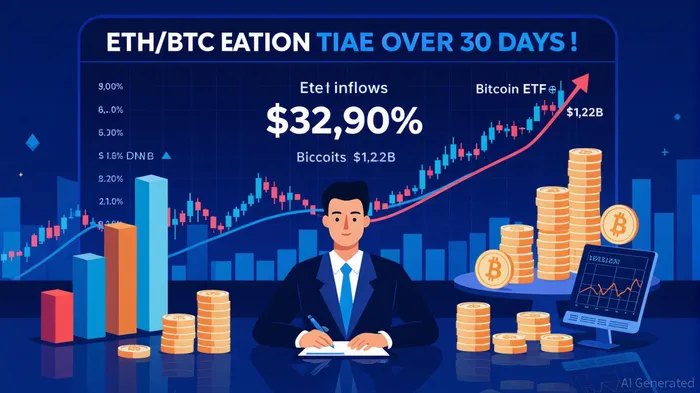
The rise of EthereumETH-- ETFs in 2025 is not merely a function of regulatory clarity or technological innovation—it is a profound reflection of how investor psychology shapes market dynamics. At the heart of this transformation lies the reflection effect, a behavioral economics principle that describes how individuals reverse their risk preferences between gains and losses. This cognitive bias is now reshaping demand for ETH ETFs, as institutional and retail investors navigate a post-regulatory landscape where Ethereum's utility-driven model contrasts sharply with Bitcoin's speculative legacy.
The Reflection Effect: Risk Aversion in Gains, Risk-Seeking in Losses
The reflection effect, first identified by Daniel Kahneman and Amos Tversky, posits that people become risk-averse when facing gains but risk-seeking when facing losses. For example, an investor holding a profitable Ethereum ETF might prefer to lock in gains through staking yields (3–5%) rather than risking a price drop. Conversely, an investor with a losing position might double down on ETH ETFs, hoping to recoup losses through market rebounds or yield accumulation.
This dynamic is evident in the post-July 2025 regulatory environment. The U.S. Securities and Exchange Commission's (SEC) approval of in-kind creation and redemption mechanisms for Ethereum ETFs—aligning them with traditional commodity ETFs—has created a psychological anchor for investors. By reducing tax inefficiencies and custody risks, these mechanisms have transformed Ethereum ETFs from speculative vehicles into infrastructure-grade assets. The result? A shift in investor behavior:
- Risk-averse gains: Institutional investors, now confident in Ethereum's regulatory status, are locking in staking yields and deflationary supply dynamics (0.5% annual contraction) to secure long-term value.
- Risk-seeking losses: Retail investors, still grappling with Bitcoin's $1.2B Q2 2025 outflows, are increasingly allocating to Ethereum ETFs to hedge against Bitcoin's non-yielding profile.
Regulatory Clarity as a Behavioral Catalyst
The SEC's July 2025 approval of in-kind mechanisms and the reclassification of Ethereum as a utility token under the CLARITY and GENIUS Acts have acted as a psychological reset for the market. Prior to these reforms, Ethereum's regulatory ambiguity created a “loss aversion” mindset, where investors hesitated to commit capital. Now, with Ethereum ETFs offering yield generation and institutional-grade custody, the asset has transitioned from a high-risk, high-reward proposition to a stable, income-producing reserve asset.
This shift is reflected in trading volumes and inflows:
- Ethereum ETFs attracted $9.4B in Q2 2025 inflows, with BlackRock's ETHAETHA-- capturing 90% of flows.
- Bitcoin ETFs faced $1.2B in outflows during the same period, as investors reallocated to Ethereum's yield-generating model.
- The ETH/BTC ratio surged 32.90% in 30 days, signaling a capital reallocation driven by behavioral preferences for utility over speculation.
Investor Psychology and Market Volatility
The reflection effect also explains Ethereum's reduced volatility compared to BitcoinBTC--. With 29.6% of Ethereum's circulating supply staked or held via ETFs, the liquid supply has shrunk, stabilizing price swings. Institutional investors, now accounting for 60% of Ethereum allocations, are prioritizing yield and infrastructure utility over short-term speculation. This behavioral shift has created a flywheel effect:
1. Staking yields (3–5%) attract capital during market downturns, mitigating panic selling.
2. Deflationary supply dynamics (EIP-1559 burns, staking) create upward price pressure, reinforcing risk-averse behavior in gains.
3. Regulatory alignment with traditional commodities reduces uncertainty, further dampening volatility.
Strategic Positioning for Investors
For investors, the interplay of behavioral economics and regulatory progress presents a compelling case for Ethereum ETFs. Here's how to strategically position:
1. Diversify into yield-generating ETH ETFs: Products like Bitwise's ETHWETHW-- or iShares' ETHA offer both staking yields and deflationary tailwinds, appealing to risk-averse investors.
2. Hedge Bitcoin exposure: The ETH/BTC ratio's 30-day surge suggests a structural shift in capital flows. Allocating to Ethereum ETFs can offset Bitcoin's non-yielding profile.
3. Monitor behavioral indicators: Track on-chain metrics like staking participation (currently 29.6% of supply) and ETF inflows to gauge institutional sentiment.
Conclusion: A New Era of Institutional Adoption
The ETH ETF surge is not just a regulatory or technological milestone—it is a behavioral revolution. By aligning with the reflection effect's risk preferences, Ethereum ETFs have become a cornerstone of institutional portfolios, offering a blend of yield, stability, and utility. As the SEC's October 2025 staking integration rulings loom, investors who recognize the psychological drivers behind this shift will be well-positioned to capitalize on Ethereum's evolving role in the financial ecosystem.
In a market where investor psychology often dictates outcomes, Ethereum ETFs now represent a strategic allocation for those seeking to navigate uncertainty with both logic and behavioral insight.

La combinación de la sabiduría tradicional en el comercio con las perspectivas más actuales sobre las criptomonedas.
Latest Articles
Stay ahead of the market.
Get curated U.S. market news, insights and key dates delivered to your inbox.
AInvest
PRO
AInvest
PRO



Comments
No comments yet