
The Behavioral Economics of ADA: How Investor Psychology Shapes Price Volatility and Market Sentiment in 2025


 Aime Summary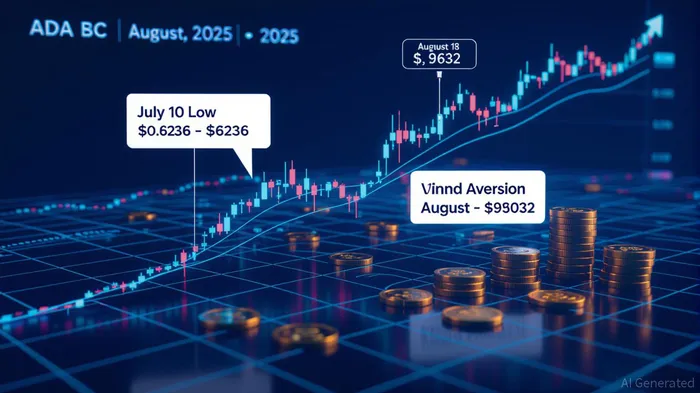
The cryptocurrency market has long been a theater for the interplay of rationality and emotion. Nowhere is this more evident than in the case of Cardano's ADAADA-- token, where behavioral economics and divergent risk preferences among investor segments have become central to understanding price volatility and sentiment. In 2025, the dynamics of ADA's price action reveal a stark divide between retail investors, driven by cognitive biases, and institutional actors, guided by fundamentals and long-term strategy.
The Reflection Effect and the Amplification of Volatility
At the heart of ADA's price swings lies the reflection effect, a behavioral economics phenomenon where losses loom larger in investors' minds than gains. This asymmetry has been a defining feature of ADA's 2025 trajectory. For instance, when ADA fell to $0.6236 on July 10, retail investors, gripped by loss aversion, liquidated long-term holdings at a 30% loss, exacerbating the decline. Conversely, when ADA surged to $0.9632 on August 18, many of the same investors, influenced by the disposition effect, sold prematurely to lock in profits, missing subsequent consolidation. This emotional overreaction—fear of loss outweighing hope for gain—has created a self-fulfilling cycle of volatility.
Institutional Rationality vs. Retail Emotion
While retail investors have been swayed by short-term noise, institutional actors and whale holders (wallets with 10–100 million ADA) have demonstrated a more disciplined approach. These entities accumulated 130 million ADA between late 2024 and mid-2025, viewing dips as buying opportunities rather than signs of weakness. On-chain data reveals a profit-to-loss ratio of 4.808, indicating minimal selling pressure from large holders. This divergence underscores a critical insight: institutional investors prioritize fundamentals—such as Cardano's Vasil hard fork (smart contracts) and Hydra Layer 2 solution (1 million TPS)—over emotional trading.
Retail behavior, by contrast, has been heavily influenced by herd mentality and social media narratives. During ADA's consolidation between $0.93 and $0.96 in August, speculative trading surged, while institutional players maintained a long-term perspective aligned with Cardano's ecosystem advancements. This behavioral asymmetry has amplified market volatility, creating opportunities for disciplined investors to act strategically.
Macro-Level Catalysts and Market Sentiment
External factors have further shaped ADA's price dynamics. The anticipation of a Grayscale ADA spot ETF, with an 83% approval probability on Polymarket, has attracted institutional capital and heightened optimism. Similarly, Bitcoin's record high of $116,000 in August 2025 created a bullish backdrop for altcoins. However, when BitcoinBTC-- corrected to $112,000 in late August, ADA followed suit, illustrating the interdependence between macro trends and altcoin performance.
Strategic Implications for Investors
For investors navigating ADA's volatile landscape, understanding these behavioral and macroeconomic forces is critical. Here are key considerations:
1. Discipline Over Emotion: Avoid panic selling during dips or premature profit-taking during rallies. Institutional accumulation suggests dips below $0.70–$0.75 could be undervalued entry points.
2. Technical and Fundamental Alignment: Monitor technical indicators (e.g., RSI near neutrality at 50.95) and on-chain metrics (e.g., rising MVRV Z-scores) to identify strategic entry/exit points.
3. Contrarian Opportunities: A Fear & Greed Index reading of 44 (indicating “fear”) on August 21, 2025, suggests a potential contrarian buying opportunity for those with a long-term horizon.
4. Institutional Confidence: Whale accumulation and the Plomin hard fork's on-chain governance features reinforce ADA's institutional appeal, offering a counterbalance to retail-driven volatility.
Conclusion: Navigating the Emotional Undercurrents
The ADA market in 2025 exemplifies how behavioral economics continues to dominate crypto investing. While retail investors remain prone to emotional overreactions, institutional actors and long-term holders are increasingly anchoring their decisions in fundamentals and technological progress. For investors, the path forward lies in balancing psychological awareness with strategic patience. By recognizing the reflection effect, disposition effect, and the contrasting behaviors of market participants, investors can navigate ADA's volatility with greater clarity—and potentially capitalize on the opportunities it creates.
In a market where sentiment often trumps fundamentals, the ability to separate emotion from analysis will determine success. As Cardano's roadmap unfolds, those who prioritize discipline over fear—and fundamentals over FOMO—may find themselves well-positioned for the next phase of its journey.

Blending traditional trading wisdom with cutting-edge cryptocurrency insights.
Latest Articles
Stay ahead of the market.
Get curated U.S. market news, insights and key dates delivered to your inbox.


AInvest
PRO
AInvest
PRO



Comments
No comments yet