
US Beef Supplies Expected to Hit Decade Low in 2026, Prices to Rise
ByAinvest
Tuesday, Aug 12, 2025 5:18 pm ET1min read
WEN--
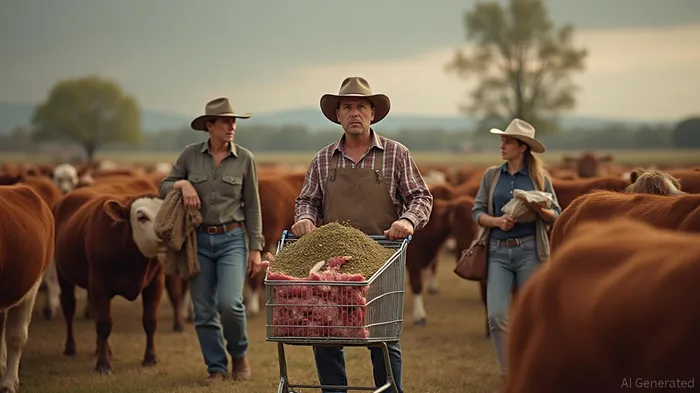
The decrease in beef supply is primarily due to a combination of persistent drought and high costs, which have led ranchers to cull cows, reducing the domestic inventory to its lowest level in several decades [1]. Additionally, the Trump administration's tariffs on Brazilian beef have increased the cost of imports, further limiting the supply [1].
Record prices for slaughter-weight animals have fueled expectations that ranchers will begin rebuilding the herd in 2026. However, this would tighten supplies even further in the short term, as ranchers would need to retain more females for breeding rather than sending them to processors [1]. The USDA has revised its forecasts for both beef production and imports lower than last month, reflecting these challenges [1].
In parallel, the Wendy's Company (WEN) has reported a decline in global systemwide sales of 1.8% in the second quarter of 2025, driven by a 3.6% decline in the US, where same-restaurant sales were down [2]. The company's management acknowledged the challenging consumer environment and emphasized the need for improved execution and performance. They also highlighted the importance of simplifying marketing programs and focusing on targeted innovations like chicken and beverage offerings [2].
In conclusion, the expected decline in US beef supply in 2026 is likely to push beef prices higher, impacting consumers and businesses alike. The Wendy's Company is navigating these challenges by simplifying its marketing strategy and focusing on targeted innovations to maintain its growth prospects.
References:
[1] https://www.bloomberg.com/news/articles/2025-08-12/us-beef-lovers-may-face-higher-prices-in-2026-as-supplies-shrink
[2] https://seekingalpha.com/news/4482903-wendys-revises-2025-outlook-projects-global-sales-decline-of-3-percent-to-5-percent-amid-u-s
WENN--
US beef lovers may face higher prices and leaner plates in 2026 due to a projected 2.5% decline in total beef supply to 31.1 billion pounds, the lowest since 2019. The decline is attributed to a shrinking herd and tariffs limiting imports from Brazil, the world's largest beef exporter. Beef production is expected to fall 1.8% to 25.5 billion pounds, the lowest since 2016.
American beef lovers may face higher prices and leaner plates in 2026 as the total beef supply in the US is expected to drop by 2.5% to 31.1 billion pounds, the lowest since 2019 [1]. This decline is attributed to a shrinking herd and tariffs limiting imports from Brazil, the world's largest beef exporter. According to the US Department of Agriculture, beef production is projected to fall by 1.8% to 25.5 billion pounds, the lowest since 2016 [1].The decrease in beef supply is primarily due to a combination of persistent drought and high costs, which have led ranchers to cull cows, reducing the domestic inventory to its lowest level in several decades [1]. Additionally, the Trump administration's tariffs on Brazilian beef have increased the cost of imports, further limiting the supply [1].
Record prices for slaughter-weight animals have fueled expectations that ranchers will begin rebuilding the herd in 2026. However, this would tighten supplies even further in the short term, as ranchers would need to retain more females for breeding rather than sending them to processors [1]. The USDA has revised its forecasts for both beef production and imports lower than last month, reflecting these challenges [1].
In parallel, the Wendy's Company (WEN) has reported a decline in global systemwide sales of 1.8% in the second quarter of 2025, driven by a 3.6% decline in the US, where same-restaurant sales were down [2]. The company's management acknowledged the challenging consumer environment and emphasized the need for improved execution and performance. They also highlighted the importance of simplifying marketing programs and focusing on targeted innovations like chicken and beverage offerings [2].
In conclusion, the expected decline in US beef supply in 2026 is likely to push beef prices higher, impacting consumers and businesses alike. The Wendy's Company is navigating these challenges by simplifying its marketing strategy and focusing on targeted innovations to maintain its growth prospects.
References:
[1] https://www.bloomberg.com/news/articles/2025-08-12/us-beef-lovers-may-face-higher-prices-in-2026-as-supplies-shrink
[2] https://seekingalpha.com/news/4482903-wendys-revises-2025-outlook-projects-global-sales-decline-of-3-percent-to-5-percent-amid-u-s
Stay ahead of the market.
Get curated U.S. market news, insights and key dates delivered to your inbox.
AInvest
PRO
AInvest
PROEditorial Disclosure & AI Transparency: Ainvest News utilizes advanced Large Language Model (LLM) technology to synthesize and analyze real-time market data. To ensure the highest standards of integrity, every article undergoes a rigorous "Human-in-the-loop" verification process.
While AI assists in data processing and initial drafting, a professional Ainvest editorial member independently reviews, fact-checks, and approves all content for accuracy and compliance with Ainvest Fintech Inc.’s editorial standards. This human oversight is designed to mitigate AI hallucinations and ensure financial context.
Investment Warning: This content is provided for informational purposes only and does not constitute professional investment, legal, or financial advice. Markets involve inherent risks. Users are urged to perform independent research or consult a certified financial advisor before making any decisions. Ainvest Fintech Inc. disclaims all liability for actions taken based on this information. Found an error?Report an Issue




Comments
No comments yet