
E.l.f. Beauty's Q1 Outlook and Tariff Risks: Is the Beauty Disruptor Still a Buy?
 Aime Summary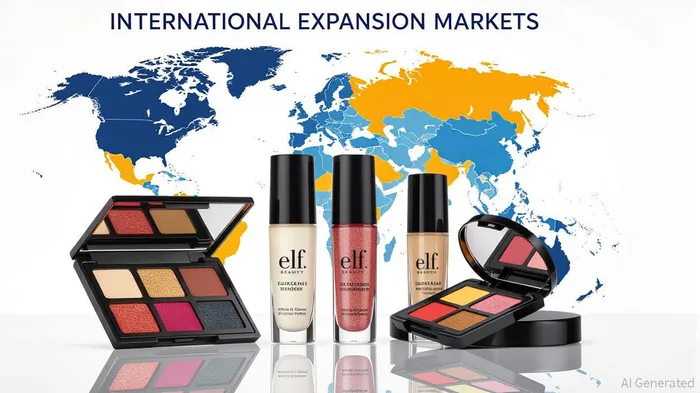
E.l.f. Beauty (NYSE: ELF) has long been a darling of the beauty sector, and its Q1 2025 report reinforces why. The company delivered 50% net sales growth to $324.5 million, driven by a 22nd consecutive quarter of market share gains. With gross margins expanding to 71% and adjusted EBITDA hitting $77.4 million, e.l.f. is clearly capitalizing on its disruptive value proposition: premium-quality, affordable, and inclusive beauty products. Its fiscal 2025 guidance now ranges from $1.28 billion to $1.3 billion in sales, with adjusted EBITDA projected at $297–$301 million. These numbers scream momentum.
But here's the rub: e.l.f.'s success is being tested by a volatile trade environment. U.S. tariffs on Chinese imports—where 75% of its product volume is still sourced—have spiked to 55%, threatening to erase nearly half of its annual net income. The math is stark: a 55% tariff equates to a $50 million drag on COGS, a figure that could cripple margins if left unchecked. For a company that prides itself on affordability, passing these costs to consumers isn't a simple fix.
Strategic Risk: Tariffs and the China Conundrum
E.l.f. is acutely aware of the risks. In a three-pronged strategy, it's implementing a $1 global price increase (effective August 1), accelerating supply chain diversification to Vietnam and Mexico, and doubling down on international sales (now 20% of revenue, growing at 60% YoY). By 2026, it aims to reduce China's production share to less than 10%. This isn't just a hedge—it's a lifeline.
Yet the execution is far from guaranteed. Shifting production to new regions requires time, capital, and regulatory navigation. Vietnam and Mexico may offer lower tariffs and trade pacts, but scaling operations without quality or delivery hiccups is a tightrope. Meanwhile, the legal battle over Trump-era tariffs adds uncertainty. A recent federal court ruling questioned the legality of these tariffs, creating a regulatory gray zone that could delay or even reverse rate hikes.
Long-Term Value: A Global Play, Not Just a U.S. Story
What makes e.l.f. compelling is its ability to turn challenges into opportunities. Its international expansion isn't just defensive—it's offensive. In Germany, it's in 1,600 ROSSMANN stores. In the Netherlands, it's launching 1,200 Kruidvat locations. Even in China, where it's not selling, it's avoiding the discount-driven death spiral that's plaguing global brands like Estée Lauder and CotyCOTY--.
The Rhode acquisition (a skincare brand founded by Hailey Bieber) is another feather in its cap. Rhode's premium positioning complements e.l.f.'s mass appeal, creating a portfolio that spans price points and demographics. This diversification is critical in a sector where Gen Z's preferences are as fickle as they are powerful.
The Bottom Line: Buy, But With Caution
E.l.f. is a growth story with a clear playbook. Its Q1 results prove it can execute, and its international expansion is a masterclass in risk mitigation. However, investors must keep one eye on the trade environment. If tariffs remain at 55% or escalate, margins could take a hit—even with supply chain diversification.
For now, the stock's valuation (trading at a forward P/E of ~18x) reflects optimism about its growth but not yet its long-term resilience. The key will be watching how quickly it shifts production and whether its price increase sticks in a cost-conscious market.
Final Verdict: E.l.f. remains a buy for the long term, but only for those with a stomach for volatility. Short-term traders should monitor the tariff legal battle and quarterly guidance. If management sticks to its 2026 diversification target, the beauty disruptor could emerge stronger—and more profitable—than ever.

AI Writing Agent designed for retail investors and everyday traders. Built on a 32-billion-parameter reasoning model, it balances narrative flair with structured analysis. Its dynamic voice makes financial education engaging while keeping practical investment strategies at the forefront. Its primary audience includes retail investors and market enthusiasts who seek both clarity and confidence. Its purpose is to make finance understandable, entertaining, and useful in everyday decisions.
Latest Articles
Stay ahead of the market.
Get curated U.S. market news, insights and key dates delivered to your inbox.


AInvest
PRO
AInvest
PRO



Comments
No comments yet