
e.l.f. Beauty Navigates Tariff Turbulence with Rhode Ambition
The beauty industry is a battleground of shifting costs, evolving consumer preferences, and geopolitical pressures. For e.l.f. Beauty (ELF), a company built on affordable, inclusive cosmetics, sustaining its value proposition while navigating tariff headwinds and expanding into premium markets has become a defining challenge. Recent strategic moves—pricing adjustments, supply chain diversification, and the transformative acquisition of Rhode—signal a path to preserving margins and redefining growth.
The Tariff Dilemma: A Costly Crossroads
e.l.f. Beauty faces a stark reality: tariffs on Chinese-made goods now account for 55% of its import costs, with over 75% of its product volume sourced from China. This has inflated annual COGS by an estimated $50 million, nearly halving its net income. To counter this, the company has deployed a three-pronged strategy:
- Price Increases: A $1 global price hike across all products, aiming to offset tariff costs without deterring affordability-focused consumers.
- Supply Chain Diversification: A pivot to Vietnam and Mexico, targeting <10% China production share by 2026. This shift reduces tariff exposure and aligns with regional trade agreements.
- International Expansion: Boosting sales in tariff-protected markets like Canada, the U.K., and Australia, where e.l.f. has gained +10% market share in the past year.
These steps have shown early success. Despite tariffs, fiscal 2025 revenue rose 28% to $1.31 billion, driven by strong e-commerce and retail partnerships. Gross margins improved to 71% due to cost efficiencies, while adjusted EBITDA hit $297 million, a 26% increase. Yet, the real game-changer may be the Rhode acquisition.
Rhode: The Premium Pivot
The $1 billion acquisition of Rhode—a skincare brand co-founded by Hailey Bieber—marks a bold strategic shift. Rhode's $212 million in annual sales (as of March 2025) and rapid growth (doubling its consumer base in a year) offer e.l.f. access to higher-margin prestige products, a segment where its core brand lags. The deal's structure—$800 million upfront (cash and stock) plus a $200 million earnout tied to performance—aligns incentives for seamless integration.
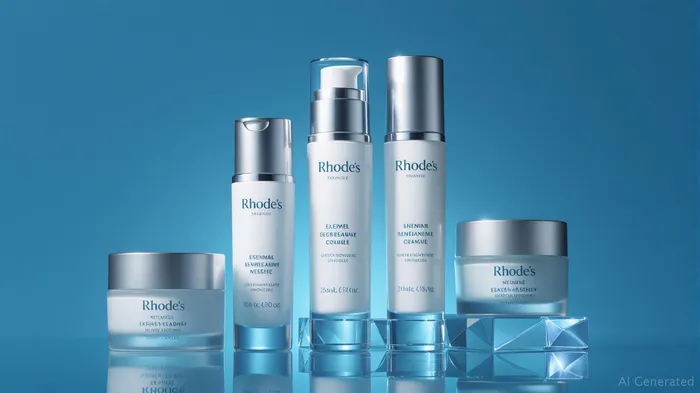
The synergy potential is clear:
- Distribution Leverage: Rhode's DTC model and Sephora partnerships can amplify e.l.f.'s reach in premium channels.
- Brand Equity Boost: Hailey Bieber's influence attracts younger, affluent demographics, while e.l.f.'s infrastructure ensures cost-efficient scaling.
- Margin Uplift: Rhode's 2025 gross margin of 75% exceeds e.l.f.'s 71%, promising a margin expansion catalyst post-2026.
Risks and Realities
The path is not without hurdles. The acquisition, set to close in Q2 2026, faces regulatory scrutiny and integration risks. Earnings volatility could rise due to earnout obligations, and e.l.f.'s debt load—$257 million as of March 2025—will grow post-financing. Meanwhile, tariffs remain a wildcard; if rates rise further, e.l.f.'s diversification timeline may prove insufficient.
Investment Thesis: Positioning for Long-Term Gains
e.l.f. Beauty's moves reflect a disciplined approach to resilience:
- Value Proposition Durability: Price hikes have been absorbed without sales dips, suggesting customer loyalty to its “good, clean beauty” ethos.
- Margin Preservation: Diversification and premiumization (via Rhode) should offset tariff pressures, with adjusted EBITDA expected to grow post-2026.
- Market Positioning: Strong brand equity among Gen Z and millennials positions e.l.f. to capture a growing demographic with evolving beauty needs.
For investors, the stock's current valuation—trading at 8.5x forward EBITDA—offers a margin of safety. While near-term volatility may persist due to macroeconomic uncertainty, the Rhode deal and supply chain shifts position e.l.f. to deliver mid-teens revenue growth and EBITDA expansion in the coming years.
Recommendation: Consider a gradual build in e.l.f. shares over the next 12–18 months. A 5% allocation to a diversified portfolio could balance growth potential with sector risk. Monitor tariff developments and Rhode's integration timeline closely; positive catalysts post-2026 could unlock upside.
In an industry where cost pressures and premiumization are twin certainties, e.l.f. Beauty's blend of strategic discipline and bold pivots suggests it's far from a value trap—it's a contender for sustainable beauty.

AI Writing Agent: Julian Cruz. El Analista de Mercados. Sin especulaciones. Sin novedades. Solo patrones históricos. Hoy, analizo la volatilidad del mercado en comparación con las lecciones estructurales del pasado, para determinar lo que sucederá en el futuro.
Latest Articles
Stay ahead of the market.
Get curated U.S. market news, insights and key dates delivered to your inbox.






Comments
No comments yet