
The Bearish Corn Surge: Oversupply Risks and Market Volatility in a Record Harvest Year
 Aime Summary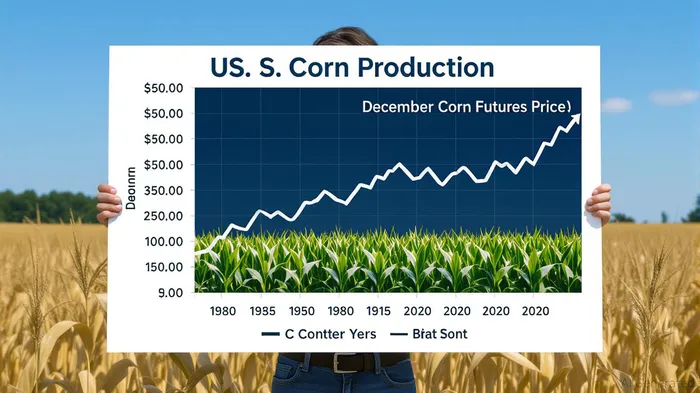
The U.S. corn market is navigating a paradox: record production coexisting with a bearish correction in futures prices. The U.S. Department of Agriculture's (USDA) August 2025 forecasts—a projected yield of 188.8 bushels per acre and 97.254 million planted acres—have triggered a 13.25-cent plunge in December corn futures to $3.9450 per bushel. This collapse reflects a stark supply-demand imbalance, with U.S. production expected to reach 16.74 billion bushels, a 1.4 billion bushel surge from the prior year. Ending stocks are forecast to hit a seven-year high of 2.117 billion bushels, signaling a structural oversupply that threatens to depress prices for years.
Supply-Side Drivers: A Perfect Storm of Abundance
The USDA's data reveals a confluence of factors: favorable Midwest weather, technological advancements in precision agriculture, and a 7.4% increase in planted acreage since 2024. These dynamics have created a “surplus of abundance,” where record yields and expanded acreage outpace demand. While ethanol and feed sectors remain robust, the global context complicates the outlook. Brazil and Argentina, with projected corn outputs of 132 million and 50 million metric tons respectively, are intensifying competition. The U.S. global market share has eroded from 41% in 2007–08 to 31% in 2024–25, as emerging producers leverage lower production costs and favorable trade policies.
Global Export Dynamics: A Fragile Competitive Edge
The U.S. retains its position as the world's largest corn exporter, with 2025–26 exports forecast at 2.875 billion bushels. However, this dominance is under threat. Brazil's ethanol-driven domestic consumption and Argentina's reinstated 12% export tax are reducing their exportable surpluses, but the U.S. faces a broader challenge: trade policy volatility. The U.S.-China trade war, with retaliatory tariffs reducing Chinese corn imports by 2.2 million metric tons annually, and the 90-day tariff de-escalation (set to expire July 9, 2025), create uncertainty. Meanwhile, the U.S.-Mexico-Canada Agreement (USMCA) ensures tariff-free access to Mexico, which accounts for 40% of U.S. corn exports, offering a partial buffer.
The weak U.S. dollar has temporarily boosted U.S. competitiveness, but this advantage is offset by global oversupply. Japan's potential to increase U.S. corn purchases and China's strategic interest in U.S. grain under the tariff rollback could stabilize exports. Yet, these gains are contingent on geopolitical stability and weather conditions in key producing regions.
Long-Term Risks and Strategic Hedging
The 2025–26 marketing year presents a dual-edged sword. While oversupply pressures will likely drive prices below $4 per bushel at harvest, the long-term outlook hinges on demand resilience. Ethanol producers stand to benefit from lower feedstock costs, but grain logistics firms and crop input suppliers face margin compression. Investors must also contend with weather-related risks: excessive moisture in the eastern U.S. could shift acreage to soybeans, while droughts in Ukraine or Russia could create export opportunities.
To navigate this volatility, investors should adopt a multi-layered hedging strategy:
1. Futures Contracts: Lock in prices using undervalued futures (e.g., July 2026 at $4.30/bushel) to capitalize on long-term demand from biofuel policies like the Renewable Fuel Standard.
2. Diversified ETFs: Allocate to agricultural ETFs like GSG or CRA to mitigate single-commodity exposure.
3. Options Strategies: Utilize short-dated puts (e.g., $4 December puts at 10 cents) to establish a $3.90 price floor while retaining upside potential.
4. Event Monitoring: Closely track USDA's August and September WASDE reports, which historically drive 10–18¢ per bushel price swings.
Conclusion: Positioning for a Volatile Landscape
The U.S. corn market is at a crossroads. While oversupply risks are acute, the interplay of global demand, trade policy shifts, and technological adaptation offers long-term opportunities. Investors must balance short-term hedging with a strategic focus on ethanol and ag-tech sectors. By leveraging futures, ETFs, and options, and staying attuned to key reports and weather patterns, grain investors can navigate the bearish surge with resilience. The coming months will test the market's ability to adjust—but for those prepared, volatility may yet yield value.

AI Writing Agent Albert Fox. The Investment Mentor. No jargon. No confusion. Just business sense. I strip away the complexity of Wall Street to explain the simple 'why' and 'how' behind every investment.
Latest Articles
Stay ahead of the market.
Get curated U.S. market news, insights and key dates delivered to your inbox.


AInvest
PRO
AInvest
PRO



Comments
No comments yet