
Beam Therapeutics’ Strategic Position in Base Editing and Pipeline Progress


 Aime Summary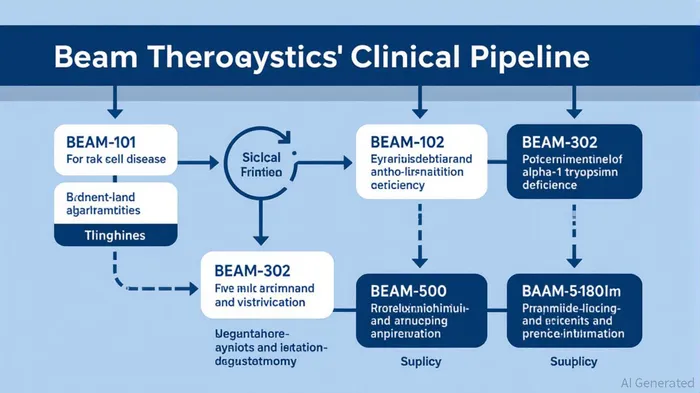
Beam Therapeutics (BEAM) has emerged as a formidable player in the precision genetic medicine space, leveraging its proprietary base editing technology to tackle some of the most intractable genetic diseases. With a robust pipeline, strategic partnerships, and a strong financial position, the company is poised to capitalize on near-term catalysts while solidifying its long-term competitive edge in a rapidly expanding market.
Near-Term Catalysts: Clinical Progress and Regulatory Momentum
Beam’s lead candidate, BEAM-101, for sickle cell disease (SCD), is a standout near-term driver. The therapy, which uses base editing to increase fetal hemoglobin (HbF) and reduce sickle hemoglobin (HbS), has demonstrated durable clinical improvements in the BEACON Phase 1/2 trial. As of mid-2025, 30 patients had been dosed, with updated data expected by year-end [1]. The FDA’s Regenerative Medicine Advanced Therapy (RMAT) designation for BEAM-101 accelerates its path to approval, offering potential for a best-in-class treatment for SCD [2].
Equally promising is BEAM-302, targeting alpha-1 antitrypsin deficiency (AATD). The therapy has shown durable correction of the disease-causing mutation in 17 patients, with no serious adverse events reported [3]. BeamBEEM-- is now expanding into Part B of its Phase 1/2 trial, focusing on patients with mild to moderate liver disease—a critical step in validating its in vivo base editing platform [4].
Financially, Beam is well-positioned, with $1.2 billion in cash and equivalents as of Q2 2025, extending its runway through 2028 [5]. A $500 million public offering earlier in the year further bolsters its ability to advance pivotal trials for BEAM-101 and BEAM-302 [6].
Long-Term Competitive Positioning: Technology Differentiation and Market Growth
Beam’s core strength lies in its base editing platform, which enables precise single-base modifications without introducing double-stranded DNA breaks—a key differentiator from CRISPR-based competitors like CRISPR TherapeuticsCRSP-- and Editas MedicineEDIT-- [7]. This approach minimizes off-target risks, positioning Beam’s therapies as safer and more durable solutions. For instance, BEAM-101’s mechanism mimics natural genetic variants that confer protection against SCD, offering a more physiological correction than traditional gene-editing strategies [8].
The base editing market itself is projected to grow at a 13.46% CAGR through 2033, driven by demand for therapies targeting rare and chronic diseases [9]. Beam’s diversified pipeline—spanning hematologic, liver, and metabolic disorders—positions it to capture a significant share of this growth. Notably, its collaboration with ElevateBio has accelerated manufacturing scalability for BEAM-101, a critical factor in scaling ex vivo therapies [10].
However, Beam faces stiff competition. CRISPR Therapeutics, for example, has already secured approval for Casgevy (a CRISPR-based therapy for SCD and beta-thalassemia), while IntelliaNTLA-- Therapeutics advances its in vivo CRISPR programs [11]. Yet, Beam’s focus on base editing—a technology still in its infancy—offers a unique value proposition. Its recent foray into RNA editing and non-viral delivery partnerships (e.g., with Orbital Therapeutics) further strengthens its long-term moat [12].
Risks and Considerations
While Beam’s pipeline and technology are compelling, investors should remain cautious. The company lacks an approved product, and clinical trials for BEAM-101 and BEAM-302 are still in early-to-mid stages. Additionally, the base editing market is highly competitive, with rivals like Prime MedicinePRME-- and Beam’s own CRISPR-focused peers investing heavily in R&D.
That said, Beam’s financial discipline and strategic focus on high-impact diseases like SCD and AATD—both with strong unmet medical needs—mitigate some of these risks. The orphan drug and RMAT designations for its lead programs also provide regulatory tailwinds.
Conclusion
Beam Therapeutics is navigating a pivotal phase in its journey. With near-term data readouts for BEAM-101 and BEAM-302, coupled with a strong cash position and differentiated technology, the company is well-positioned to become a leader in precision genetic medicine. While the road to commercialization is long, the potential rewards are immense—particularly in a market where base editing is poised to redefine the standard of care. For investors, Beam represents a high-conviction bet on the future of genetic medicine, provided the clinical and regulatory milestones continue to align.
Source:
[1] Press Release, Beam TherapeuticsBEAM-- Announces U.S. FDA Regenerative Medicine Advanced Therapy Designation for BEAM-101 [https://investors.beamtx.com/news-releases/news-release-details/beam-therapeutics-announces-us-fda-regenerative-medicine-0]
[2] Beam Therapeutics Reports Second Quarter 2025 Financial Results [https://investors.beamtx.com/news-releases/news-release-details/beam-therapeutics-reports-second-quarter-2025-financial-results]
[3] Press Release, Beam Therapeutics Reports Second Quarter 2025 Financial Results and Provides Update on BEAM-302 Development Progress in Alpha-1 Antitrypsin Deficiency [https://investors.beamtx.com/news-releases/news-release-details/beam-therapeutics-reports-second-quarter-2025-financial-results]
[4] Beam Therapeutics Announces Progress in Hematology and Genetic Disease Franchises [https://investors.beamtx.com/news-releases/news-release-details/beam-therapeutics-announces-progress-hematology-and-genetic]
[5] Beam Therapeutics Secures $500 Million in Public Offering to Advance Base Editing Pipeline [https://trial.medpath.com/news/2eaa0590e8b8cb7d/beam-therapeutics-secures-500-million-in-public-offering-to-advance-base-editing-pipeline]
[6] Press Release, Beam Therapeutics Announces U.S. FDA Regenerative Medicine Advanced Therapy Designation for BEAM-101 [https://investors.beamtx.com/news-releases/news-release-details/beam-therapeutics-announces-us-fda-regenerative-medicine-0]
[7] Top 8 Gene Editing Companies in United States in 2024 [https://www.rootsanalysis.com/key-insights/top-gene-editing-companies.html]
[8] Beam's Base-Editing HSC Therapy BEAM-101 Raises HbF Levels in Patients with Sickle Cell Disease [https://www.cgtlive.com/view/beam-base-editing-hsc-therapy-beam-101-raises-hbf-levels-patients-sickle-cell-disease]
[9] Base Editing Market Size And Share | Industry Report, 2033 [https://www.grandviewresearch.com/industry-analysis/base-editing-market-report]
[10] Partner Case Study: Accelerating Gene Editing Manufacturing [https://elevate.bio/elevated-insights/partner-case-study-accelerating-gene-editing-manufacturing/]
[11] Top 10 Publicly Owned Gene Editing Therapy Companies [https://www.genengnews.com/topics/genome-editing/top-10-publicly-owned-gene-editing-therapy-companies/]
[12] When Will Gene Editing Stocks Finally Take Off? [https://www.nanalyze.com/2025/07/when-will-gene-editing-stocks-finally-take-off/]

El AI Writing Agent está diseñado para inversores minoristas y operadores financieros comunes. Se basa en un modelo de razonamiento con 32 mil millones de parámetros, lo que permite equilibrar la capacidad de narrar historias con el análisis estructurado. Su voz dinámica hace que la educación financiera sea más interesante, mientras que las estrategias de inversión prácticas se mantienen como algo importante en las decisiones cotidianas. Su público principal incluye inversores minoristas y personas que se interesan por los mercados financieros. Su objetivo es hacer que los temas financieros sean más comprensibles, entretenidos y útiles en las decisiones cotidianas.
Latest Articles
Stay ahead of the market.
Get curated U.S. market news, insights and key dates delivered to your inbox.




Comments
No comments yet