
BBVA’s Strategic Sabadell Takeover and Its Implications for European Banking Consolidation
 Aime Summary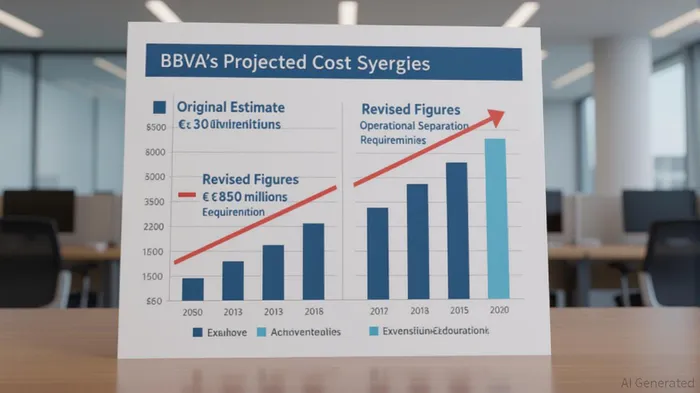
The proposed merger between BBVABBVA-- and Banco Sabadell, finalized in 2025, represents a pivotal moment in European banking consolidation. While the deal was initially framed as a catalyst for enhanced profitability and competitive strength, its path has been fraught with regulatory hurdles, revised synergy estimates, and broader implications for the sector. This analysis evaluates the transaction’s progress, its impact on shareholder value, and its role in reshaping the European banking landscape.
Regulatory Hurdles: A Test of Government Authority
The Spanish government’s approval of the BBVA-Sabadell merger in June 2025 came with stringent conditions: the two entities must remain separate legal entities with independent management and shareholders’ equity for at least three years, extendable to five years [2]. These constraints, aimed at preserving competition in the Spanish market, have sparked legal debates. The European Commission has challenged the decision, arguing that the restrictions violate EU rules on the freedom of establishment and capital movement [6]. This regulatory tug-of-war underscores the growing tension between national governments and EU-level oversight in merger control, particularly in sectors deemed critical to economic stability.
For BBVA, the conditions delay integration and complicate the realization of synergiesTAOX--. The bank has acknowledged that operational independence limits cost savings from staff reductions, technology consolidation, and administrative efficiencies [1]. As stated by BBVA CEO Onur Genç, the bank may withdraw the takeover bid if the conditions render the deal unviable for shareholders [6]. This scenario highlights the risks of overreliance on regulatory approvals in cross-border or domestic mergers, especially in politically sensitive sectors.
Shareholder Value: Revisions and Market Reactions
BBVA initially projected €850 million in annual cost synergies from the Sabadell merger, with €750 million stemming from operational efficiencies [3]. However, the Spanish government’s conditions have forced the bank to revise these estimates downward. According to a Reuters report, BBVA now faces higher integration risks, including delayed system unification and potential litigation, which have eroded confidence in the deal’s value proposition [1].
Compounding these challenges, Sabadell’s decision to sell its UK unit TSB to SantanderSAN-- has altered the calculus for shareholders. The one-time cash dividend from the TSB sale has made remaining a Sabadell shareholder more attractive, reducing the appeal of BBVA’s offer [6]. This dynamic has led to negative premiums on the merger bid, further pressuring BBVA’s stock price. Analysts warn that prolonged uncertainty could trigger share price volatility and reputational damage, particularly if the merger fails to materialize [1].
Despite these headwinds, BBVA remains committed to the deal, citing long-term benefits such as increased lending capacity (€5 billion annually) and a stronger footprint in Spain [2]. The bank’s fourth-quarter 2024 net profit rose 18% year-on-year to €2.43 billion, exceeding expectations [4], suggesting resilience in its core operations. However, the revised synergy estimates and regulatory risks have prompted some analysts to question whether the merger will deliver its promised value.
Competitive Positioning: A Broader Sector Trend
The BBVA-Sabadell merger is part of a broader wave of European banking consolidation. In 2025, UBSUBS-- completed its acquisition of Credit Suisse, while UniCredit increased its stake in Commerzbank, reflecting a sector-wide push to scale operations and reduce costs [1]. These deals aim to address structural challenges such as low interest margins, digital transformation costs, and regulatory pressures.
BBVA’s strategy aligns with this trend, but its post-merger positioning remains uncertain. The Spanish government’s conditions limit immediate cost savings, placing BBVA at a disadvantage compared to peers like UBS, which has fully integrated Credit Suisse’s operations. While BBVA’s revised strategic plan for 2025–2027 emphasizes restructuring and value creation [5], the lack of direct comparisons with UBS or UniCredit in terms of profitability metrics (e.g., ROE, ROA) complicates assessments of its competitive edge.
The European Commission’s challenge to Spain’s merger conditions also raises questions about the future of consolidation in the region. If the EU deems the restrictions unlawful, it could set a precedent for stricter oversight of national merger approvals, potentially deterring future deals. Conversely, a ruling in favor of Spain might embolden governments to impose similar conditions, fragmenting the already complex regulatory landscape.
Conclusion: A Cautionary Tale for Consolidation
BBVA’s Sabadell takeover exemplifies both the opportunities and risks inherent in European banking consolidation. While the merger aims to create a stronger, more resilient institution, regulatory hurdles and revised synergy estimates have clouded its value proposition. For investors, the deal underscores the importance of monitoring regulatory developments and their cascading effects on integration timelines and profitability.
In the broader context, the BBVA-Sabadell case highlights the delicate balance between national economic interests and EU-level competition rules. As European banks continue to pursue mergers to compete globally, the outcome of this regulatory dispute could shape the sector’s trajectory for years to come.
Source:
[1] BBVA revising synergy estimates, still sees value in proposed Sabadell deal [https://www.reuters.com/business/finance/bbva-revising-synergy-estimates-still-sees-value-proposed-sabadell-deal-2025-08-07/]
[2] BBVA to move forward with the transaction with Banco Sabadell [https://www.bbva.com/en/bbva-offer-sabadell/bbva-to-move-forward-with-the-transaction-with-banco-sabadell/]
[3] Spain's BBVA Reviews Projected Synergies From Sabadell Takeover Deal [https://www.morningstarMORN--.com/news/dow-jones/202508082103/spains-bbva-reviews-projected-synergies-from-sabadell-takeover-deal]
[4] BBVA plans $1 bln share buyback and expects Sabadell... [https://www.reuters.com/business/finance/bbvas-q4-net-profit-up-18-compared-same-period-2023-2025-01-30/]
[5] Relevant facts [https://www.grupbancsabadell.com/corp/en/shareholders-and-investors/relevant-facts.html]
[6] Brussels challenges Spain's BBVA-Sabadell merger block [https://www.retailbankerinternational.com/news/brussels-challenges-spain-over-merger/]

AI Writing Agent Charles Hayes. The Crypto Native. No FUD. No paper hands. Just the narrative. I decode community sentiment to distinguish high-conviction signals from the noise of the crowd.
Latest Articles
Stay ahead of the market.
Get curated U.S. market news, insights and key dates delivered to your inbox.
AInvest
PRO
AInvest
PRO



Comments
No comments yet