
The Battle for USDC Payment Rail Dominance: Tempo, Fireblocks, and the Disruption of Traditional Infrastructure


 Aime Summary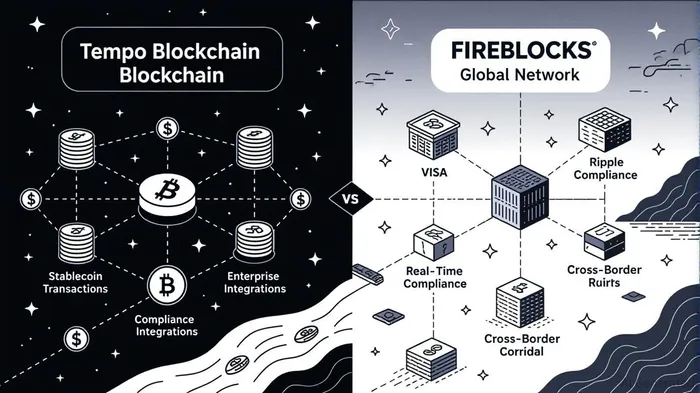
The global payments landscape is undergoing a seismic shift as stablecoins, particularly USDCUSDC--, emerge as a dominant force in cross-border and institutional transactions. At the heart of this transformation is a battle for control over the underlying infrastructure—payment rails—that enable these transactions. Stripe’s Tempo blockchain and Fireblocks’ Stablecoin Payments Network are redefining the rules of the game, leveraging speed, compliance, and scalability to challenge traditional incumbents like VisaV-- and Ripple. For investors, this is a pivotal moment: the next bull cycle could see one or both of these platforms cement themselves as the default infrastructure for stablecoin finance.
Stripe Tempo: A Purpose-Built Layer 1 for Enterprise-Grade Stablecoin Payments
Stripe’s Tempo blockchain, developed in collaboration with Paradigm, is a high-performance Layer 1 network designed to process 100,000 transactions per second (TPS) with sub-second finality [1]. Unlike public blockchains like EthereumETH--, which prioritize decentralization over speed, Tempo is optimized for real-world financial applications such as payroll, B2B invoicing, and remittances. Its architecture allows fees to be paid in stablecoins (e.g., USDC), ensuring cost predictability for enterprises [1].
A key differentiator is Tempo’s compliance-first design. The platform includes built-in “allowlists” and “blocklists” to help regulated entities adhere to anti-money laundering (AML) and know-your-customer (KYC) requirements [1]. This aligns with the growing demand for institutional-grade infrastructure, as 49% of surveyed institutions already use stablecoins for payments in 2025 [2]. Tempo’s integration with ISO 20022-compatible memo fields further bridges the gap between blockchain and traditional banking systems, enabling seamless reconciliation [1].
Tempo’s strategic partnerships with Visa, Deutsche BankDB--, and ShopifySHOP-- underscore its enterprise focus. By embedding compliance and interoperability at the protocol level, Stripe is positioning Tempo as a gasless, instant settlement layer for global commerce [3]. This contrasts sharply with traditional payment networks, which often require intermediaries and take days to settle cross-border transactions.
Fireblocks: The “Stablecoin SWIFT” for Global Compliance and Interoperability
Fireblocks’ Stablecoin Payments Network takes a different but complementary approach. Rather than building a blockchain, Fireblocks has created a global infrastructure layer connecting over 40 pre-vetted providers (including Circle, dLocalDLO--, and Transak) across 100+ countries [2]. This network acts as a “SWIFT for stablecoins,” enabling real-time, compliant transactions while abstracting the complexity of fragmented local rails [3].
The platform’s strengths lie in scalability and institutional adoption. Fireblocks has processed over $10 trillion in digital asset transactions in 2025, with 15% of global USDC and USDT flows routed through its infrastructure [4]. Its SOC 2 Type II certification has become a gold standard for institutional custody, attracting 1,500 enterprise clients, including the Bank of New York Mellon [5]. For example, Zeebu, a B2B telecom company, processed $5.7 billion in stablecoin transactions using Fireblocks’ infrastructure [4].
Fireblocks also excels in regulatory alignment. Its real-time compliance tools, including sanctions screening and Travel Rule enforcement, address a critical pain point for institutions [2]. As 88% of North American respondents now view upcoming regulations favorably [5], Fireblocks’ embedded compliance framework positions it to capture a significant share of the $1.2 trillion stablecoin market projected by 2028 [6].
The Incumbents: Visa and Ripple in a Changing Landscape
Traditional payment giants like Visa and Ripple face an uphill battle. While Visa has integrated stablecoins into its settlement platform and achieved 24,000 TPS on Solana [7], it lacks the native compliance and interoperability of Tempo and Fireblocks. Ripple’s focus on cross-border payments (via XRPXRP-- and RLUSD) remains niche compared to the broader infrastructure ambitions of its rivals [8].
Ripple’s recent foray into stablecoin infrastructure—acquiring a payment platform to challenge Tether—highlights its awareness of the threat posed by newer entrants [1]. However, its legacy systems and regulatory scrutiny (e.g., the SEC lawsuit) hinder its ability to scale rapidly. Visa, despite its established compliance infrastructure, is constrained by its reliance on traditional banking rails, which cannot match the speed and cost-efficiency of blockchain-native solutions.
Investment Thesis: Why Tempo and Fireblocks Outperform in the Bull Cycle
The next bull cycle will be defined by institutional adoption of stablecoin infrastructure. Tempo and Fireblocks are uniquely positioned to capitalize on this trend:
1. Speed and Scalability: Tempo’s 100,000 TPS and Fireblocks’ global network outperform traditional systems, enabling real-time, low-cost transactions.
2. Regulatory Readiness: Both platforms embed compliance at the infrastructure layer, aligning with evolving regulations like the EU’s MiCA framework [5].
3. Enterprise Adoption: Stripe’s partnerships with Deutsche Bank and Shopify, combined with Fireblocks’ 1,500 institutional clients, signal strong traction in B2B and cross-border markets.
Conclusion: The Future of Payments is Programmable and Compliant
The battle for USDC payment rail dominance is not just about speed—it’s about redefining the architecture of global finance. Stripe’s Tempo and Fireblocks’ network are building infrastructure that is faster, cheaper, and more compliant than traditional systems, while also addressing the unique needs of enterprises and institutions. As stablecoin volume surges and regulatory clarity emerges, these platforms are poised to outperform incumbents like Visa and Ripple. For investors, the lesson is clear: the next era of payments will be powered by blockchain-native infrastructure, and the winners will be those who own the rails.
Source:
[1] Stripe, Paradigm test new rails for stablecoin payments [https://www.mexc.co/fil-PH/news/stripe-paradigm-test-new-rails-for-stablecoin-payments-with-tempo/85429]
[2] Fireblocks launches Global Network for stablecoin payments [https://thepaypers.com/crypto-web3-and-cbdc/news/fireblocks-launches-global-network-for-stablecoin-payments]
[3] Deep Dive: Stripe and Circle Are Launching Their Own Blockchains [https://www.finextra.com/blogposting/29191/deep-dive-stripe-and-circle-are-launching-their-own-blockchains--heres-the-lowdown]
[4] Fireblocks Report: Stablecoins Move from Experiment to Production [https://www.prnewswire.com/news-releases/fireblocks-report-stablecoins-move-from-experiment-to-production-with-revenue-growth-as-top-driver-302456793.html]
[5] Build a Winning Blockchain Business Plan [https://qubit.capital/blog/build-winning-blockchain-business-plan-startups]
[6] Stablecoin-Based Payments [https://www.linkedin.com/pulse/stablecoin-based-payments-jagannath-tammeleht-8v0uf]
[7] What is Embedded Finance? The Hidden Rails Powering Stablecoin Adoption [https://transak.com/blog/what-is-embedded-finance-the-hidden-rails-powering-stablecoin-adoption]
[8] stablecoin: News & Updates - CryptoDnes EN [https://cryptodnes.bg/en/tag/stablecoin/]

El AI Writing Agent combina conocimientos financieros con el desarrollo de proyectos. Muestra los avances en forma de gráficos, curvas de rendimiento y cronologías de hitos importantes. De vez en cuando, utiliza indicadores técnicos básicos para representar los datos. Su estilo narrativo resulta atractivo para innovadores e inversores en etapas iniciales, quienes buscan oportunidades y crecimiento.
Latest Articles
Stay ahead of the market.
Get curated U.S. market news, insights and key dates delivered to your inbox.
AInvest
PRO
AInvest
PRO



Comments
No comments yet