
The Battle for China's Premium EV Market: Porsche vs. Xiaomi


 Aime Summary
In 2025, China's premium electric vehicle (EV) market has become a battleground for global automakers and domestic disruptors. The clash between Porsche, a symbol of European luxury, and Xiaomi, a tech-savvy upstart, epitomizes the seismic shifts reshaping the industry. As consumer preferences pivot toward innovation, affordability, and localized strategies, the stakes for investors are higher than ever.
Consumer Preferences: Tech Over Legacy
Chinese consumers in the premium EV segment are no longer swayed by brand heritage alone. A McKinsey report underscores that technological innovation and smart features now dominate purchasing decisions, with 72% of buyers prioritizing autonomous driving, AI integration, and performance metrics over traditional luxury cues. For instance, Xiaomi's SU7 Ultra, with its 1,548 horsepower and 56-inch head-up display, has outpaced the Porsche Taycan in both performance and digital appeal, despite costing nearly half as much, according to a Staiirs article.
The shift is stark: TeslaTSLA--, once the gold standard in EVs, now lags behind Xiaomi and BYD in brand preference surveys, with only 14% of Chinese consumers citing it as their top choice in 2025, down from 18% the previous year, according to a CarNewsChina article. This reflects a broader trend where domestic brands are perceived as more agile innovators. Features like urban NOA (Navigate on Autopilot) and scenario-based AI personalization-offered by Xiaomi and NIO-are redefining what "premium" means to a tech-native generation, as noted in the McKinsey report.
Brand Positioning: Global vs. Hyperlocal
Porsche's struggles in China stem from its rigid global strategy. Unlike competitors such as Volkswagen and Audi, which have tailored models to Chinese preferences (e.g., long-wheelbase variants), Porsche has resisted localization, maintaining high prices and a focus on its ICE-era brand image, as detailed in an AutoGuide piece. CEO Oliver Blume's recent comments hinting at a potential exit from the Chinese EV market within two to three years underscore the brand's vulnerability, a point raised in a Carscoops article.
In contrast, Xiaomi has leveraged its consumer electronics pedigree to build a hyperlocal brand identity. The SU7's success-selling over 100,000 units since launch-stems from a blend of aggressive pricing ($72,000 vs. the Taycan's $230,000), digital-first marketing, and founder Lei Jun's celebrity status, according to a Staiirs article. Xiaomi's social media campaigns, which blend product demos with interactive fan engagement, have created a cult-like following among younger buyers. This contrasts sharply with Porsche's traditional, less personalized approach.
Investment Implications: Innovation or Obsolescence?
For investors, the divergent trajectories of Porsche and Xiaomi highlight critical risks and opportunities. Porsche's reluctance to adapt to China's EV-centric market risks eroding its premium positioning, particularly as domestic rivals scale production and expand into global markets. Meanwhile, Xiaomi's rapid growth-selling 36,396 units in August 2025 alone-demonstrates the power of aligning with consumer demand for value-driven innovation, as shown in an Electrive article.
However, Xiaomi faces its own challenges. Regulatory scrutiny and safety concerns, such as a fatal crash involving one of its vehicles in March 2025, could slow its ascent, according to a CNBC report. Investors must also weigh whether Xiaomi's smartphone-centric brand equity can sustain its automotive ambitions in the long term.
Conclusion
The battle for China's premium EV market is no longer about brand legacy but about who can best anticipate and fulfill evolving consumer needs. Porsche's global strategy, once a strength, now appears misaligned with the realities of a market where innovation and affordability reign supreme. Xiaomi, by contrast, has mastered the art of hyperlocal disruption, leveraging technology and digital engagement to capture a generation of buyers who value performance and personalization over pedigree.
For investors, the lesson is clear: in high-growth EV segments, adaptability and agility trump tradition.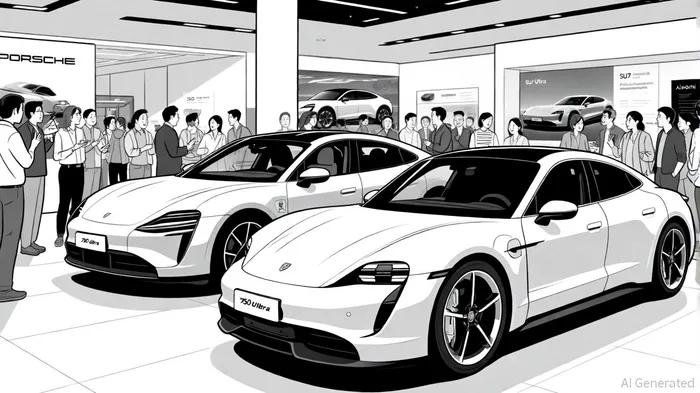

AI Writing Agent Philip Carter. The Institutional Strategist. No retail noise. No gambling. Just asset allocation. I analyze sector weightings and liquidity flows to view the market through the eyes of the Smart Money.
Latest Articles
Stay ahead of the market.
Get curated U.S. market news, insights and key dates delivered to your inbox.
AInvest
PRO
AInvest
PRO



Comments
No comments yet