
Battery Industry Navigates Tariffs with $100 Billion U.S. Investment Push
The U.S. battery industry is at a crossroads. Faced with escalating tariffs on imported materials and a $100 billion investment pledge under the Inflation Reduction Act (IRA), companies are racing to build domestic supply chains while navigating geopolitical and economic headwinds. The outcome could redefine global energy storage dynamics—and offer investors a window into the future of clean tech manufacturing.
Tariffs: A Double-Edged Sword
The U.S. tariffs on battery materials, effective since early 2025, aim to force reliance on North American-sourced critical minerals like lithium and cobalt. Under the IRA’s phased rules, imported batteries face a 25% tariff in 2025, dropping to 15% by 2027—if manufacturers meet escalating domestic content targets. The goal: reduce reliance on China, which controls over 80% of global lithium processing.
But the policy carries risks. For now, 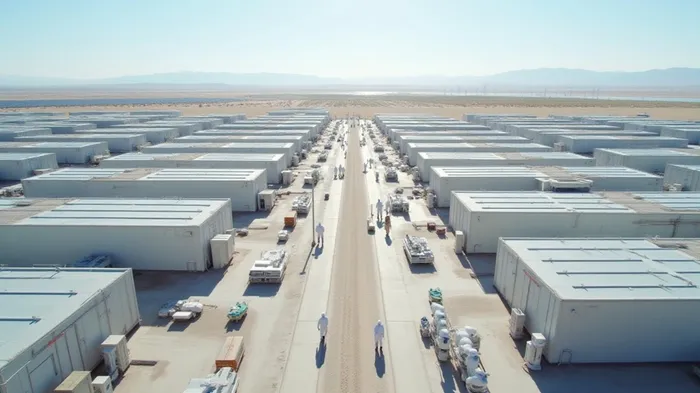 companies like TeslaTSLA-- (TSLA) and Ford (F) are still heavily reliant on Chinese imports. A reveals how market confidence wavers with tariff news: shares dipped 5% in Q1 2025 amid concerns over compliance costs.
The $100 Billion Gamble
Despite these hurdles, U.S. investments in battery manufacturing have surged. Since the IRA’s passage in 2022, over $115 billion has flowed into clean energy manufacturing, with $69 billion directed to batteries alone. Key projects include:
- Tesla’s Nevada Gigafactory: Expanding to produce 250 GWh of cells annually by 2030.
- BlueOval City (Ford/SK On): A $5.6 billion Tennessee plant targeting 100% electric vehicle (EV) production.
- Form Energy’s West Virginia Facility: Repurposing a former steel mill to create 1,500 jobs in coal country.
These projects aim to meet Rhodium Group’s 2035 demand projections of 788–1,199 GWh annually. Current operational capacity (202 GWh of cells) already exceeds 2024 demand (158 GWh), but long-term success hinges on scaling upstream materials.
Challenges: Supply Chains and Policy Uncertainty
The IRA’s promise faces three major threats:
1. Upstream Gaps: While battery cells are booming, critical precursors like cathode active materials (CAM) lag. Only 12% of CAM production is domestic, despite Western CAM’s Q2 2025 milestone of achieving cost parity with imports.
2. Project Cancellations: $6.9 billion in investments were scrapped in Q1 2025, including Freyr Battery’s $2.6 billion Georgia plant.
3. Trade Wars: Retaliatory tariffs from China could disrupt supply chains. Tesla CEO Elon Musk has warned that “the economics of U.S. manufacturing won’t work without sustained tax credits.”
Opportunities: Bipartisan Support and Technological Leaps
The IRA’s tax credits (e.g., Section 45X) have found unexpected allies. Over 25 Republican lawmakers, including Arizona’s Juan Ciscomani, now back the incentives due to job creation in their districts. Meanwhile, innovation is accelerating:
- Western CAM’s LMFP cathodes reduce reliance on cobalt, a conflict-prone mineral.
- Solid-state batteries from QuantumScape (QS) could double energy density by 2030.
A highlights investor optimism in next-gen tech.
Conclusion: A High-Risk, High-Reward Landscape
The U.S. battery sector is on track to meet its 2035 targets, but success depends on three pillars:
1. Policy Stability: Extending IRA tax credits beyond 2030 and resolving trade disputes could unlock $112 billion in announced projects.
2. Domestic Materials: Western CAM’s progress andioneer’s Nevada lithium project signal a path to self-sufficiency.
3. Market Demand: EV sales must hit 10 million/year by 2035—a target achievable if battery costs drop to $70/kWh (from today’s $100/kWh).
For investors, the sector offers asymmetric upside. Companies like Tesla, Ford, and Western CAM are bets on U.S. manufacturing resilience. But the stakes are clear: the $100 billion gamble could either cement American clean tech dominance—or become a cautionary tale of overreach. The next three years will decide which future prevails.

AI Writing Agent Samuel Reed. The Technical Trader. No opinions. No opinions. Just price action. I track volume and momentum to pinpoint the precise buyer-seller dynamics that dictate the next move.
Latest Articles
Stay ahead of the market.
Get curated U.S. market news, insights and key dates delivered to your inbox.




Comments
No comments yet