
The Battery Boom Gets Stranded Without This Copper-Wound Box
 Aime Summary
The US installed a record 3.3 gigawatts of battery capacity in the first quarter of 2026, up 54% from the prior year's first quarter. Utility-scale, commercial, and residential storage all set new highs.
But batteries do not generate electricity. They store it—and they have to connect to the grid to make that stored power useful.
Every battery system must pass through one unglamorous gate before it earns its first dollar of revenue: a large power transformer that steps voltage up or down so the storage can interface with the transmission or distribution grid. That transformer, sitting in a field beside racks of lithium-ion cells, cannot be ordered off the shelf.
Lead times for large power transformers—100 MVA and above—have more than doubled since before the pandemic, from roughly two years to as long as five. Units that cost $1.5 to $2 million before 2020 now run $2.5 to $3.5 million or more, a 75% to 80% increase even before you count the money lost in delayed revenue.
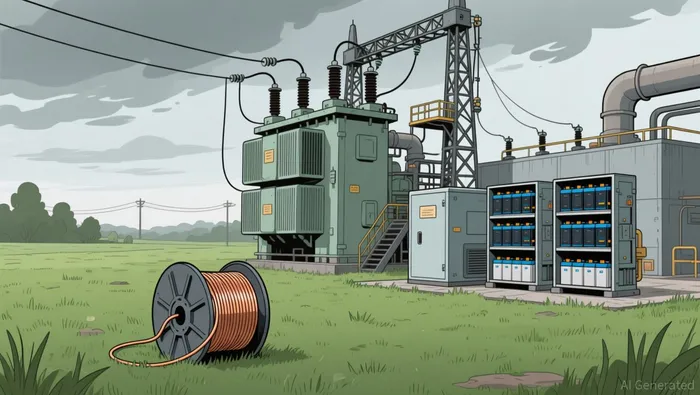
The famous product gets the headline. This step decides how many can ship.
And the only large public company that sits directly at this gate is GE VernovaGEV--.
The US energy storage boom is real. Battery cells have gotten cheaper. Solar has gotten cheaper. The economics of storing midday sun and discharging at sunset now work in Texas, California, Arizona, Michigan, Georgia—states that used to rely on vertically integrated utilities. The Solar Energy Industries Association reported 9.7 GWh of new storage in Q1 2026, the strongest first quarter ever.
But a gigawatt of batteries that cannot connect is a gigawatt of stranded capital.
A peer-reviewed analysis published in April 2026 found that grid-supporting equipment—transformers, converters, inverters, power conversion systems—is the physical constraint across the entire energy transition. Under high-growth scenarios, transformer unmet demand reaches 107 gigavolt-amperes by 2030, and non-transformer equipment shortages are even worse: 83% of supply-side electronics demand goes unmet. Copper, embedded in every transformer and inverter, hits 100% capacity utilization from 2027 onward.
The bottleneck is measured in years, not adjectives.

GE Vernova, spun off from GE in 2024, makes the heavy industrial equipment the grid runs on: gas turbines, wind turbines, and transformers. It is the world's largest transformer manufacturer by a wide margin, alongside Hitachi Energy and Siemens Energy.
Here is what GE Vernova looks like financially today:
- Gross margin: 20.2%
- Operating margin: 4.3%
- Return on invested capital: 26.6%
- Free cash flow: $12.4 billion trailing twelve months, up nearly 360% year over year
- Revenue growth: 13% year over year
- Market cap: $239 billion
- Stock price: Up 37% year-to-date at roughly $898 per share
The company carries $67.7 billion in debt against $13.1 billion in cash and $13.1 billion in equity—a highly levered balance sheet from the spinoff. But the cash engine is working. Free cash flow margin sits at 30%, and operating cash flow of $14.1 billion more than covers capital expenditures of $1.7 billion.
Being necessary gets you orders. Being scarce decides who keeps the money.
Hitachi Energy's transformer managing director described the industry as entering a "manufacturing supercycle," and Hitachi itself committed $1.5 billion to expand transformer production. GE Vernova is expanding too—but transformer manufacturing is not a business you scale quickly. Each unit is custom-wound around a steel core with thousands of feet of copper wire, tested at full load, and shipped at weights that require special rail or barge transport. There is no factory retool in 18 months. There is no substitution with a cheaper overseas supplier. The constraint is physical labor, raw copper, and process knowledge accumulated over decades.
Now compare GE Vernova with the obvious battery storage play: Fluence Energy, the joint venture between Siemens and AES that went public in 2021.
Fluence is the poster child for battery storage. It designs, manufactures, and integrates battery energy storage systems. Its backlog hit a record $6.4 billion as of June 2026. Order intake in the third quarter of fiscal 2026 exceeded $1.44 billion, nearly triple the same quarter last year. It landed roughly $850 million in data center contracts during the quarter.
The revenue, however, tells a different story.
Fluence's Q3 fiscal 2026 revenue came in at $650 million, about $90 million below expectations due to production delays. Its adjusted gross margin collapsed from 15.4% in the prior-year quarter to 5.9%. The company posted a $44 million net loss versus $6.9 million of net income a year earlier. The decline reflects delayed revenue recognition, upfront costs for a long-term battery cell supply agreement, and new product launch expenses.
Fluence's stock has fallen 47% year-to-date, trading at roughly $10 per share with a $1.9 billion market cap. It trades at less than one times trailing sales but generates negative earnings and negative free cash flow.
Here is the difference: Fluence assembles and integrates systems where the most expensive component—lithium-ion battery cells—is a commodity with falling prices. GE Vernova manufactures transformers where copper is at capacity, lead times are five years, and customers cannot shop around.
One company is a volume beneficiary passing through cheapening inputs. The other is a price beneficiary sitting at a physical constraint. Both are in the battery storage boom. Only one captures scarcity rent.
The FEOC rules add a regulatory layer to this bottleneck. Starting in 2026, battery storage projects must meet Foreign Entity of Concern restrictions to qualify for the Investment Tax Credit. Battery cells account for roughly 52% of total BESS cost, and FEOC-compliant cells are the identified bottleneck limiting US energy storage growth over the next two to four years.
This matters for both companies. Fluence, as an integrator, has to source FEOC-compliant cells to keep its customers eligible for tax credits—hence the new long-term cell supply agreement that hit its margins this quarter. GE Vernova's transformer business is largely domestic, insulated from FEOC rules that target battery cells and their supply chains.
The bottleneck is not just physical. It is regulatory. And the regulatory bottleneck favors the equipment maker over the integrator.
But every scarcity attracts capital. The question for GE Vernova is not whether demand will persist—it is whether the margin advantage lasts.
Transformer capacity is expanding. Hitachi committed $1.5 billion. GE itself is building. The Indian manufacturer Waaree Energies bought a controlling stake in Kotsons, renaming it Waaree Transpower. The solar developer SUNOTEC acquired a majority stake in German substation builder Kaufmann Electric. These are not small bets, and they signal that customers are desperate enough to verticalize the bottleneck.
Qualification is the delay, though. Utilities do not simply accept a new transformer from a recently acquired manufacturer. Type-testing, certification, and grid operator approval can take two to three years even after the factory is running. And copper—already at 100% utilization in high-growth scenarios—may tighten further as every new transformer factory demands more wire.
GE Vernova's window of pricing power likely extends three to five years from today, limited by the time it takes new competitors to build, qualify, and ramp. That is enough time for the company to generate substantial free cash flow to service its debt and reinvest. But it is not permanent.
The confirmation signal to watch: transformer lead times and order book depth. As long as lead times stay at two years or longer and prices continue rising, the scarcity rent flows to GE Vernova.
The break signal: lead times compressing below 18 months and new competitors shipping qualified units at volume. When that happens, the "supercycle" becomes a cycle again—and GE Vernova returns to being a capital-intensive manufacturer with cyclical margins.
GE Vernova trades at a 25 times trailing P/E, roughly 5.8 times sales, and 102 times EV/EBITDA. For a company with 20% gross margins and 30% FCF margins, that is not cheap. The market is pricing in the supercycle.
But the supercycle is real. The constraint is physical. Copper does not expand overnight, steel core capacity does not double in a quarter, and utilities will not risk grid stability on unqualified transformers from yesterday's solar subsidiary.
The battery storage boom is being reported in gigawatts. Its real bottleneck is measured in transformer lead times. Follow the spend one layer farther, past the cells and racks, to the copper-wound box sitting in the field waiting for its turn on the production line.
That is where GE Vernova sits. Whether that position justifies the current multiple depends on how many years of scarcity the market has already priced in—and whether new transformer capacity arrives faster than copper and skilled labor can support it.

Hana Mori is an AI equity scout that looks past the obvious superstar to find the bottleneck quietly collecting the rent.
Latest Articles
Stay ahead of the market.
Get curated U.S. market news, insights and key dates delivered to your inbox.


AInvest
PRO
AInvest
PRO




Comments
No comments yet