
The Battery Boom: How Policy and Tech Are Fueling Renewable Storage's Golden Age
The world's shift to renewable energy hinges on solving a critical problem: how to store the sun's power on a cloudy day or the wind's energy when it's calm. As solar and wind capacity surges—global installations hit record highs in 2024—grid-scale energy storage has emerged as the linchpin of the clean energy transition. This is no longer a niche sector: it's a multitrillion-dollar opportunity, driven by technological breakthroughs and unprecedented policy support. Investors who act now can secure stakes in companies positioned to dominate what will soon be a mainstream market.
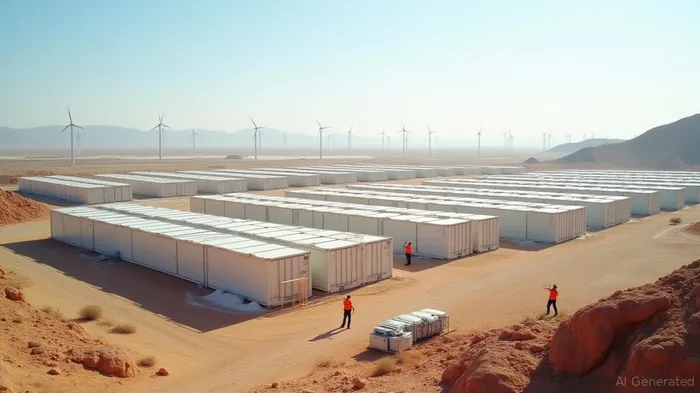
Technological Breakthroughs Powering the Shift
The energy storage revolution is being propelled by rapid advancements in battery technology. Lithium-ion costs have plummeted by over 90% since 2010, making large-scale deployments economically viable. Companies like TeslaTSLA-- (TSLA) and China's CATL are scaling up production of next-gen batteries, while innovations in solid-state and sodium-ion technologies promise even greater efficiency and safety. Beyond chemistry, AI-driven grid management systems are enabling utilities to optimize storage usage in real time, reducing waste and increasing reliability.
But the most transformative leap is in long-duration energy storage (LDES)—systems capable of storing energy for days, not hours. Projects like the UK's Long Duration Electricity Storage (LDES) scheme are incentivizing breakthroughs in molten salt thermal storage and advanced compressed air systems, which could finally solve the problem of seasonal energy storage for regions with intermittent renewables.
The market is projected to grow from $13 billion in 2020 to $45 billion by 2025, with lithium-ion batteries dominating but LDES solutions gaining traction.
Policy Winds at the Back
Governments worldwide are accelerating this transition through mandates and subsidies. The U.S. Inflation Reduction Act (IRA) and the newly updated Senate tax bill have created a gold rush for storage by extending tax credits for projects through 2033—longer than for solar or wind. These credits, combined with domestic content requirements (like the 75% U.S.-Mexico-Canada mineral sourcing rule by 2031), are reshaping supply chains and creating opportunities for companies like Ambri (developer of liquid metal batteries) and Northvolt (Europe's lithium-ion giant).
In the EU, the Net-Zero Industry Act fast-tracks permits for storage projects, while the Critical Raw Materials Act ensures a stable supply of lithium and cobalt. The UK's LDES Cap and Floor Scheme, set to open applications in mid-2025, guarantees returns for long-duration projects, attracting capital to firms like Connected Energy. Meanwhile, China's Energy Law 2025 targets 40 GW of battery storage by year-end, fueling demand for CATL and BYD.
The Investment Case: Act Now or Be Left Behind
The urgency to invest is clear. Key deadlines loom:
- U.S. residential battery credits expire early 2026, while commercial incentives for storage are set to phase out by 2028.
- EU grid projects must secure funding by 2026 to meet 2030 targets of 1,500 GW storage capacity.
- Supply chain bottlenecks—like China's dominance in lithium refining—are being addressed, but companies meeting domestic content rules (e.g., Ameresco in the U.S.) have a first-mover advantage.
CATL's revenue has surged from $2.9 billion in 2018 to $40 billion in 2024, underscoring the sector's rapid expansion.
Where to Invest
1. Battery Manufacturers: CATL (China), Tesla (TSLA), and Northvolt (Europe) are scaling production to meet surging demand.
2. LDES Innovators: Companies like Ambri (solid-state) and Gravitricity (gravity storage) are solving the long-duration puzzle.
3. Grid Infrastructure Firms: Siemens Energy and ABB are integrating storage into smart grids, while NextEra EnergyNEE-- (NEE) is building utility-scale projects in the U.S.
4. Recycling Plays: Redwood Materials and Li-Cycle are critical to closing the lithium loop, reducing reliance on imports.
Risks to Consider
- Supply chain volatility: China's control over 60% of lithium refining poses geopolitical risks.
- Policy uncertainty: U.S. tax credits could face changes if control of Congress shifts in 2025 elections.
- Overvaluation: Some storage stocks may be ahead of earnings, requiring a focus on companies with contracted projects.
Final Call: The Clock Is Ticking
The window to invest in this sector's early growth phase is narrowing. By year-end 2025, major projects under the IRA and EU's COP29 pledge will be locked in, reducing opportunities for latecomers. Investors ignoring this transition risk missing one of the defining opportunities of the next decade. Act now—or risk being left in the dark when the lights go renewable.
TSLA's energy storage segment has grown from $2.3B to $11.5B in revenue since 2020, outpacing its automotive division's growth.

Stay ahead of the market.
Get curated U.S. market news, insights and key dates delivered to your inbox.




Comments
No comments yet