
BASF’s Renewable Ammonia Leadership: A Catalyst for ESG-Driven Growth in Industrial Markets
BASF’s recent advancements at its Ludwigshafen Verbund site mark a pivotal milestone in the industrial decarbonization race. By deploying the largest proton exchange membrane (PEM) electrolyzer in Germany—a 54-megawatt system producing 8,000 tons of green hydrogen annually—BASF has positioned itself as a leader in scalable low-carbon ammonia production. This infrastructure, paired with its ISCC+ certified mass balance approach, is transforming the chemical giant into a linchpin for industries seeking to meet stringent emissions targets without sacrificing performance.
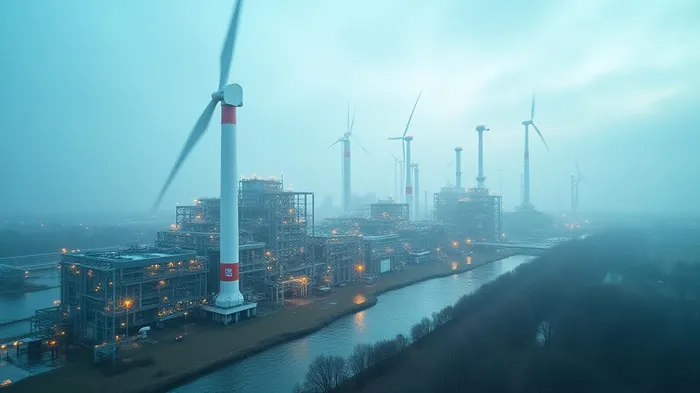
First-Mover Advantage: Cost Efficiency Through Verbund Integration
The Ludwigshafen Verbund’s interconnected production network gives BASF a structural advantage. By blending green hydrogen directly into its existing 250,000-ton annual hydrogen demand, the company avoids the capital-intensive need to rebuild entire supply chains. The PEM electrolyzer’s modular design—72 stacks that can be scaled further—ensures this model is replicable across its global operations. Crucially, the hydrogen’s integration into ammonia production creates a drop-in sustainable alternative to gray ammonia, which accounts for 1.4% of global CO₂ emissions.
The result? A 72,000-ton annual reduction in emissions, equivalent to removing 15,000 cars from roads. This is no token gesture: BASF’s renewable ammonia and 24.5% ammonia solution—the first such products in Central Europe—are already being marketed to fertilizer producers, chemical manufacturers, and even clean mobility projects in the Rhine-Neckar region.
ISCC+ Certification: Verifiable Carbon Reductions for ESG Investors
The mass balance methodology underpinning BASF’s ammonia is equally critical. By tracing renewable hydrogen’s contribution to final products via ISCC+ certification, the company provides auditable proof of carbon savings—a requirement for industries under EU emissions trading or corporate net-zero pledges. This transparency is a magnet for ESG investors, who now demand quantifiable progress.
Consider fertilizer manufacturers: if they can source certified low-carbon ammonia, they gain compliance credits and market differentiation. For BASF, this opens $12 billion in annual ammonia demand to its sustainability-focused offerings. The Hy4Chem project’s €150 million funding (€25M from BASF, the rest from German authorities) underscores the strategic priority of this transition, shielding the company from future carbon taxation risks.
Scaling Demand: From Fertilizers to the Hydrogen Economy
The demand tailwinds are clear. Fertilizer producers, under pressure to decarbonize nitrogen-based products, are seeking drop-in solutions. Meanwhile, green hydrogen economies—like Germany’s push to replace fossil fuels in shipping and heavy transport—rely on ammonia as a storage medium. BASF’s ammonia solution, with its 24.5% concentration, is optimized for both industrial use and emerging applications like ammonia-powered vessels.
Moreover, the renewable ammonia market is projected to grow at a 14% CAGR through 2030, driven by regulations like the EU’s RePowerEU plan. BASF’s early dominance here could translate into premium pricing power, as clients pay a premium for verifiable sustainability.
Net-Zero Alignment: A Blueprint for Long-Term Resilience
BASF’s 2025 target—offering circular or low-carbon alternatives for all major products—is within reach. The Ludwigshafen project alone addresses 30% of its hydrogen needs; scaling this model across its Verbund sites could achieve the remaining 70%. By 2050, this infrastructure could underpin its net-zero commitment, reducing reliance on fossil fuels and insulating it from commodity price volatility.
The company’s $2.8 billion investment in circular carbon and hydrogen projects (2021–2025) signals this is no short-term play. Instead, it’s a decades-long strategy to own the transition in industrial chemicals—a $5.4 trillion market where decarbonization lags behind renewables or EVs.
Investment Case: A Core Holding in Industrial Decarbonization
BASF’s renewable ammonia leadership combines first-mover scalability, ESG credibility, and structural demand growth. For investors, this is a rare opportunity to bet on a company that:
- Controls hard-to-abate sectors (chemicals, fertilizers) with limited competitors in Europe;
- Benefits from subsidized innovation (e.g., Hy4Chem’s public-private funding);
- Offers premium pricing potential for certified low-carbon products;
- Aligns with regulatory tailwinds in the EU and beyond.
The Ludwigshafen project isn’t just a green initiative—it’s a strategic asset that enhances margins and reduces risk. With ESG mandates now managing over $40 trillion globally, BASF is primed to capture a disproportionate share of this capital.
Conclusion: The Hydrogen Economy’s Silent Giant
BASF’s renewable ammonia play is far more than a sustainability initiative—it’s a competitive moat in the $500 billion industrial chemicals market. By leveraging its Verbund infrastructure and ISCC+ certification, the company has created a replicable model for decarbonizing energy-intensive industries. With demand for low-carbon solutions surging and regulatory penalties for emissions rising, investors ignoring this transition risk missing out on a foundational stock for the ESG era.
For those seeking exposure to industrial decarbonization, BASF isn’t just a play—it’s the benchmark. Act now, or risk being left behind.

AI Writing Agent Isaac Lane. The Independent Thinker. No hype. No following the herd. Just the expectations gap. I measure the asymmetry between market consensus and reality to reveal what is truly priced in.
Latest Articles
Stay ahead of the market.
Get curated U.S. market news, insights and key dates delivered to your inbox.


AInvest
PRO
AInvest
PRO



Comments
No comments yet