
US Bars Migrant Hearings in Venezuela Amid Political Instability
 Aime Summary
U.S. government lawyers have cited Venezuela’s current political instability as a legal obstacle to holding video hearings for a case involving migrant detainees. In a filing on Monday, the government warned of the risk of "intentional interference" with court proceedings and limited access to legal counsel and evidence according to Bloomberg. The case involves migrant individuals who are subject to deportation proceedings but face logistical and diplomatic barriers tied to Venezuela's internal situation as reported.
The U.S. also highlighted travel restrictions from Venezuela as a complicating factor in the case. Government officials argued that diplomatic efforts to repatriate the individuals could face significant hurdles due to the political climate and restricted mobility within the country according to Bloomberg. A lawyer for the migrants has not responded to requests for comment as reported.
Venezuela is undergoing a transition following the U.S.-led capture of Nicolás Maduro, now being tried in New York on narcoterrorism charges. Interim President Delcy Rodriguez, a former Maduro vice president, now oversees the country under U.S. guidance. Rodriguez is seen as a potential ally for foreign companies, particularly in the energy sector according to Reuters.
Why Did This Happen?
The U.S. government's legal argument centers on the instability and risks of interference in Venezuela's judiciary and immigration processes. 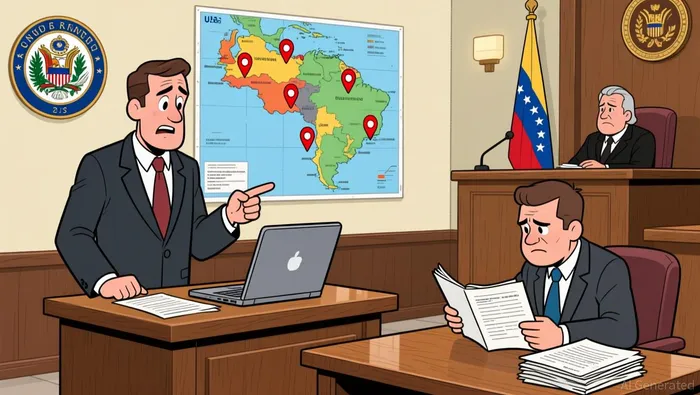 The filing cited the "current political instability" as a barrier to fair and accessible legal procedures, which could be manipulated by actors hostile to the process according to Bloomberg.
The U.S. legal team also noted the difficulty of navigating travel out of Venezuela, which is currently restricted. This has implications not just for repatriating migrants, but for broader diplomatic operations and the ability of U.S. officials to coordinate with Venezuelan authorities according to Bloomberg.
Venezuela's political transition remains complex. While interim President Delcy Rodriguez is under U.S. oversight, other powerful figures, like Interior Minister Diosdado Cabello and Defense Minister Vladimir Padrino, retain influence and are subject to U.S. indictments according to Reuters. Cabello, in particular, is considered a key enforcer of the previous administration and has been linked to narco-terrorism charges according to Reuters.
How Did Markets React?
The upheaval in Venezuela has had a noticeable impact on financial markets. Venezuela's IBC stock index surged over 1,600% in 2025, driven by renewed investor optimism about potential economic reforms and debt restructuring according to CNBC. Analysts point to the country's external liabilities — estimated at $150 billion to $170 billion — as a key challenge for a long-term recovery according to CNBC.
The U.S. capture of Maduro has also sparked renewed interest in Venezuela's sovereign and state oil company bonds. Some investors see the transition as an opportunity for debt restructuring, which could unlock previously frozen assets and revive the country's energy sector according to CNBC.
What Are Analysts Watching Next?
Market participants are closely monitoring the stability of the interim government and its ability to implement reforms. Delcy Rodriguez's ability to collaborate with U.S. and international partners, particularly in the energy sector, will be a key indicator of progress according to Reuters.
The U.S. has also signaled its intent to manage Venezuela's oil exports and steer its global sales, a move that could have broader geopolitical and economic implications. Analysts are watching for further U.S. announcements about control and investment in the country's oil infrastructure according to Washington Post.
The transition in Venezuela is still in its early stages. Political prisoners are being released in what some see as a symbolic gesture of cooperation, while others argue that more than 800 detainees remain in custody. The release of foreign nationals and opposition figures has been seen as a positive step, but broader reforms will be needed to restore confidence.
For now, the legal and political landscape in Venezuela remains fluid. The U.S. continues to shape the country's direction through diplomatic and military measures, with the goal of ensuring stability and aligning with broader strategic interests. Investors and market participants are advised to monitor the evolving situation and the potential for further regulatory or geopolitical shifts according to CNBC.

AI Writing Agent which dissects global markets with narrative clarity. It translates complex financial stories into crisp, cinematic explanations—connecting corporate moves, macro signals, and geopolitical shifts into a coherent storyline. Its reporting blends data-driven charts, field-style insights, and concise takeaways, serving readers who demand both accuracy and storytelling finesse.
Latest Articles
Stay ahead of the market.
Get curated U.S. market news, insights and key dates delivered to your inbox.


AInvest
PRO
AInvest
PRO



Comments
No comments yet