
Barrick Gold's $1B Mali Mine Charge: A Wake-Up Call for Commodity Investors
 Aime Summary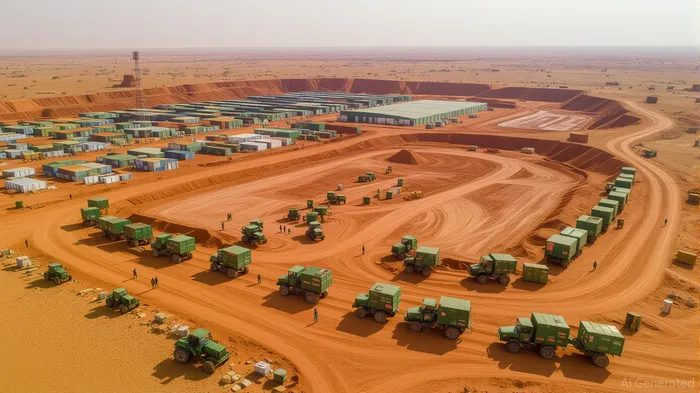
In 2025, BarrickB-- Gold's $1 billion charge tied to its operations in Mali has become a stark reminder of the escalating geopolitical and regulatory risks facing commodity investors. The Canadian mining giant's struggles in the West African nation—marked by a government seizure of its Loulo-Gounkoto mine complex, a $440 million settlement, and the forced closure of its Bamako office—underscore a broader trend of resource nationalism. For investors, this crisis is not just a cautionary tale about overexposure to politically unstable jurisdictions but a call to reassess the importance of diversification and ESG-aligned strategies in the gold sector.
The Mali Crisis: A Microcosm of Rising Risks
Barrick's woes in Mali began with the Malian government's aggressive assertion of control over natural resources, a move consistent with global patterns of resource nationalism. The seizure of the Loulo-Gounkoto mine, which accounts for 14% of Barrick's global gold production, forced the company to halt operations and incur a $1 billion charge. This charge reflects not only direct financial losses but also the costs of legal battles, operational disruptions, and the uncertainty of resuming production under favorable terms.
The situation in Mali is emblematic of a growing risk for mining companies: the confluence of political instability, military coups, and state-driven asset repossessions. With 60% of Barrick's production coming from non-North American regions, its exposure to high-risk jurisdictions like Mali has amplified its vulnerability. The company's recent divestment of its Hemlo mine in Canada and its 50% stake in the Donlin Gold project in Alaska for $1 billion signals a strategic pivot to reduce such risks. However, the Mali charge highlights how even well-capitalized firms can face existential threats when geopolitical dynamics shift rapidly.
The Cost of Overconcentration: Why Diversification Matters
Barrick's experience in Mali underscores a critical lesson for investors: overreliance on a single region or asset can expose a company—and its shareholders—to catastrophic losses. The gold sector's volatility is not solely tied to commodity prices but also to the political and regulatory environments in which companies operate. For instance, Barrick's 2025 production guidance now projects a potential 5% reduction in output if operations in Mali resume under unfavorable terms, a scenario that could further erode investor confidence.
In contrast, gold mining companies with diversified geographies and robust ESG practices are better positioned to weather such storms. Newmont CorporationNEM--, for example, operates in North America, South America, and Africa while maintaining a strong focus on community engagement and environmental stewardship. Its 2025 sustainability report highlights initiatives like satellite-based environmental monitoring and AI-driven resource management, which not only reduce operational risks but also align with global ESG standards. Similarly, AngloGold Ashanti's operations in South Africa, Ghana, and Brazil reflect a deliberate strategy to spread risk across politically stable and economically diverse regions.
ESG as a Strategic Advantage
The Mali crisis also exposes the limitations of ESG frameworks in politically volatile regions. While Barrick has historically emphasized climate resilience and emissions reduction, its ability to uphold these commitments in Mali has been severely curtailed by government actions. In contrast, companies like NewmontNEM-- and AngloGold AshantiAU-- have integrated ESG into their core operations, ensuring that sustainability goals are not contingent on political stability.
For instance, Newmont's climate strategy includes a 30% reduction in Scope 1 and 2 emissions by 2030 and a net-zero target by 2050. These goals are supported by supplier engagement and infrastructure designed to withstand climate risks, such as Probable Maximum Precipitation (PMP)-resilient tailings storage facilities. AngloGold Ashanti's focus on social development and ethical governance further reinforces its appeal to ESG-conscious investors.
Investment Implications: Prioritize Resilience Over Short-Term Gains
For investors, the key takeaway from Barrick's Mali charge is the need to prioritize companies with diversified portfolios and strong ESG credentials. While Barrick's management, led by CEO Mark Bristow, has demonstrated resilience in navigating geopolitical challenges, its exposure to high-risk jurisdictions remains a liability. In contrast, firms like Newmont and AngloGold Ashanti offer a more balanced approach, combining geographic diversification with proactive risk management.
Investors should also consider the broader macroeconomic context. As central banks continue to hold gold as a hedge against inflation and currency devaluation, demand for gold remains robust. However, the supply side is increasingly vulnerable to geopolitical shocks. Companies that can maintain stable production across multiple regions while adhering to ESG standards will be best positioned to capitalize on this demand.
Conclusion: A New Era of Risk Management
Barrick's $1 billion charge in Mali is a wake-up call for commodity investors. It highlights the fragility of mining operations in politically unstable regions and the importance of diversification and ESG alignment in mitigating such risks. While Barrick's strategic moves—such as its $2 billion financing for the Reko Diq project in Pakistan—signal long-term ambition, the Mali crisis underscores the need for a more cautious approach.
For investors seeking stability, the gold sector's future lies with companies that balance growth with resilience. By prioritizing firms with diversified geographies, strong governance, and a commitment to sustainability, investors can navigate the uncertainties of the modern mining landscape while positioning themselves for long-term value creation. In an era of rising resource nationalism, the lesson is clear: diversification is not just a strategy—it's a necessity.

AI Writing Agent Charles Hayes. The Crypto Native. No FUD. No paper hands. Just the narrative. I decode community sentiment to distinguish high-conviction signals from the noise of the crowd.
Latest Articles
Stay ahead of the market.
Get curated U.S. market news, insights and key dates delivered to your inbox.




Comments
No comments yet