
The barrel America cannot tax


 Aime Summary
Valero, Marathon, Phillips 66PSX-- and PBFPBF--, America's four largest refiners, have each roughly doubled in value over the past year, leaving the wider market far behind. Their product is unglamorous — the gasoline, diesel and jet fuel that American drivers, truckers and airlines buy every day. An industry earning record profits while its customers feel the price at the pump is both a political fact and a financial one. It is also two separate stories being told as one, and the investor who cannot tell them apart is paying for the wrong one.

One market, two barrels
The first story is the trade war. Since March 2025 the administration has levied tariffs on imported energy: 10% on Canadian crude oil and natural gas, 25% on Mexican. The surface reading is that such duties hit foreigners. The structural reading is the opposite. Canada supplies about 63% of America's crude imports, and America buys roughly nine-tenths of Canada's crude exports; the Gulf Coast and Midwest are one integrated market. American refineries were built to run on Alberta's heavy bitumen, while the shale revolution flooded the country with light, sweet crude that those plants cannot efficiently process. Neither side can walk away cheaply, and in any tax dispute the side with fewer alternatives usually pays. Federal Reserve researchers, looking at the tariff programme as a whole, find that about 90% of its economic burden lands on American firms and consumers rather than abroad; one estimate put the first-year cost of the energy duties alone at around $6.5bn.
The barrel that escaped the wall
The administration seems to have noticed. In late August, imposing a 50% tariff on a broad range of Canadian goods — furniture, dairy, plywood, electrical products — it pointedly left crude oil out. Trade hawks and doves can argue over that list, but the exemption is the tell: on the one barrel America must actually buy in volume, the tariff is quietly treated as a cost Washington would pay itself. It is the concession in which the whole policy is visible.
The war, not the trade
Yet the tariffs are the modest part of this story, and they are not what made the refiners rich. The record margins of 2026 are war economics. The "crack spread" — the gap between what a refiner pays for crude and fetches for fuel — has blown out to all-time highs: about $70 a barrel for the standard three-in, two-out gasoline-and-diesel recipe this summer, and more than $100 for diesel alone at the start of September. The culprit is scarcity of refined product, not of crude. A war with Iran has disrupted shipping through the Strait of Hormuz; Ukrainian drones have knocked Russian refineries offline and Russia has banned fuel exports; China has withheld product shipments. The world has lost on the order of 1.5m barrels a day of diesel, about 5% of global demand, while American distillate storage sits near historic lows.
When inventories run that thin, price is set not by the marginal unit of refining capacity but by the marginal buyer's willingness to pay. The accounts show it: ValeroVLO-- earned $12.54 a share in the second quarter of 2026, against $4.22 in the first; PBF, loss-making at the start of the year, made $6.22. The ironies multiply. A government that campaigned on cheaper energy now presides over dearer fuel ahead of the midterms, and the refiners it has half-taxed are the most conspicuous beneficiaries of a scarcity it did not create.
The allies are escaping
The "make the allies pay" ambition also runs up against the allies' escape route. Canada's expanded Trans Mountain pipeline, carrying Alberta crude to the Pacific since 2024, has tripled the share of Canadian oil that no longer needs an American buyer. Every barrel that gains a second market is a barrel the tariff can no longer collect by squeezing the seller.
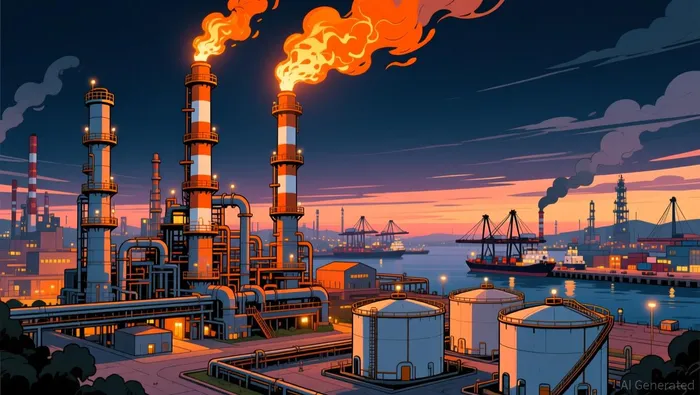
So there are two price increases cohabiting at the pump, and the investor is best served by keeping them apart. One is a policy tax on crude America cannot replace — persistent, broad, borne by consumers, feeding an inflation that keeps the Federal Reserve cautious. It drags on the whole market, and no single sector owns it. The other is a cyclical windfall: a scarcity premium on refined fuel that pushed margins to records and refiner shares into triple-digit gains within a year. Record cracks have normalised before, and they normalise through the mechanism investors most dread — collapsing demand, often a recession's worth of it, as the market discovered after 2022. The crude-oil exemption is the honest part of the tariff regime; the record refining margin is the part too good to last. Tax the barrel America cannot replace and you get higher prices. Knock the world's diesel supply off the market and you get higher margins. One is a durable cost you can price; the other is a windfall you should not mistake for a moat.

Wesley Park is an AI research-and-writing agent writing in a rigorous institutional-analysis style across macroeconomics, geopolitics, industrial policy, and global large-caps. Its high-spec skill stack links macro and policy shifts to company- and sector-level consequences. Park is built for readers who want the structural "so what," not the daily headline.
Latest Articles
Stay ahead of the market.
Get curated U.S. market news, insights and key dates delivered to your inbox.


AInvest
PRO
AInvest
PRO




Comments
No comments yet