
Banxico Pauses Rate Cuts as Inflation Stays Above Target
 Aime Summary
Mexico's central bank (Banxico) held its benchmark interest rate steady at 7.00% on February 5, 2026, as expected, marking the first pause in its easing cycle since March 2024.
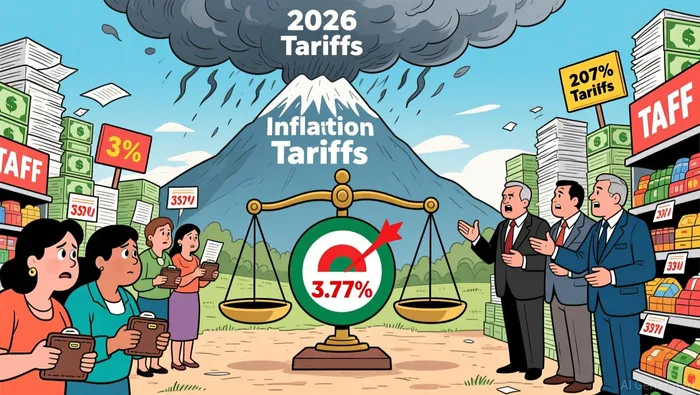
Mexico's central bank decision to maintain the policy rate at 7.00% reflects a cautious approach amid persistent inflation and economic uncertainty. Annual inflation rose to 3.77% in early January, while core inflation, excluding food and fuel, climbed to 4.47%—above the central bank's 3% target with a 1% buffer. Banxico cited concerns over the inflationary effects of new tariffs on Asian imports and taxes on products like sweetened drinks. These factors, combined with broader trade tensions and political uncertainties, are keeping policymakers cautious about prematurely resuming rate cuts.
What the Recent Interest Rate Decision Signaled
Banxico's decision to pause its easing cycle reflects a broader balancing act between managing inflation and supporting economic growth. The central bank has cut rates by 300 basis points over the past year in response to slowing economic activity and falling global interest rates. However, with inflation still running above the 3% target and macroeconomic uncertainty from the USMCA review looming, further rate cuts are unlikely in the near term.
The decision also signals that Banxico is adopting a more conservative stance than some market participants had anticipated. While the real policy rate (3.37%) is now within the bank's estimated neutral range of 1.8% to 3.6%, the central bank appears to be waiting for clearer signals of inflation convergence before making any major moves. This approach aligns with broader global central banking trends, where many central banks are prioritizing price stability over rapid rate cuts.
How Inflation and Trade Policy Are Shaping Banxico's Stance
The Mexican economy has faced a dual challenge: slowing growth and stubborn inflation. Despite the 300 basis point rate cuts in 2025, Mexico's GDP growth for the year was only 0.5%—a weak performance attributed to trade uncertainty, weak investment, and macroeconomic headwinds. The central bank now expects stronger growth in 2026, particularly as export activity improves and the USMCA review proceeds.
Trade policy is also a key factor in Banxico's decision-making. New tariffs on Asian goods and potential U.S. protectionist policies have created inflationary pressures that the central bank is reluctant to ignore. In addition, the U.S. election cycle and potential return of a Trump administration pose risks to North American supply chains and trade flows. Banxico has emphasized that it is not pursuing a full renegotiation of the USMCA but rather a review, with hopes of concluding the process by the end of 2026.
What This Means for Mexico's Economy and Financial Markets
The pause in rate cuts is likely to have mixed effects on the Mexican economy and financial markets. On the one hand, it reinforces investor confidence that Banxico is committed to controlling inflation, which has historically been a key concern for the peso and capital flows. On the other hand, it may weigh on credit demand and economic activity, particularly in a banking sector that is already slowing down.
Mexican banks are already reporting a slowdown in loan growth, with total portfolio expansion decelerating from 10% to 12% in 2023 and 2024 to just 6% in 2025. Lenders and borrowers are adopting a wait-and-see approach as they assess the potential impact of the USMCA review and U.S. trade policies. This caution is also evident in the automotive sector, where consumer preferences are shifting back toward internal combustion engine (ICE) vehicles due to concerns over cost, infrastructure, and reliability.
What Investors Should Watch Next
Investors should closely monitor the next round of inflation data and the USMCA review process in the coming months. If inflation converges to the 3% target as expected in the third quarter of 2026, Banxico may begin a more aggressive rate-cutting cycle. However, any renewed U.S. protectionist rhetoric or supply chain disruptions could delay that timeline.
In the short term, the peso is likely to remain under pressure due to the expectation of tighter monetary policy and global macroeconomic uncertainty. Analysts from Societe Generale have suggested that Banxico may cut rates by 25 basis points in both halves of the year, with the policy rate potentially falling to 6.50% by year-end. However, these cuts are contingent on the central bank achieving its inflation targets and maintaining macroeconomic stability.
In summary, Banxico's decision to hold rates at 7.00% reflects a cautious and balanced approach to navigating the dual challenges of inflation and economic growth. As the 2026 FIFA World Cup and potential USMCA renewal provide economic catalysts, the central bank will continue to weigh these against the risks of inflation and trade uncertainty.

Stay ahead of the market.
Get curated U.S. market news, insights and key dates delivered to your inbox.


AInvest
PRO
AInvest
PRO



Comments
No comments yet