
Banks Win as CPI Miss Fails to Guarantee Rate Cuts
 Aime Summary
The February CPI miss—headline inflation at 0.2% and core CPI at 0.3%, both below expectations—has reignited debates about the Federal Reserve's rate-cut timeline. While the market initially rallied, the euphoria faded as investors grappled with the reality that this miss, while welcome, isn't a green light for aggressive rate cuts. This moment demands a sharp focus on sector rotation, particularly between Banks and Food Products, where divergent dynamics are shaping 2026's investment landscape.
Banks: The Disinflationary Winners
Historical backtests from 2010 to 2025 reveal a clear pattern: Banks thrive in disinflationary environments. The S&P Bank Select Sector Index has averaged a 4.2% gain in the three months following a core CPI undershoot, outperforming healthcare and consumer staples. This resilience stems from two key drivers:
1. Net Interest Margin (NIM) Expansion: Lower inflation signals rate cuts, which reduce funding costs for banks while keeping loan yields stable. For example, the Bank Select Sector SPDR Fund (XLF) surged 6.3% in the wake of the November 2025 CPI miss, as investors anticipated Fed easing.
2. Loan Demand: Easier credit conditions boost borrowing for mortgages, small business loans, and consumer credit, directly benefiting banks' revenue streams.
The Fed's 2026 rate-cut projections (likely 2–3 cuts) further amplify this tailwind. Banks with strong balance sheets—like JPMorgan ChaseJPM-- (JPM) and CitigroupC-- (C)—are positioned to capitalize on lower rates and improved credit demand. ETFs like the Invesco KBW Bank ETF (KBWB) offer broad exposure to this sector's potential.
Food Products: A Sector in Retreat
Contrast this with the Food Products industry, which has underperformed the S&P 500 by 96 percentage points over the past five years. The Grain-Based Foods Share Index (GBFSI) fell 9% from 2020 to 2025, despite food prices rising 3.0% in 2025. This disconnect highlights structural challenges:
- Cost-Pass-Through Struggles: While food-at-home prices rose 2.4% in 2025, companies like Conagra Brands (CAG) and Flowers Foods (ACI) failed to translate higher prices into profits due to input cost inflation and weak demand.
- Supply Chain Volatility: The 2022 HPAI outbreak and Russia-Ukraine war disrupted egg and poultry markets, yet companies like Bunge (BG) and Archer-Daniels-Midland (ADM) only saw modest rebounds in 2025.
Even as food-away-from-home prices surged 3.9% in 2025, restaurant chains like Denny's (DENN) and Bloomin' Brands (BLMN) faced margin compression from labor costs and shifting consumer preferences. The sector's reliance on inelastic demand and thin margins makes it a poor bet in a disinflationary environment.
Short-Term Tactics and Long-Term Resilience
Short-Term Positioning:
- Overweight Banks: Use the CPI miss to rotate into financials. A 2026 rate-cut cycle could expand NIMs by 30–50 basis points, directly boosting earnings.
- Underweight Food Products: Avoid overvalued food stocks. The sector's P/E ratio of 12x is 40% below its 10-year average, but earnings growth is unlikely to justify this discount.
Long-Term Outlook:
- Banks: Structural tailwinds—like AI-driven credit underwriting and a shift to variable-rate loans—will enhance resilience.
- Food Products: Structural headwinds persist. Rising input costs and regulatory pressures (e.g., ESG mandates) will weigh on margins unless companies innovate in cost efficiencies.
Conclusion: Rotate with the Fed's Narrative
The February CPI miss isn't a signal to panic but a call to recalibrate. Banks are the clear beneficiaries of a disinflationary narrative, while Food Products remains a sector in transition. As the Fed inches toward rate cuts, investors should tilt portfolios toward financials and away from food equities. The data is unambiguous: Banks are the 2026 story, and Food Products is a cautionary tale.
By aligning with the Fed's evolving policy and sector-specific fundamentals, investors can navigate 2026's inflationary uncertainty with confidence.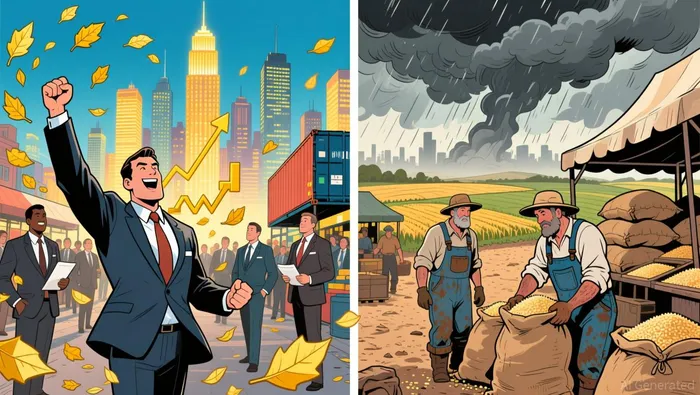

Stay ahead of the market.
Get curated U.S. market news, insights and key dates delivered to your inbox.


AInvest
PRO
AInvest
PRO



Comments
No comments yet