
Banks Thrive as Consumer Durables Stumble in Fractured Labor Market
 Aime Summary
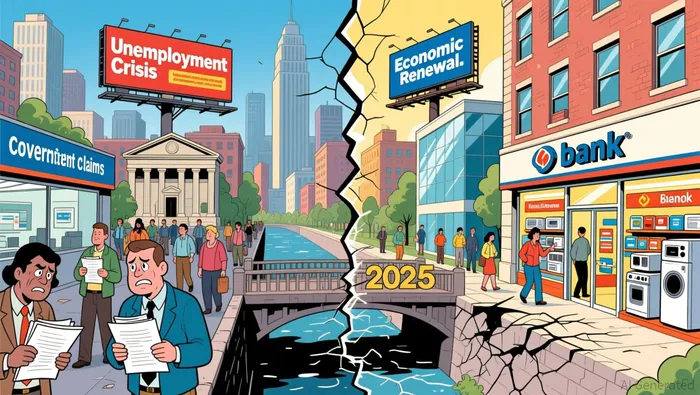
The U.S. labor market in late 2025 has become a battleground for investors navigating sector rotation strategies. Continuing jobless claims, which measure the number of individuals still receiving unemployment benefits, have surged to 2.15 million by January 2026—a 4% decline from October 2025's peak but still 1.2% higher than the same period in 2025. This data paints a mixed picture: while initial claims (new unemployment filings) have fallen to 219,000, signaling short-term labor market resilience, the rise in continuing claims highlights growing concerns about long-term unemployment and its ripple effects on consumer spending and credit risk.
For investors, this divergence creates a critical inflection point. The labor market's fragility is reshaping sector dynamics, with Banks emerging as a defensive play and Consumer Durables facing headwinds. Let's dissect the implications.
Banks: A Tailwind from Dovish Policy and Credit Stability
The Federal Reserve's dovish pivot in late 2025—marked by three consecutive rate cuts—has positioned the Banks sector as a beneficiary of accommodative monetary policy. With the Fed's benchmark rate now at 3.5%, banks are seeing improved net interest margins (NIMs) and a surge in loan demand. The S&P 500 Financials Index has gained 12% year-to-date, outperforming the broader market, as institutions like JPMorgan ChaseJPM-- (JPM) and Bank of AmericaBAC-- (BAC) capitalize on lower borrowing costs and a stable credit environment.
The labor market's “slow hiring, slow firing” dynamic—where employers retain workers but hiring slows—has helped contain credit risk. Unemployment remains at 4.4%, and while delinquency rates on consumer loans (credit cards, auto loans) are rising, they remain well below 2008 crisis levels. This stability allows banks to expand lending without a sharp spike in defaults. Regional banks with low-cost deposit bases, such as Wells FargoWFC-- (WFC) and CitigroupC-- (C), are particularly well-positioned to benefit from this environment.
Investors should consider broad exposure via the Financial Select Sector SPDR (XLF) or individual names with strong balance sheets. The Fed's projected 50-basis-point rate cut in early 2026 further solidifies the sector's favorable outlook.
Consumer Durables: A Sector on the Defensive
The Consumer Durables sector, however, faces a more challenging landscape. Weak labor market data—particularly the 4.6% unemployment rate in November 2025 and a declining labor force participation rate of 62.4%—has eroded consumer spending power. Real durable goods spending, which surged 3.1% in Q3 2025, is expected to contract to 1.5% in 2026 as inflation and higher interest rates dampen demand.
Home Depot (HD) and Lowe's (LOW), which rely heavily on discretionary spending for home improvement and appliances, have seen inventory-to-sales ratios rise to 1.37, signaling weak demand. Meanwhile, Deere & Co. (DE) reported mixed earnings in Q4 2025, with revenue growth outpacing earnings, highlighting sector-wide vulnerabilities.
The sector's exposure to cyclical demand makes it a prime candidate for underweighting. Investors should avoid overexposure to firms with high leverage or reliance on credit-driven purchases. Instead, focus on defensive plays like utilities or healthcare to balance risk.
Strategic Rotation: Balancing Risk and Reward
The key to navigating this environment lies in aligning sector allocations with macroeconomic signals. Banks, bolstered by dovish policy and stable credit conditions, offer a hedge against economic uncertainty. Conversely, Consumer Durables' reliance on fragile consumer demand makes it a high-risk bet.
Investors should also monitor alternative metrics, such as the four-week moving average of jobless claims and regional labor market data. For example, the DMV region's mixed performance—declining claims in Maryland and Virginia but rising in the District of Columbia—highlights the need for localized analysis.
Conclusion: Positioning for 2026
As the U.S. labor market enters a period of recalibration, sector rotation strategies must adapt. Banks, with their policy-driven tailwinds and stable credit profiles, are a compelling overweight play. Consumer Durables, meanwhile, requires caution as weak labor trends and inflationary pressures weigh on demand. By leveraging these insights, investors can navigate the evolving landscape with a disciplined, data-driven approach.

Stay ahead of the market.
Get curated U.S. market news, insights and key dates delivered to your inbox.


AInvest
PRO
AInvest
PRO



Comments
No comments yet