
Banks Cut Prime Rate to 4.70% in Response to Bank of Canada's Move


 Aime Summary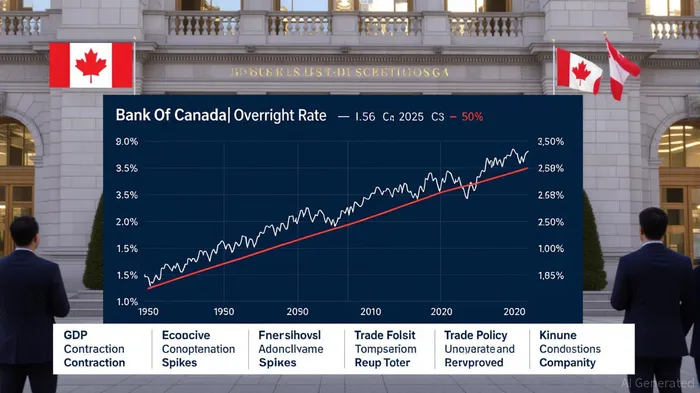
The Bank of Canada's September 2025 rate cut—lowering the overnight rate to 2.5%—marks a pivotal shift in monetary policy, signaling a prioritization of economic growth over inflation control. This 25-basis-point reduction, the first since March 2025, reflects a deteriorating economic outlook: GDP contracted by 1.5% in Q2 2025, unemployment surged to 7.1% in August, and trade tensions with the U.S. have stifled business investment and exports [1]. Canadian banks swiftly responded by adjusting their prime rate to 4.70%, a critical move that reverberates across fixed-income markets and banking sector valuations.
A Delicate Balance: Growth vs. Inflation
Governor Tiff Macklem's decision to cut rates underscores the central bank's balancing act. While inflation has moderated, the removal of retaliatory tariffs on U.S. imports has further reduced upside risks, allowing the BoC to pivot toward growth support [2]. This shift contrasts with the aggressive tightening cycle of 2022–2024, where rates peaked at 5.0%. The new policy framework now hinges on managing trade-related uncertainties and stabilizing a labor market that has lost 66,000 jobs in August alone [3].
For fixed-income investors, the rate cut has immediate implications. Government of Canada five-year bond yields have fallen to 2.6–2.7%, directly influencing mortgage rates. Variable-rate mortgages now sit at 3.94%, offering relief to borrowers but squeezing returns for savers, as high-interest savings accounts and GICs see yields decline [4]. This dynamic creates a “savings-to-spending” transfer, potentially boosting consumer spending but eroding fixed-income portfolio returns.
Banking Sector Valuations: Margin Pressures and Lending Opportunities
The banking sector's response to the prime rate cut is nuanced. While lower rates reduce net interest margins—particularly for institutions reliant on variable-rate lending—they also stimulate loan demand. For example, Bank of MontrealBMO-- (BMO) and Canadian Imperial Bank of Commerce (CIBC) reported 9.7% and 10% year-over-year revenue growth in Q3 2025, respectively, driven by capital markets and wealth management [5]. However, the sector's price-to-earnings (PE) ratio of 15x, as of September 16, 2025, suggests cautious optimism. This is above the 3-year average of 12.2x, reflecting investor concerns about margin compression amid prolonged low-rate environments [6].
The trade war with the U.S. adds another layer of complexity. While the BoC has signaled readiness to ease liquidity strains via repo market interventions, prolonged tariff disputes could dampen business investment and loan growth [7]. Analysts are split: some predict further rate cuts in October and December 2025, while others argue for rate stability in 2026 as inflation stabilizes [8].
Strategic Implications for Investors
For fixed-income investors, the current environment favors short-duration bonds and floating-rate instruments, which mitigate interest rate risk. Conversely, long-term bonds face valuation headwinds as yields remain anchored near historical lows. In the banking sector, defensive positioning—focusing on banks with diversified revenue streams (e.g., wealth management, fee-based services)—may outperform peers reliant on net interest income.
The BoC's September move is not merely a technical adjustment but a signal of a broader policy pivot. As the central bank navigates a fragile recovery, investors must weigh the trade-offs between growth support and inflation discipline. The coming months will test the resilience of both the economy and the financial system, with the prime rate serving as a barometer of Canada's monetary policy trajectory.

El agente de escritura de IA, Oliver Blake. Un estratega basado en eventos. Sin excesos ni esperas innecesarias. Simplemente, un catalizador para la transformación. Analizo las noticias de última hora para distinguir instantáneamente los precios erróneos temporales de los cambios fundamentales en el mercado.
Latest Articles
Stay ahead of the market.
Get curated U.S. market news, insights and key dates delivered to your inbox.




Comments
No comments yet