
Banks Bridge Public and Private Blockchains for 24/7 Real-Time Institutional Payments


 Aime Summary
Singapore's DBS Bank and JPMorgan's Kinexys are advancing a groundbreaking interoperability framework to enable cross-chain tokenized deposit transfers between their blockchain ecosystems, marking a significant step toward seamless institutional digital payments, according to a TradingView report. The collaboration, announced in late October, aims to bridge public and permissioned blockchains, allowing clients to execute 24/7 real-time settlements without relying on traditional financial infrastructure, as CoinDesk reported. This development aligns with a broader industry push to tokenize deposits, a trend gaining momentumMMT-- as major banks seek to leverage blockchain for faster, more efficient transactions, according to a LookonChain feed. 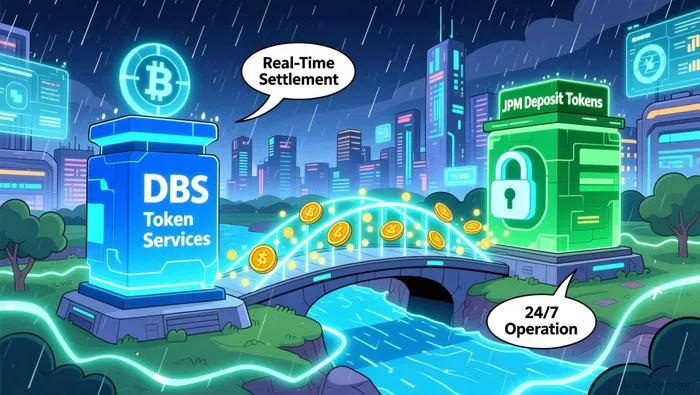 By creating a bi-directional interoperability layerLAYER--, the banks aim to expand access for institutional clients, enabling them to transact across both systems while maintaining the integrity of their underlying value, as CoinDesk reported.
The framework will connect DBS Token Services—operating on a permissioned blockchain—with JPM Deposit Tokens built on Ethereum's Layer 2 network, Base, according to the TradingView report. This integration addresses longstanding challenges in cross-chain interoperability, which has historically limited the utility of tokenized assets due to technical barriers and security risks, as LookonChain noted. Naveen Mallela, global co-head of Kinexys, emphasized the initiative's potential to set new standards for tokenized deposits. "Working with DBS is a clear example of how financial institutions can collaborate to further the benefits of tokenized deposits for institutional clients while protecting the singleness of money and ensuring interoperability across markets," he stated in the TradingView report. The project builds on both banks' existing capabilities: DBS and JPMorganJPM-- already offer real-time payment settlements within their respective blockchain networks, but this collaboration extends those services to cross-border, cross-chain transactions, as CoinDesk reported.
The move underscores a growing appetite for tokenized deposits among global financial institutions. Last month, BNY Mellon, the world's largest custodian by assets under custody, was reported to be exploring similar services, according to the TradingView report. In the UK, Barclays, Lloyds, and HSBC recently launched a pilot for tokenized sterling deposits, backed by Bank of England Governor Andrew Bailey, as LookonChain noted. According to a 2024 report by the Bank for International Settlements (BIS), nearly one-third of surveyed jurisdictions have already piloted or researched tokenized deposit systems, as the TradingView report notes.
JPMorgan's foray into tokenization has been methodical. The bank recently issued a USD deposit token on Coinbase's Base blockchain, signaling its intent to engage with decentralized finance (DeFi) ecosystems, as CoinDesk reported. This latest partnership with DBS could further cement JPMorgan's role in bridging traditional and digital financial systems. For DBS, the collaboration reinforces its position as a regional innovator, having previously experimented with blockchain-based trade finance and cross-border payments, as LookonChain noted.
The initiative also aligns with broader regulatory developments. The European Union's Markets in Crypto-Assets (MiCA) framework and evolving policies in the U.S. and Asia-Pacific are creating a more structured environment for tokenized assets, as the TradingView report states. As institutions like BNY Mellon and the UK banks demonstrate, tokenized deposits could revolutionize collateral management, margin posting, and settlement processes, reducing counterparty risk and operational complexity, as the TradingView report notes.

Comprender rápidamente la historia y el contexto de distintas monedas conocidas
Latest Articles
Stay ahead of the market.
Get curated U.S. market news, insights and key dates delivered to your inbox.
AInvest
PRO
AInvest
PRO



Comments
No comments yet