
BankrCoin Surges Amid AI Crypto Rally as Banks Expand Bitcoin Services
 Aime Summary
Over 60% of the top 25 U.S. banks now offer BitcoinBTC-- custody or trading services, primarily for high-net-worth clients according to reports.
BankrCoin (BNKR) and Pippin (PIPPIN) have surged by over 87% and 57%, respectively, as part of a broader AI crypto rally according to market analysis.
Bittensor (TAO) has rebounded above $240, driven by renewed retail and institutional interest in AI-focused crypto tokens according to price forecasts.
The expansion of Bitcoin services among major U.S. banks marks a key milestone in institutional acceptance of cryptocurrencies. As of January 27, 2026, institutions like JPMorgan ChaseJPM--, CitigroupC--, and Morgan StanleyMS-- are offering access to Bitcoin services, including custody and trading, for select clients according to industry reports. This shift reflects a growing appetite for digital assets within the banking sector and aligns with broader efforts to modernize financial infrastructure and meet client demand for alternative assets.
Simultaneously, the AI crypto sector is experiencing a surge in momentum. Tokens like BankrCoin (BNKR) and Pippin (PIPPIN) have posted significant gains, with BNKR rising over 87% to $0.005 and Pippin climbing by 57% to $0.49 according to trading data. These movements are part of a broader market trend where investors are seeking exposure to AI-driven innovations in blockchain and enterprise software. BittensorTAO-- (TAO), a leading AI crypto token, has reclaimed $240 amid rising optimismOP--, supported by growing open interest in derivatives markets and favorable technical indicators 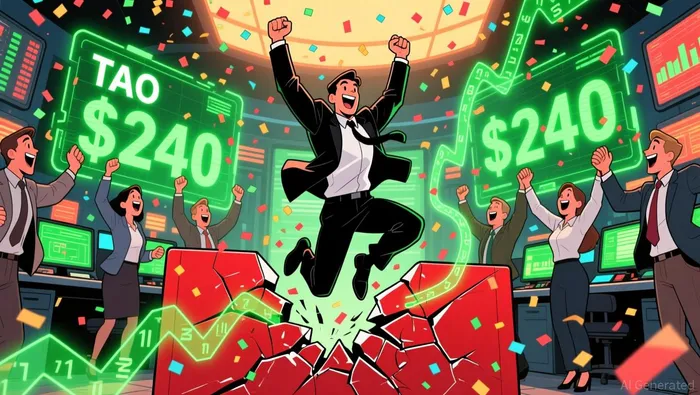 according to market analysis.
The convergence of institutional and retail investor interest in both traditional and AI-focused cryptocurrencies highlights the evolving landscape of digital asset adoption. Morgan Stanley's recent appointment of Amy Oldenburg to lead its digital asset strategy underscores the bank's commitment to expanding into the crypto space. The firm is preparing a crypto wallet for its wealth management clients and has filed for spot Bitcoin and SolanaSOL-- ETFs according to company announcements. These moves signal a broader institutional embrace of digital assets and could influence market dynamics as more traditional financial players enter the space.
What Drives the AI Crypto Surge?
The AI crypto rally has been fueled by a combination of technological optimism and macroeconomic factors. Investors are increasingly viewing AI-focused tokens as proxies for the future of automation and enterprise software innovation according to market analysis. This perception has been reinforced by the surge in open interest and positive price momentum for tokens like TAOTAO-- and BNKR. Additionally, the Federal Reserve's upcoming monetary policy decisions have added a layer of uncertainty, prompting traders to seek assets that could outperform in different interest rate scenarios according to economic analysis.
How Are Traditional Banks Responding to Crypto Growth?
Traditional banks are responding cautiously but strategically to the rising demand for crypto services. Institutions are prioritizing high-net-worth and institutional clients while testing compliance frameworks and infrastructure according to industry reports. This approach reflects the regulatory uncertainty surrounding digital assets and the need to manage risk while capitalizing on opportunities. The banks' limited access model also highlights the ongoing tension between traditional financial institutions and crypto exchanges, particularly around legislative proposals like the CLARITY Act according to market analysis.
What Risks and Limitations Exist in This Market?
Despite the positive momentum, several risks remain. The crypto market is still highly volatile, and sudden shifts in regulatory or macroeconomic conditions could trigger corrections. For example, if the Federal Reserve signals a hawkish stance on inflation, it could dampen investor risk appetite and impact crypto prices according to market forecasts. Additionally, the limited access model offered by banks means that most retail investors are still excluded from direct exposure, which could create market imbalances over time. As the sector evolves, clearer regulatory frameworks and broader institutional participation will likely play key roles in shaping long-term outcomes.

Blending traditional trading wisdom with cutting-edge cryptocurrency insights.
Latest Articles
Stay ahead of the market.
Get curated U.S. market news, insights and key dates delivered to your inbox.


AInvest
PRO
AInvest
PRO



Comments
No comments yet