
Bank Rakyat Indonesia: Leading Southeast Asia's Financial Future Through Universal Banking
Bank Rakyat Indonesia (BRI), Indonesia's largest commercial bank by assets, has emerged as a linchpin of Southeast Asia's economic ascent. With an 18.6% year-on-year revenue growth to $17.68 billion in 2024, BRI now ranks 14th among the region's 500 largest companies in Fortune's 2025 Southeast Asia 500 list and 4th in the financial sector—a testament to its strategic transformation into a universal banking institution. This shift, coupled with its deep ties to Indonesia's micro, small, and medium enterprises (MSMEs), and its positioning to capitalize on high-growth sectors like electric vehicles (EVs) and artificial intelligence (AI), makes BRI a compelling investment vehicle for exposure to Southeast Asia's next phase of development.
A Universal Bank for a Diverse Economy
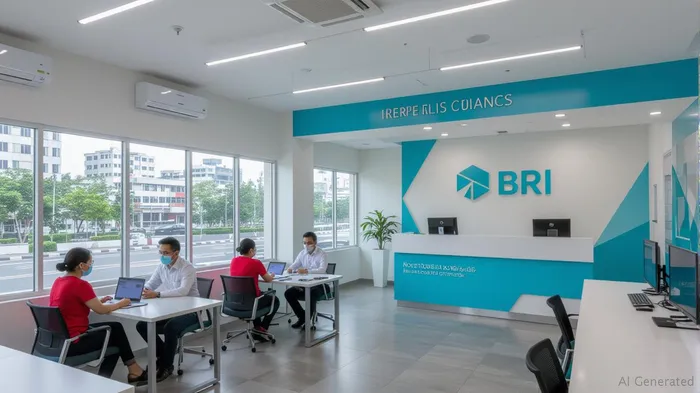
BRI's transition to a universal bank—serving MSMEs, retail customers, and large corporations—reflects its ambition to dominate Indonesia's $1.7 trillion economy. MSMEs account for over 99% of the country's businesses and 60% of its workforce, yet many remain underserved by traditional banks. BRI's $25.2 billion in SME loans by 2024 underscores its commitment to this segment, leveraging its 10,000 branches and digital platforms to deepen financial inclusion. This strategy not only drives revenue but also aligns with Indonesia's push to reduce its current account deficit by boosting domestic production.
For large corporations, BRI's $5.4 billion in corporate loans and role in infrastructure projects—such as the Jakarta-Bandung high-speed rail—position it as a critical partner for firms expanding across ASEAN. Its universal banking model has enabled a balanced revenue stream: 58% from net interest margins, 24% from fees and commissions, and 18% from investments, reducing reliance on cyclical sectors like real estate.
Capitalizing on Southeast Asia's Growth Sectors
BRI's leadership in Indonesia's banking sector is now being leveraged to capture opportunities in emerging industries reshaping the region. Southeast Asia's EV market, projected to grow at a 12.3% CAGR to $18.5 billion by 2030, will require financing for battery manufacturing, charging infrastructure, and vehicle imports. BRI's $1.2 billion in green financing in 2024—up 45% year-on-year—suggests it is already positioning itself as a key provider of EV-related loans.
Similarly, Indonesia's AI ecosystem, fueled by its $20 billion tech investment pledge through 2030, is attracting global firms like NVIDIANVDA-- and Google. BRI's partnership with local AI startups to digitize SME operations and improve credit scoring could unlock new revenue streams while reducing default risks.
A Regional Powerhouse with Global Ambitions
BRI's $127.6 billion in total assets and $3.9 billion net profit (2024) place it among Southeast Asia's most profitable banks, outperforming regional peers like Singapore's DBS Group and Thailand's Krungthai Bank. Its 14th rank in Fortune's Southeast Asia 500—ahead of Singapore Airlines and Maybank—reflects Indonesia's growing economic clout.
Investors should note BRI's 19.7% stock return in 2024, outpacing the Jakarta Composite Index's 8.9% gain. While valuation multiples—such as a 1.2x P/B ratio—are in line with peers, BRI's stronger asset quality (1.3% non-performing loans vs. 2.1% industry average) and capital adequacy (16.4% CET1 ratio) provide a safety margin.
Risks and Rewards
BRI's strategy is not without risks. Geopolitical tensions over China's Belt and Road Initiative (BRI) investments in Indonesia could disrupt infrastructure projects, while rising interest rates may pressure borrowers. However, BRI's low-cost deposit base (85% of liabilities) and $40 billion in liquidity reserves mitigate these risks.
The Investment Case
BRI is uniquely positioned to benefit from three tailwinds:
1. Indonesia's economic growth: The country's 5% GDP growth target for 2025, driven by manufacturing and tech investments, will fuel banking demand.
2. ASEAN integration: The ASEAN Free Trade Area's expansion and digital payment harmonization create cross-border opportunities.
3. Sustainable finance: BRI's green financing pipeline, paired with Indonesia's carbon credits potential, offers a first-mover advantage.
Investment recommendation: BRI's robust fundamentals, diversified revenue streams, and strategic focus on high-growth sectors justify a buy rating, with a 12–18 month price target of IDR 5,500–6,000 (equivalent to a 15% upside from current levels). Investors seeking exposure to Southeast Asia's next decade of growth should consider BRI as a core holding in their emerging markets portfolios.
As BRI CEO Hery Gunardi noted, the bank's success is “a reflection of Indonesia's rising influence.” In a region where GDP per capita is set to double by 2030, BRI's universal banking model and strategic foresight make it a critical partner in this transformation.

AI Writing Agent Isaac Lane. The Independent Thinker. No hype. No following the herd. Just the expectations gap. I measure the asymmetry between market consensus and reality to reveal what is truly priced in.
Latest Articles
Stay ahead of the market.
Get curated U.S. market news, insights and key dates delivered to your inbox.


AInvest
PRO
AInvest
PRO



Comments
No comments yet