
Bank Of Japan Surprises Market With Interest Rate Hike To 0.25%
The Bank of Japan announced its latest interest rate decision - to raise the short-term interest rate from the current 0~0.1% to around 0.25%, a decision that was essentially anticipated by the market.
Although until the beginning of this week, the Bank of Japan had not given a clear hint about the outcome of the decision, similar to the first rate hike in March, Japanese media suddenly released news before the meeting, indicating that the Bank of Japan would raise interest rates to 0.25% beyond market expectations.
Regarding the details of the debt purchase reduction that the market is also concerned about, the Bank of Japan did not give a range as expected by the market, but directly gave a specific amount. The Bank of Japan announced that it will reduce the scale of government bond purchases by about 40 billion yen each quarter, and the monthly bond purchase scale will be reduced to 3 trillion yen by the first quarter of 2026.
Specifically, according to the plan details announced today, the monthly bond purchase scale in July is about 5.7 trillion yen, from August to September it will be about 5.3 trillion yen, from October to December it will be about 4.9 trillion yen, from January to March 2025 it will be about 4.5 trillion yen, from April to June 2025 it will be about 4.1 trillion yen, from July to September 2025 it will be about 3.7 trillion yen, from October to December 2025 it will be about 3.3 trillion yen, and from January to March 2026 it will be about 2.9 trillion yen.
At the same time, the Bank of Japan stated that it would adjust the bond purchase plan as needed and conduct a mid-term assessment of the bond purchase in June 2025. After the Bank of Japan announced the exit from the Yield Curve Control (YCC) policy, Japanese government bonds continued to decline. In response, the Bank of Japan said today that it will respond to the rapid rise in Japanese government bond yields.
The Bank of Japan's attitude this time is also hawkish. In the past, almost every time an interest rate decision was made, the Bank of Japan would emphasize the uncertain risks of inflation and economic recovery prospects, and be ready to increase the intensity of quantitative easing measures at any time.
However, in this decision, the Bank of Japan rarely stated that it would adjust the easing policy as the prospects undergo substantial changes. The actual interest rate is still negative and significantly low, and the upward risk of prices needs to be noted. If the inflation prospects become a reality, it will continue to raise interest rates.
Before and after this interest rate decision, the yen fluctuated by about 200 basis points against the US dollar. After the announcement of the decision, the yen fell against the US dollar in the short term, breaking through the 153 mark, once falling to 153.88 and then rebounding to hovering around 153.19.
Yesterday, it broke through three passes from 153 to 155 in a single day, and before today's decision, it quickly rose and broke through the 152 mark to 151.58. Although there was a short-term pullback, the yen against the US dollar is still at a high level of one and a half years, with a cumulative increase of about 5% so far in July.
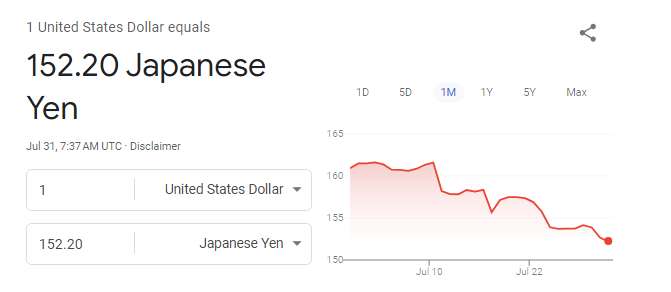
Compared with the Japanese authorities' ambiguous attitude towards the yen earlier this year, Japanese officials have recently been more clear about not wanting the yen to be too weak. The Bank of Japan said today that the yen exchange rate is more likely to affect prices than before.
The new top official of Japanese foreign exchange affairs, Atsushi Mimura, also said before this decision that the recent weakness of the yen is more detrimental than beneficial to the Japanese economy. If necessary, interventions will be taken to curb the speculative behavior of the yen.
Fred Neumann, Chief Asia Economist at HSBC, said: The BOJ took the plunge. Despite sluggish consumer spending, monetary officials sent a decisive signal by raising interest rates and allowing for more gradual balance sheet reduction. Despite sluggish consumer spending, rising wages are offering room for optimism that growth will recover in the coming quarters. Rising inflation expectations also open the path for ongoing monetary policy normalization by the BOJ. Barring major disruptions, the BOJ is on course to tighten further, with another interest hike by the start of next year.
Shaun Osborne, Chief Currency Strategist at Scotiabank, said: We've seen quite a move in the yen on the day. Some people were thinking that this move had probably already played out, but I think there's still the potential for some of these carry trades and some of the positioning to unwind a little bit further.
Japanese government bond yields fell. The 2-year Japanese government bond yield rose by 7 basis points, reaching the highest level in 15 years, and the benchmark 10-year Japanese government bond yield also climbed to 1.055%.
The Nikkei 225 Index and the Tokyo Stock Exchange Index both reversed the decline before the interest rate decision, and Japanese bank stocks benefited from the rate hike and the expectation of further rate hikes, making the largest increase in a month. The Tokyo Stock Exchange Bank Index once rose by 3.1%. The stock prices of major Japanese banks such as Mitsubishi UFJ Financial Group, Sumitomo Mitsui Financial Group, and Mizuho Financial Group all rose by more than 2%.

Expert analysis on U.S. markets and macro trends, delivering clear perspectives behind major market moves.
Latest Articles
Stay ahead of the market.
Get curated U.S. market news, insights and key dates delivered to your inbox.
AInvest
PRO
AInvest
PRO



Comments
No comments yet