
Bank Earnings Signal Resilience Amid Shifting Monetary Tides: Q2 2025 Insights for Investors
The Q2 2025 earnings reports from major U.S. banks—JPMorgan Chase (JPM), Bank of AmericaBAC-- (BAC), CitigroupC-- (C), and U.S. Bancorp (USB)—offer a critical lens into the health of the economy and the evolving monetary landscape. By analyzing metrics like loan growth, net interest margins (NIM), deposit costs, and capital management, investors can decode broader market trends, anticipate Fed policy shifts, and position portfolios for the second half of 2025.
Loan Growth: A Mixed Bag of Resilience and Caution
The banking sector's loan growth in Q2 2025 reflects a cautious optimism. Citigroup reported modest 5% industry-wide loan growth, driven by commercial and industrial lending, while JPMorganJPM-- emphasized disciplined risk management in its corporate lending. However, macroeconomic headwinds—such as lingering trade tensions and elevated interest rates—kept growth restrained.
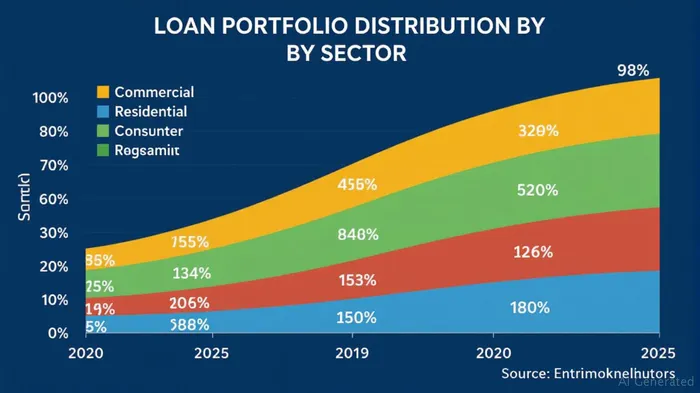
Investment Implication: Banks with diversified loan portfolios (e.g., JPMorgan's tech banking focus) may outperform peers reliant on volatile sectors. Equity investors should prioritize institutions with strong credit underwriting and exposure to high-growth industries like technology or renewable energy.
Net Interest Margins: Stability Amid Volatility
Net interest margins—the lifeblood of banking profitability—remained resilient in Q2. The industry-wide NIM stabilized at 3.25%, with community banks outperforming at 3.46%. JPMorgan and Citigroup benefited from the Federal Reserve's decision to hold rates steady at 4.25-4.5%, which slowed deposit cost inflation.
Key Takeaway: Stable NIMs suggest banks are effectively managing interest rate risk. This bodes well for equity investors, as NIM stability often precedes dividend hikes or buybacks. However, fixed-income investors should monitor bond yields: a narrowing NIM could signal weakening demand for corporate debt.
Deposit Costs: The Quiet Success Story
Deposit costs—a critical cost driver for banks—showed surprising resilience in Q2. The Fed's pause on rate hikes allowed institutions like JPMorgan to reduce funding costs via wholesale deposits and Federal Home Loan Bank (FHLB) borrowings. Bank of America's non-interest-bearing deposits grew by 27.5% year-over-year, a testament to retail franchise strength.
Investment Play: Banks with low-cost deposit bases (e.g., USB's community banking focus) are better positioned to weather rate cuts. Fixed-income portfolios could favor bank bonds over Treasuries, given their superior yields and stable funding costs.
Capital Management: Return of the Dividend King
Capital returns were a standout theme in Q2. Citigroup announced a 7.1% dividend hike to $0.60 per share, while JPMorgan maintained steady payouts despite revenue headwinds. Share repurchases also surged, with Citigroup targeting $1.75 billion in buybacks for the quarter.
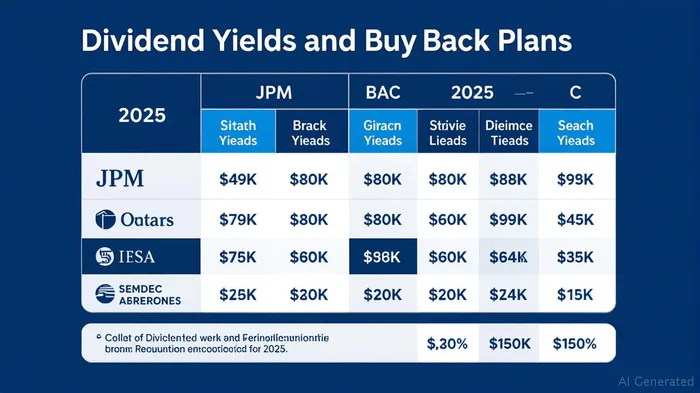
Actionable Insight: High-yielding bank stocks (e.g., Citigroup's 2.6% dividend yield) offer defensive equity exposure. However, investors should prioritize banks with strong capital ratios (e.g., JPM's Tier 1 capital at 13.8%) over those with elevated credit risks (e.g., Hingham's rising non-performing assets).
Risks on the Horizon
While Q2 earnings were broadly positive, risks loom large:
1. Tariff-Driven Inflation: Elevated borrowing costs (4.5%-5%) could strain regional banks reliant on small-business lending.
2. Credit Quality: Hingham's 129% YoY net income jump was tempered by non-performing assets rising to 0.70% of total assets—a warning for banks exposed to commercial real estate.
3. Fed Policy Uncertainty: The Fed's July 2025 decision to hold rates despite cooling inflation clouds the path for future easing.
Portfolio Strategy for Q3 2025
- Equity Plays:
- Buy: JPMorgan (dividend stability + tech banking diversification), U.S. Bancorp (strong deposit franchise).
Avoid: Regional banks with concentrated CRE exposure (e.g., Hingham).
Fixed Income:
- Overweight: Bank bonds (e.g., JPM's senior notes) for their yield advantage over Treasuries.
Underweight: Long-dated government bonds if NIM stability signals sustained rate support.
Hedging: Use put options on bank ETFs (e.g., KBW Bank Index) to protect against a sudden credit contraction.
Conclusion
Q2 2025 bank earnings reveal a sector navigating macro headwinds with disciplined management. Loan growth and NIM stability suggest underlying economic resilience, while deposit cost control and capital returns offer near-term catalysts. Investors should lean into institutions with diversified revenue streams and robust balance sheets, while remaining vigilant to credit risks and Fed policy shifts. For now, banks remain a barometer of both economic health and market sentiment—watch them closely.

Stay ahead of the market.
Get curated U.S. market news, insights and key dates delivered to your inbox.
AInvest
PRO
AInvest
PRO



Comments
No comments yet