
Bank Earnings Season: Setting the Stage for the Broader Market
As the upcoming earnings season kicks off, banks are once again set to lay the foundation for the broader market, providing crucial insights into the state of the economy. Often regarded as the bloodline of the financial system, banks not only drive economic activity through their lending and credit operations but also offer a unique lens into the financial landscape in which corporations operate. Their earnings reports deliver valuable information on key areas such as loan growth, credit quality, and trade activity, helping market participants understand the underlying economic conditions and potential risks or opportunities ahead.
The performance of the banking sector will set the tone for the earnings season, influencing expectations across other industries and offering a clearer picture of how companies are navigating the current financial environment.
Several critical factors will be at the forefront of investors' minds. One of the main areas of focus will be reserves, as banks either build or withdraw from their reserves to reflect the current state of credit defaults. With concerns rising about the potential uptick in consumer and commercial loan delinquencies, how banks manage their reserve levels will provide key insights into their expectations for credit quality and economic conditions. A buildup in reserves could signal caution and preparedness for a downturn, while withdrawals might indicate confidence in credit performance.
Net interest income (NII) will also be a crucial metric to monitor, especially in light of the Federal Reserve's recent rate cuts. While lower interest rates can stimulate loan demand, they also compress the margins banks earn on their lending activities. Investors will be keen to see how banks have navigated these pressures and whether they have been able to offset rising deposit costs, which have surged as banks compete to attract and retain funds in a challenging rate environment. How effectively banks balance these dynamics will be critical to their profitability in the quarters ahead.
Additionally, expense management remains a significant concern as banks grapple with increased costs, not only from rising deposit rates but also from investments in new technologies, including artificial intelligence (AI). Many institutions are ramping up their AI capabilities to streamline operations and enhance customer services, which, while beneficial in the long term, adds to near-term expenses. Investors will be looking for updates on efficiency ratios and cost-control initiatives to see how well banks are managing these investments and their impact on overall profitability.
Lastly, changes in regulatory frameworks and capital requirements will play an essential role in shaping the outlook for the banking sector. The recent recommendations to lower risk-weighting for residential and retail loans and to align capital requirements with Basel standards could reduce the amount of capital banks need to hold, potentially freeing up funds for lending and other initiatives. How banks respond to these regulatory shifts, alongside their strategies for maintaining solid capital ratios and driving shareholder returns through buybacks and dividends, will be key elements to watch in the upcoming earnings season.
J.P. Morgan (JPM)
JPMorgan Chase is scheduled to report its earnings on Friday, October 11, before the market opens, with analysts projecting EPS of $3.99 and revenue of $41.4 billion. As a bellwether for the financial sector, JPMorgan often sets a high benchmark for the rest of the banking industry. Investors will be closely monitoring the bank's results for any signs of economic weakness, especially given CEO Jamie Dimon's recent cautious outlook on the economy.
Recent analyst commentary on JPMorgan Chase has been cautious, with Deutsche Bank downgrading the stock to Hold from Buy due to its strong year-to-date performance, which has already driven shares up by 30%. Deutsche Bank highlighted that while JPM's gains have been supported by higher net interest income, solid trading, a recovery in investment banking, and strong credit performance, much of this positive outlook is already priced into the stock, limiting its near-term potential.
Morgan Stanley also downgraded JPMorgan from Overweight to Equal-weight, citing the potential for more favorable net interest margin (NIM) surprises among other stocks in their coverage. They also pointed out concerns about negative operating leverage next year, leading them to reduce their exposure to the stock following its outperformance.
At the Barclays Financial Services Conference in early September, JPMorgan's President Daniel Pinto provided a cautiously optimistic outlook for the bank's third quarter. He noted that Q3 markets revenue is expected to be relatively flat to slightly up by about 2% year-over-year, while M&A volume will likely remain flat as well. However, Pinto highlighted that investment banking fees could see a significant increase of around 15% for the quarter, suggesting a solid performance in that segment. Despite this positive outlook in investment banking, he tempered expectations for net interest income (NII), remarking that current market forecasts for 2025 NII and expenses might be overly optimistic.
Pinto also touched on JPMorgan's broader strategy, emphasizing that the bank is actively investing in hiring more bankers in corporate and investment banking to strengthen its position in these areas. He expressed skepticism about large-scale acquisitions in asset management, indicating a preference for organic growth in this sector. Additionally, Pinto pointed to the potential benefits of AI, estimating that it could contribute up to $2 billion to the bank's revenue this year. Despite these positive aspects, Pinto cautioned that the market's expectations for NII remain high, and a more realistic approach may be necessary given the current economic landscape.
JPMorgan Chase is in advanced talks with Apple to take over its credit card program from Goldman Sachs, a move that investors will closely watch around the company's earnings. Discussions between JPMorgan and Apple began earlier this year and have recently gained momentum, though key details like pricing still need to be negotiated, meaning a deal is not yet certain. Apple had been exploring other potential partners, including Synchrony Financial and Capital One, after its decision with Goldman Sachs to end their credit card and savings account partnership.
JPMorgan Chase's Q2 earnings report delivered strong results, with EPS exceeding expectations and revenue rising 22% year-over-year to $50.8 billion. The bank's Consumer & Community Banking (CCB) segment saw mixed performance, with overall revenue up 3%, driven by a 31% jump in Home Lending and a 14% increase in Card Services & Auto revenue. However, Banking & Wealth Management revenue declined by 5%. In the Commercial & Investment Bank (CIB) segment, revenue grew by 9%, with a notable 46% increase in Investment Banking revenue, despite coming off a low base last year. The Asset & Wealth Management segment also performed well, with revenue rising 6% year-over-year.
Despite the positive financial results, JPMorgan's provision for credit losses (PCL) of $3.05 billion, including a net reserve build of $821 million, raised concerns about the bank's cautious economic outlook. The increase in net charge-offs, primarily in Card Services, and the unexpected reserve build suggest the bank is preparing for potential near-term economic challenges. JPMorgan's commentary highlighted concerns about ongoing geopolitical risks, inflationary pressures, and the uncertain effects of quantitative tightening, signaling that inflation and interest rates may remain higher for longer than the market expects. The cautious sentiment from JPM, along with weaker performances from other banks like Wells Fargo and Citigroup, has led to a more cautious outlook for the sector as more banks prepare to report their earnings.
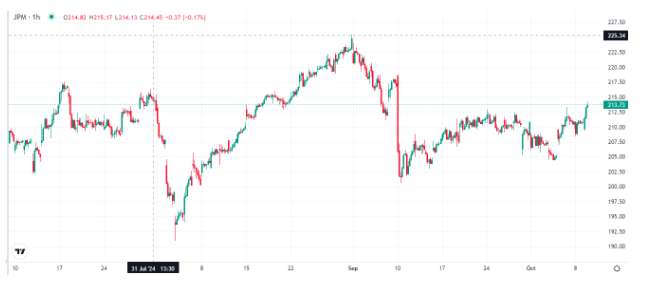
Investment Thoughts: This remains a best-in-breed name. The valuation is frothy but deserved given its performance under the stewardship of Jamie Dimon. The stock has traded between $200-220 since the Spring and is likely to remain range bound barring any major surprises. We would continue to view JPM as a Buy but upside will be limited if economic and geopolitical uncertainty persist.
Wells Fargo (WFC)
Wells Fargo (WFC) will report earnings on Friday, October 11 before the market opens. Analysts project WFC EPS to be $1.28 amd revenue is expected to come in at $20.4 billion.
Wells Fargo is seeing renewed investor optimism following an upgrade from Wolfe Research to Outperform, citing the bank's current valuation and potential upside from the eventual lifting of its regulatory asset cap. Wolfe noted that while their earnings estimates for 2025 and 2026 are below consensus due to rate sensitivity, the bank's low trading multiple of less than 10 times its 2026 expected EPS reflects this risk well. They believe that if the asset cap were to be lifted, it could add about 8% to Wells Fargo's earnings potential, driving normalized EPS power above $6, which isn't currently priced into the stock.
The asset cap, in place since 2018 due to regulatory actions tied to past scandals, has significantly hindered Wells Fargo's ability to compete with peers like Bank of America and JPMorgan Chase. During this period, these rivals have grown their assets by more than 35%, while Wells Fargo has faced limitations on its expansion and higher compliance costs. Recent developments suggest progress toward lifting the cap, including the bank's submission of a third-party review to the Federal Reserve, which analysts like Evercore ISI's John Pancari view as a crucial step forward. While the cap may not be lifted until at least 2025, its eventual removal could unlock significant growth potential for the bank.
Wells Fargo's valuation remains attractive, especially considering its robust deposit base of $1.3 trillion, which provides a competitive advantage with lower interest costs than peers. Analysts, including Jason Goldberg of Barclays, believe that lifting the asset cap could enable Wells Fargo to scale its business more effectively, enter new markets, and utilize its balance sheet more efficiently. The bank's efficiency ratio, currently around 66%, could see substantial improvement if regulatory constraints are eased, allowing it to better compete with the likes of JPMorgan and improve its return on tangible equity to its target of 15%.
Despite these positive signs, challenges remain for Wells Fargo, primarily the uncertainty surrounding the actual timing of the asset cap's removal and the bank's numerous regulatory issues that continue to weigh on its reputation and expenses. CEO Charles Scharf has emphasized that while the cap's lifting would be a significant milestone, it would not immediately eliminate all compliance-related costs. Furthermore, the bank still faces more than a half-dozen consent decrees, including recent scrutiny over its anti-money laundering practices. As such, while the path forward appears promising, Wells Fargo must continue to navigate regulatory hurdles and market competition to fully realize its growth potential.
At the Barclays Financial Services conference on September 10, Wells Fargo reaffirmed its full-year 2024 net interest income guidance, expecting a decline of 7-9%. Following this update, Evercore ISI adjusted its outlook for the bank, lowering its price target to $65 from $67. Analyst John Pancari cited a revised interest rate forecast and a more conservative loan growth outlook as key factors behind the adjustment. This revision also includes a modestly lower outlook for non-interest income due to a more conservative view on investment banking and trading, partially offset by a reduced loan loss provision tied to slower loan growth.
Wells Fargo's Q2 earnings results revealed a mixed performance, with some positive developments tempered by ongoing challenges. On the positive side, consumer deposits saw a modest increase for the first time in nearly two years, reflecting some stabilization in this area. However, the bank's net interest income (NII) fell by 9% year-over-year to $11.9 billion, missing analyst expectations. This decline was mainly due to higher funding costs as customers shifted towards higher-yielding deposit products, offsetting gains from the bank's loan portfolio.
WFC's credit performance showed signs of resilience despite some challenges in specific areas. The bank benefited from its credit tightening actions, particularly in auto loans, where losses continued to decline. In its Consumer Banking and Lending segment, which constitutes 43% of total Q2 revenue, revenue fell by 5% to $9.0 billion, driven by reduced mortgage origination and weaker auto lending, both impacted by higher interest rates. Still, the company anticipates some improvement in credit card charge-off rates heading into Q3.
A notable bright spot in WFC's earnings was the strong performance of its Investment Banking and Markets segments. Investment Banking revenue jumped by 38% to $430 million, thanks to a more active IPO market, while equities trading revenue surged by 41%, leading to a 16% increase in total Markets revenue to $1.8 billion. Additionally, the Wealth and Investment Management segment grew by 6%, supported by higher asset-based fees amid favorable stock market conditions. These gains provided a much-needed boost to WFC's overall revenue base, countering some of the negative impacts from other areas.
Despite these positive aspects, Wells Fargo's commercial real estate portfolio raised some concerns as nonperforming assets increased by 5%, driven by higher nonaccrual loans in this segment. This uptick in commercial net loan charge-offs highlights potential vulnerabilities in the bank's credit quality. Overall, while WFC's Q2 results were mixed, the ongoing pressure from higher interest rates and rising nonperforming assets tempered the optimism from stronger performances in investment banking and trading. The bank's cautious outlook for the remainder of 2024 adds to investor concerns, especially as it expects NII to decline in the range of 7-9% year-over-year.
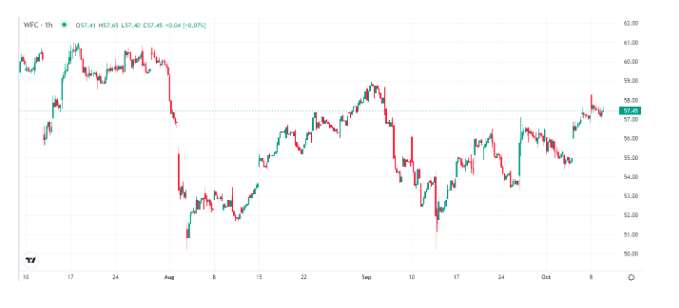
Investment Thoughts: Wells operations have improved under new management but it remains handcuffed by the Fed cap on its asset holdings. The low valuation and potential tailwind make this an intriguing investment for long-term holders. There is solid support at the $54 level and a break above $60 would be an important signal on the technical side.
Citigroup (C)
Citigroup is set to report its third-quarter 2024 results on October 15, with expectations for both earnings and revenue to decline year-over-year. The consensus estimate for Q3 EPS has been revised down to $1.31, reflecting a 9.2% drop from the prior year's $1.63, while revenue is expected to come in at $19.8 billion, slightly lower than the $20.1 billion reported in the same quarter last year. This follows Q2 2024 results where Citigroup posted revenue of $20.1 billion and EPS of $1.52.
As Citigroup approaches its third-quarter 2024 earnings report, its efforts to streamline operations through organizational restructuring will be a key focus. The bank has been making progress in its plan to exit the consumer banking business in international markets, allowing it to concentrate on growing its wealth management and commercial banking segments. However, a rise in credit losses is becoming a challenge, as consumers shift their spending to essential items, leading to increased revolving credit and lower payment rates, as noted by CEO Jane Fraser at the recent Barclays conference.
Despite these challenges, the broader macroeconomic landscape may provide some support to Citigroup's lending activities. With the Federal Reserve's recent rate cut of 50 basis points, interest rates have stabilized, which, combined with modest demand for commercial and consumer loans, could improve Citigroup's average interest-earning asset balance. However, the bank's net interest income (NII) could be pressured by elevated funding costs and the impact of an inverted yield curve throughout most of the quarter, with the Zacks Consensus Estimate for NII suggesting a slight decline of 2.2% year-over-year.
On the capital markets front, Citigroup could benefit from a resurgence in global mergers and acquisitions (M&As) and increased client activity in various asset classes. The improved market conditions, along with a softening U.S. economic landing, might boost its investment banking revenues, although overall market revenues are expected to decline by around 4% compared to the same quarter last year. While Citigroup's realignment strategy and efforts to simplify its structure offer long-term growth potential, investors will be closely watching the bank's ability to navigate the current headwinds of rising expenses, regulatory scrutiny, and credit losses.
At the Barclays Financial Services Conference, Citi provided an update for Q3, projecting a 4% year-over-year decline in trading due to a tough Fixed Income, Currencies, and Commodities (FICC) comparison, while investment banking is expected to grow 20% on strong debt capital markets (DCM) and M&A activity. The bank anticipates a Q3 cost of credit at $2.7 billion, driven by new card growth, with a $1 billion share buyback planned for the quarter. Citi's 2024 outlook remains unchanged, with net interest income in the second half of the year expected to be slightly higher than in the first half. Citigroup is experiencing an increase in credit losses as U.S. consumers focus their spending on essential items, reducing non-essential purchases. The bank is seeing a rise in revolving credit balances, with a slight decline in payment rates.
Citigroup's Q2 earnings showed solid performance, with both revenue and EPS exceeding expectations, driven by growth across all segments. The company reported a 3.6% year-over-year revenue increase to $20.14 billion, reversing previous quarters' declines due to M&A impacts. Markets and Wealth segments rebounded, with Markets revenue growing by 6% and Wealth seeing a 2% rise, fueled by non-interest income and new client assets. However, Net Interest Income (NII) dipped by 4% due to higher mortgage funding costs. Banking led the way with a 38% revenue surge, while the Services segment grew by 3%, with challenges in Argentina partially offset by gains in Securities Services and Treasury and Trade Solutions.
Despite these positive results, Citigroup's shares declined due to profit-taking, as the stock had already rallied 15% since April, factoring in the Q2 gains. The company maintained its full-year 2024 guidance, targeting revenue between $80-81 billion and expenses of $53.5-53.8 billion. Citigroup's continued focus on cost-cutting and divestitures has led to improved operating leverage, positioning the firm to benefit from its ongoing transformation plan. Management's confidence in reaching its medium-term goals, including a 4-5% revenue CAGR, remains strong as the company builds on its recent progress toward stronger profitability.
Citigroup reaffirmed its FY24 guidance, projecting revenue of $80-81 billion, in line with the FactSet consensus of $80.66 billion. The company expects full-year expenses to be around $53.5-53.8 billion, excluding the FDIC special assessment and Civil Money Penalties, likely leaning towards the higher end of that range. Citigroup aims for a long-term efficiency ratio of below 60% and targets $51-53 billion in expenses, depending on revenue growth. The company maintains its goal of achieving a 4-5% revenue CAGR by focusing on growth in its Services, Markets, and USPB segments, with a medium-term target of 11-12% Return on Tangible Common Equity (RoTCE).
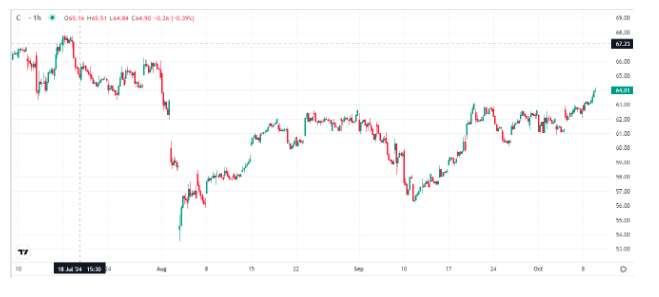
Investment Thoughts: The turnaround under Jane Fraiser continues. C and WFC are the two cheapest money centers and for good reason, their performance has lagged peers. However, C has taken drastic steps over the past couple of quarters. If we see that bear fruit, then the chart is set up for a nice breakout toward $70.
Goldman Sachs (GS)
Goldman Sachs is set to report its Q3 2024 earnings on October 15, with analysts expecting EPS of $7.69 on revenue of $12.15 billion, up from the $5.47 EPS and $11.82 billion in revenue reported in Q3 2023. In the previous quarter, the bank posted strong results with net revenue of $12.73 billion and EPS of $8.62.
Improved deal flow has been a key trend, with global merger and acquisition volumes reaching $1.6 trillion in the first half of the year, a 20% increase from the prior year, and equity capital market activity up 10% during the same period. As the second-largest player in the global investment banking space, Goldman Sachs is well-positioned to capitalize on these market conditions heading into 2025.
The company faces a challenging environment, with CEO David Solomon warning of a potential 10% decline in trading revenue due to volatile market conditions in August. This dip in trading could put pressure on results for firms heavily dependent on trading revenues, including Morgan Stanley, JPMorgan Chase, and Citigroup. However, Goldman Sachs' investment banking division remains a bright spot, buoyed by increased deal activity and lower interest rates, which fueled a 21% rise in investment banking fees in Q2.
Goldman Sachs has also been shifting its focus back to its core investment banking, asset management, and trading businesses, scaling back its consumer operations, including its decision to exit a credit card partnership with General Motors. While trading revenue is under pressure, the firm's strong performance in debt and equity underwriting may help mitigate these losses, contributing to a more balanced performance in Q3. Investors will be closely watching how GS's investment banking strength offsets its trading challenges, particularly considering the firm's strategic focus and ongoing market volatility.
Goldman Sachs posted solid Q2 results, surpassing top and bottom-line expectations and announcing a 9% increase in its quarterly dividend. Despite delivering strong double-digit growth across its primary divisions, Global Banking & Markets (GBM) and Asset & Wealth Management (AWM), the market response was relatively muted, likely due to the heightened scrutiny following a significant +24% rise in GS's share price since last quarter. Investors appeared cautious as the earnings beat was slimmer compared to Q1, with slowing revenue growth across several divisions and ongoing concerns about near-term economic uncertainties.
In Q2, GS reported a 16.8% year-over-year increase in total revenue to $12.73 billion, driven by double-digit growth in both GBM and AWM, following the sale of its consumer business, GreenSky. GBM grew by 14% year-over-year, although it saw a sequential decline due to lower investment banking fees and equities revenue, while AWM outpaced with a 27% increase in revenue, boosted by substantial gains in equity investments and higher fees from increased assets under supervision. CEO David Solomon expressed optimism about a potential recovery in M&A activity, which could further boost GBM revenues, while also highlighting the positive impact of a robust market on AWM's performance.
Looking ahead, Goldman Sachs remained cautiously optimistic, despite acknowledging challenges like persistent inflation and geopolitical uncertainties. Mr. Solomon noted a relatively constructive economic outlook for the U.S., with markets seemingly pricing in a soft landing. GS also highlighted the potential growth opportunities in artificial intelligence, anticipating increased corporate demand for financing related to AI technologies. The sale of GreenSky has allowed GS to sharpen its focus on its core strengths, positioning itself for healthier long-term growth, even as the broader economic landscape remains unpredictable.
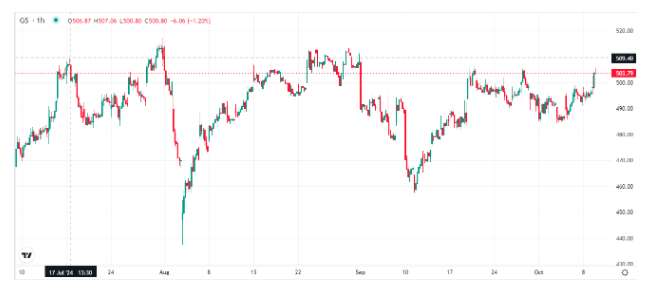
Investment Thoughts: Goldman is in the midst of a transition away from consumer products and back to its core Investment Banking unit. Expectations will be higher for the IBs as the environment is being viewed as more favorable. Shares of GS have been trying to hold the $500 level. Given the heightened expectations for GS, we would prefer to wait on the sidelines for results to hit and then eye up a potential pullback.
Bank of America (BAC)
Bank of America (BAC) is set to report its earnings for the quarter ended September 2024 on October 15, with analysts expecting a year-over-year decline in earnings despite slightly higher revenues. The bank is projected to deliver earnings of $0.78 per share, representing a decrease of 13.3% from the same period last year, while revenues are anticipated to rise 0.7% to $25.33 billion. Over the past 30 days, the consensus EPS estimate has been revised downward by 3.52%, reflecting a cautious outlook heading into the report.
In Bank of America's Q3 earnings report, key areas of focus will include net interest income (NII) and the impact of rising interest rates. Investors will be watching how the bank balances increased interest income from loans with the higher costs of deposits. Loan growth trends in both commercial and consumer lending will also be crucial, alongside credit quality metrics like provisions for credit losses and non-performing assets. Performance in capital markets and investment banking will be another highlight, with attention on how M&A, debt capital markets, and equity capital markets activities might offset potential trading revenue declines.
Additionally, expense management will play a significant role, as investors look for updates on efficiency ratios and cost-control measures in light of rising compliance costs. Share buybacks and dividend strategies will also be under scrutiny, reflecting the bank's approach to capital returns amid economic uncertainties. Management's outlook on inflation, recession risks, and interest rate trends will be essential for understanding Bank of America's future performance and strategic direction as it navigates potential headwinds in the broader economic landscape.
Warren Buffett's Berkshire Hathaway recently reduced its stake in Bank of America through its 14th round of sales, selling approximately 9.57 million shares between October 3 and October 7 for around $383 million. This brings Berkshire's total sales proceeds from BAC to over $10 billion, while its remaining 10.1% stake in the bank is now valued at about $31.4 billion. Since mid-July, Buffett's gradual stake reduction has contributed to a 7% decline in BAC's share price. Notably, Berkshire has been selling fewer shares in recent rounds compared to earlier disposals.
Bank of America reported its eighth consecutive quarter of exceeding EPS expectations in Q2, although high interest rates took a toll on its net interest income (NII), which fell by 3%, and EPS, which declined by 6%. The higher rates also led to decreased demand for loans, causing revenue to edge up by less than 1%. In the Consumer Banking segment, deposits dropped by 6% as customers sought higher-yielding products amid the competitive high-rate environment, while average loans and leases still grew by 2% due to higher asset yields.
Despite challenges, BAC's Global Markets unit delivered strong results with a 12% revenue increase, driven by a 20% jump in equities trading. The investment banking segment also performed well, with fees rising 29% thanks to the recovering IPO market, positioning BAC as the third largest in investment banking fees. Additionally, the Global Wealth and Investment Management segment achieved record client balances of over $4 trillion, up 10%. The stock reacted positively to BAC's earnings report, buoyed by its Q4 NII outlook of $14.5 billion, reflecting a 4% year-over-year increase, and its expectation of lower net charge-offs in the second half of 2024 compared to the first half.
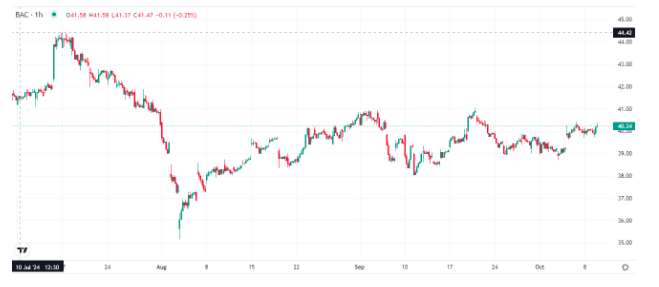
Investment Thoughts: The stock saw a 10% decline in late July. Many were attributing that to Berkshire selling a large swath. As we see above, the selling by Buffet and Co has cooled. Shares of BAC have cut a tight pattern between $38-40 in the weeks ahead of this report. If we are to assume that Berkshire is done selling, then that removes a major seller. If it holds $40 then that could entice other buyers into the name. BAC would set up as a nice swing long into the end of the year under this scenario.
Morgan Stanley (MS)
Morgan Stanley is set to release its Q3 2024 earnings on October 16, with analysts expecting earnings of $1.61 per share on revenue of $14.3 billion. This would mark an improvement from the $1.38 per share and $13.3 billion in revenue reported in Q3 2023, but a slight decline from Q2 2024 results of $1.82 per share on revenue of $15 billion. Investors will be closely watching to see if the bank can sustain its recent momentum despite the softer sequential expectations.
As Morgan Stanley (MS) approaches its Q3 2024 earnings release, investor sentiment has seen mixed updates from major analysts. HSBC recently upgraded MS to a Buy from Hold, citing its strong investment banking and Wealth Management businesses as well-positioned to capitalize on favorable market conditions. HSBC believes that previous concerns about net interest income (NII) are overstated, with robust fee-based asset flows and growing management fees providing stability. They also argue that the downward earnings revisions that had weighed on the stock's performance are likely stabilizing, signaling a potential end to the underperformance trend compared to Goldman Sachs and the broader market.
Conversely, Goldman Sachs downgraded Morgan Stanley to Neutral from Buy, citing its premium valuation relative to large bank peers and the likelihood that other names may benefit more as the investment banking cycle advances. Goldman noted that independent investment banks have a higher revenue skew toward capital markets, which could lead to faster growth compared to MS. They also highlighted risks to MS's wealth management margins and net interest income, given its exposure to cash sorting pressures and potential rate declines, which could impact earnings growth.
Wells Fargo also took a more cautious stance, downgrading MS to Underweight from Equal Weight, noting that while the bank's structural repositioning over the past decade has led to significant stock re-rating, further growth may be challenging. They argue that Morgan Stanley's valuation now implies a return on tangible common equity (ROTCE) higher than what they forecast for 2025, suggesting limited upside potential. These varied perspectives set the stage for a closely watched Q3 report, where investors will focus on whether Morgan Stanley can continue to leverage its strengths in Wealth Management and investment banking amid a shifting financial landscape.
Morgan Stanley posted solid Q2 earnings, reporting a double-digit EPS beat for the second consecutive quarter and an 11.6% year-over-year revenue increase to $15.02 billion, marking its first double-digit revenue growth since Q3 2021. The quarter's performance was driven by the Institutional Securities segment, which saw a 23.5% rise in revenue to $6.98 billion, boosted by strong results in equities and a significant increase in investment banking (IB) revenue, up 51% year-over-year due to higher M&A activity and robust debt underwriting. The Equity subsegment also performed well, with an 18% increase in revenue, reflecting strong client activity, particularly in Asia.
While the Wealth Management segment's revenue growth was more modest at 2% year-over-year, this was partly due to clients moving funds into higher-yield accounts, leading to a 17% drop in net interest income. Despite this, the segment's Asset Management subsegment delivered a record quarter with a 16% increase in revenue. Investment Management, Morgan Stanley's smallest division, grew its revenue by 8% year-over-year, supported by higher average assets under management (AUM). Overall, the results highlighted Morgan Stanley's strong position in investment banking and a resilient U.S. economy, with the stock continuing to trend higher amid optimism about the rate environment and the company's growth prospects.
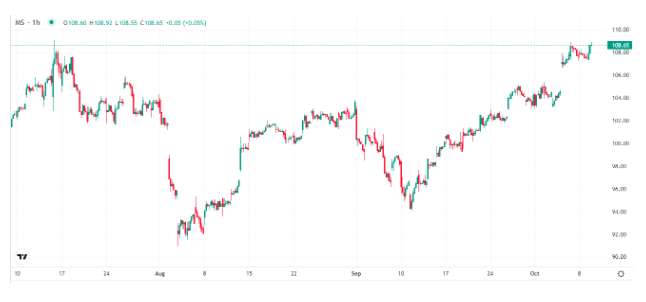
Investment Thoughts: This is the strongest chart in the group so, from a technical standpoint, it looks enticing. Long-term holders should continue to hold, barring a break back below the $100 level. Valuation is frothy and expectations are high which would keep us on the sidelines ahead of the report. We would prefer to see a pullback before trying to initiate a position.

Independent investment research powered by a team of market strategists with 20+ years of Wall Street and global macro experience. We uncover high-conviction opportunities across equities, metals, and options through disciplined, data-driven analysis.
Latest Articles
Unlock Market-Moving Insights.
Subscribe to PRO Articles.
Already have an account? Sign in
Unlock Market-Moving Insights.
Subscribe to PRO Articles.
Already have an account? Sign in
Stay ahead of the market.
Get curated U.S. market news, insights and key dates delivered to your inbox.
AInvest
PRO
AInvest
PRO



