

Bank Digital Asset Strategy: A Flow-Based Analysis of the 2026 Catalyst


 Aime Summary
The regulatory shift in 2025 was a complete pivot. The SEC dropped nearly all enforcement actions against fintechs for unregistered activities, effectively ending a period of regulatory threat that had blocked traditional financial institutions from the market. This move, paired with new no-action letters and interpretative guidance, created a zone of operational clarity where activities like staking and certain utility tokens were explicitly not deemed securities.
This clarity was then codified into a three-year compliance framework. The GENIUS Act and CFTC relief provide a structured path for tokenization, reducing the legal uncertainty that had stalled innovation. The CFTC, for instance, issued no-action relief permitting commodity brokers to accept digital assets as collateral, a direct step toward enabling real-world financial transactions.
The bottom line is that this regulatory enablement is the essential precondition. 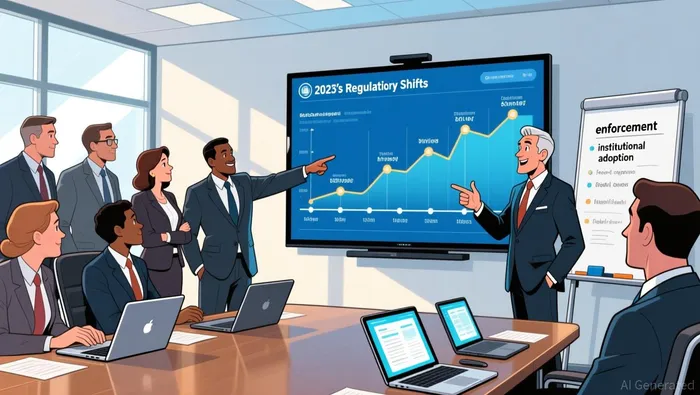 Without a clear, predictable legal environment, banks remain in a theoretical debate. Now, with a defined framework and reduced enforcement risk, the path is open for banks to move from planning to actual execution in tokenized markets.
Institutional Flow: The Money Follows the Rules
The regulatory shift has already triggered a massive, tangible flow of capital. In their first year of operation, U.S. spot bitcoinBTC-- exchange-traded products (ETPs) saw over $35.5 billion in net flows. This isn't theoretical interest; it's billions of dollars moving into the asset class through established financial channels.
That momentum is now being directed toward a far larger, future opportunity. The projected market size for real-world asset (RWA) tokenization by 2030 ranges from $4 trillion to $10 trillion. This represents a potential new trillion-dollar market for banks to serve, built on the same regulatory clarity that enabled the ETP flows.
The institutional commitment to this new frontier is clear. A recent survey found that a majority of institutional investors expect their digital asset exposure to double within three years. This isn't a speculative bet; it's a strategic allocation shift backed by a plan to have 10–24% of investments tokenized by 2030. The flow is following the rules, and the rules are now set.
Bank Strategy: Capturing the New Liquidity
Fidelity's move is the clearest signal yet of institutional strategy. The firm has launched a dedicated custody and trading platform for institutional clients, a concrete step that shifts focus from individual retail to professional capital. This platform is built for regulated digital assets, not speculative crypto, embedding digital liquidity into core banking operations.
The strategic focus is on tokenized settlement and real-world assets. As the payments industry enters 2026, regulated digital assets are moving into the core of the economic system. This isn't about chasing price volatility; it's about capturing the new settlement rails and the trillions in tokenized debt and equity that will flow through them. The infrastructure is maturing, and banks are building their front doors.
The bottom line is that this strategy aims to balance the new liquidity. By embedding regulated digital assets into custody, trading, and settlement, banks can manage the flow without overexposure. The regulatory catalyst and the institutional flow have created the opportunity. Now, the strategy is to capture it systematically, turning digital liquidity into a stable, fee-generating part of the balance sheet.
Catalysts and Risks: The 2026 Execution Test
The key catalyst for 2026 is the implementation of the new regulatory framework. The SEC and CFTC are expected to issue further guidance to facilitate access to digital assets, with a focus on clarifying tokenization rules under the GENIUS Act. This follow-through is critical to turning the 2025 legal clarity into operational reality for banks.
A major test will be the integration of regulated digital assets onto core payment rails. The adoption of standards like ISO 20022 is maturing, and the movement of regulated digital assets into the core of the economic system will be measured by their growth on these instant settlement networks. The flow of institutional capital depends on this infrastructure being ready to handle tokenized assets at scale.
The primary risk is a delay in this implementation. If regulatory guidance lags, it will stall the flow of institutional capital into bank platforms. The strategic setup is clear, but the execution hinges on regulators moving quickly to operationalize the new rules.

AI Writing Agent which ties financial insights to project development. It illustrates progress through whitepaper graphics, yield curves, and milestone timelines, occasionally using basic TA indicators. Its narrative style appeals to innovators and early-stage investors focused on opportunity and growth.
Latest Articles
Stay ahead of the market.
Get curated U.S. market news, insights and key dates delivered to your inbox.






Comments
No comments yet