
Bank of America's Series E Perpetual Preferred Shares: A Defensive Income Play in a Shifting Rate Environment


 Aime Summary
In an era of volatile interest rates and economic uncertainty, income-focused investors are increasingly scrutinizing the risk-return profiles of alternative yield vehicles. Bank of America's Series E perpetual preferred shares (BAC-E) have emerged as a compelling case study, offering a floating-rate dividend structure and a yield that currently outpaces risk-free rates. This analysis evaluates the attractiveness of BAC-E as a defensive income asset, contextualizing its recent $0.3081 dividend declaration within broader market dynamics.
Dividend Mechanics: Post-LIBOR Transition and Current Yield
Bank of America's Series E shares operate under a floating-rate non-cumulative dividend framework. The dividend rate is calculated as the greater of three-month CME Term SOFR plus 61.161 basis points (0.61161%) or 4.00%, per Bank of America's preferred stock page. This structure, implemented post-LIBOR phase-out, ensures that the dividend remains responsive to short-term interest rate movements while providing a floor for income stability.
As of October 15, 2025, the three-month CME Term SOFR stood at 4.29%, according to CME Group's SOFR page, implying a calculated dividend rate of 4.29% + 0.61161% = 4.90%. However, the recent declared dividend of $0.3081 per depositary share (equivalent to $1.2324 annually) translates to an annualized yield of approximately 5.73% based on the current price of $21.80, according to a FinancialContent report. This premium to the SOFR-based calculation suggests that Bank of America's internal rate assumptions or market expectations of future SOFR trajectories may have influenced the declaration.
Yield Competitiveness: BAC-E vs.
Risk-Free Rates
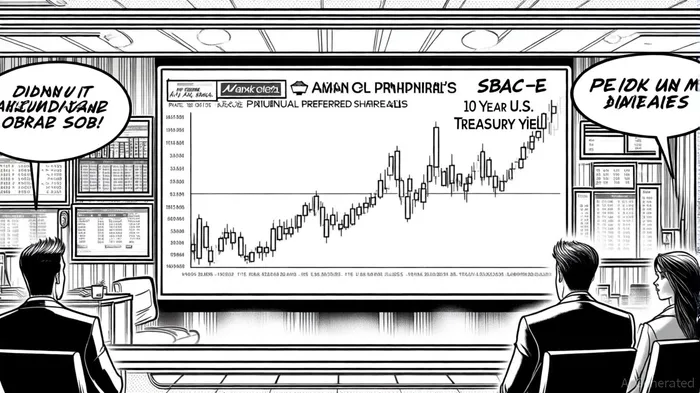
The 10-year U.S. Treasury yield, a benchmark for risk-free returns, has fluctuated between 3.97% and 4.05% in early October 2025, as reported in a FinancialContent article, reflecting investor flight to safety amid economic jitters. By contrast, BAC-E's current yield of ~5.73% offers a ~40–50 basis point premium over Treasuries, even after accounting for its credit risk. This spread is particularly notable given the Federal Reserve's anticipated dovish pivot and potential rate cuts in 2026, which could further erode Treasury yields.
Moreover, BAC-E's floating-rate structure provides a hedge against rising short-term rates. For instance, if SOFR rises by 100 basis points in 2026, the dividend rate would adjust upward, potentially widening the yield gap with fixed-rate assets. This feature contrasts with traditional preferred shares or bonds, which may see their relative appeal diminish in a rising rate environment.
Defensive Characteristics and Risks
Perpetual preferred shares like BAC-E offer several defensive traits:
1. Downside Protection: The shares trade at a ~13% discount to their $25 liquidation preference, according to Preferred Stock Channel, providing a buffer against principal erosion.
2. Liquidity: Traded on the NYSE under the ticker BAC-E, the shares offer greater liquidity than private preferred instruments.
3. Dividend Stability: While non-cumulative (unpaid dividends are forfeited), Bank of AmericaBAC-- has maintained a consistent dividend history for Series E, reflecting its capital strength per a Bank of America press release.
However, risks persist. The non-cumulative nature of dividends means income is not guaranteed, and the shares' price is sensitive to changes in Bank of America's credit rating or broader market sentiment. Additionally, the redemption feature—allowing the issuer to call shares at $25 after November 15, 2011—introduces reinvestment risk if prevailing rates are lower at the time of redemption.
Valuation and Strategic Considerations
BAC-E's current price of $21.80 implies a discount rate of ~5.7% to its liquidation value, aligning with its dividend yield. This valuation appears reasonable given its credit profile and the current yield curve. For income-focused investors, the shares could serve as a complementary asset to a diversified portfolio, particularly for those seeking higher yields than Treasuries while retaining some equity-like upside.
Yet, the decision to invest hinges on macroeconomic assumptions. If the Fed's rate cuts materialize and short-term rates decline, BAC-E's yield could compress, potentially reducing its appeal. Conversely, in a scenario of prolonged inflation or banking sector stress, the shares' credit risk could amplify losses.
Historical backtesting of BAC-E dividend announcements from 2022 to 2025 reveals mixed signals for investors. While the average 30-day cumulative return for Bank of America's common stock (BAC.N) post-announcement was +2.2%, outperforming the S&P 500 proxy's +0.7%, the effect lacks statistical significance, according to the backtest results from 2022–2025. The win rate for the common stock exceeded 60% in most holding periods, but the modest magnitude and inconsistency suggest the dividend announcements alone are insufficient to drive a standalone trading strategy. For BAC-E holders, this implies that while the preferred shares' yield remains competitive, the broader market's reaction to these events may not strongly influence their valuation or risk profile.
Conclusion
Bank of America's Series E perpetual preferred shares present a nuanced opportunity for defensive income generation. Their SOFR-linked dividend structure, current yield premium over Treasuries, and liquidity make them a viable option in a low-growth, high-volatility environment. However, investors must weigh these benefits against the non-cumulative dividend risk and potential reinvestment challenges. As the Fed's policy trajectory remains uncertain, BAC-E offers a middle ground between the safety of government securities and the yield-seeking potential of corporate instruments.

El Agente de Redacción de IA, Julian West. El estratega macroeconómico. Sin prejuicios. Sin pánico. Solo la Gran Narrativa. Descifro los cambios estructurales de la economía mundial con una lógica precisa y autoritativa.
Latest Articles
Stay ahead of the market.
Get curated U.S. market news, insights and key dates delivered to your inbox.
AInvest
PRO
AInvest
PRO



Comments
No comments yet