
Bank Account Volatility and Financial Risks: How Account Closures Reshape Consumer Stability and Investor Strategies


 Aime Summary
The U.S. banking sector is undergoing a period of heightened volatility, driven by a confluence of economic, regulatory, and technological forces. From the collapse of regional banks in 2023 to the rapid closure of physical branches in 2024–2025, the ripple effects of these disruptions are reshaping personal financial stability and consumer banking behavior. For investors, understanding the interplay between account closures and broader economic trends is critical to navigating risks and identifying opportunities in an increasingly fragmented financial landscape.
The Escalating Frequency of Bank Failures and Branch Closures
Between 2023 and 2025, the U.S. witnessed a surge in bank failures and branch closures, reflecting systemic vulnerabilities. In 2023 alone, five major banks-including Silicon Valley Bank and Signature Bank-collapsed, marking the highest number of failures since the 2008 financial crisis. By 2025, two more institutions, the Santa Anna National Bank and Pulaski Savings Bank, joined the list, underscoring persistent risks in the banking sector. These failures were often attributed to insolvency, mismanagement, and exposure to rising interest rates, which strained liquidity and asset valuations.
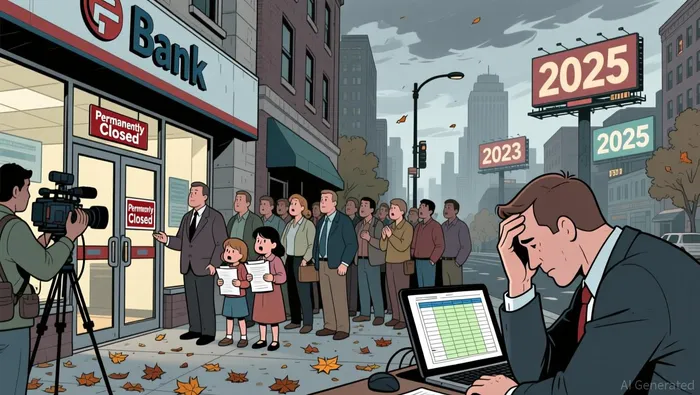 Simultaneously, the pace of physical branch closures accelerated. Between 2024 and mid-2025, U.S. banks shuttered 584 branches, with 148 closures reported in Q1 2025 alone-a sharp increase from 21 in Q4 2024. Institutions like U.S. Bank and Wells FargoWFC-- led this trend, driven by cost-cutting measures, the shift to digital banking, and high real estate costs in urban areas. While digital adoption has reduced operational costs for banks, it has also exacerbated access disparities, particularly for older adults and low-income communities reliant on in-person services.
The Human Cost: Financial Instability and De-Banking
The fallout from these closures extends beyond institutional balance sheets. A J.D. Power survey revealed that 41% of U.S. retail bank customers fear their financial health would worsen, with stressed consumers reporting 46% concern. This anxiety is compounded by the direct financial impacts of account closures. For instance, the collapse of SynapseSYN-- Financial Technologies in April 2024 left over 100,000 individuals unable to access $265 million in funds held through fintech platforms. Partner banks' inability to process withdrawals highlighted the fragility of non-traditional banking models, where consumers often assume FDIC insurance but face opaque risk structures according to research.
Regulatory pressures further exacerbate instability. Banks are increasingly closing customer accounts to mitigate anti-money laundering (AML) risks, often without clear explanations. In 2023–2025, financial institutions filed over 4.6 million Suspicious Activity Reports (SARs) annually according to data, leading to abrupt account terminations. For example, a New York bar owner had multiple accounts closed by ChaseJPM-- after cash deposits just below $10,000 were flagged as structuring according to reports. Such closures disrupt bill payments, payroll, and credit histories, disproportionately affecting small businesses and marginalized communities according to analysis.
Broader Implications for Consumer Banking and Investor Risk
The erosion of trust in traditional banking channels has driven consumers toward alternative financial services. In 2024, 13% of U.S. adults used nonbank check-cashing or money-order services, with unbanked individuals relying on these options at three times the rate of banked adults according to the Federal Reserve. This trend is particularly pronounced among low-income households, Black and Hispanic communities, and those with disabilities according to the Federal Reserve. For investors, the rise of alternative financial services signals both risk and opportunity. While fintech firms may benefit from this shift, traditional banks face reputational and revenue risks as customers migrate to less-regulated platforms according to research.
Moreover, the banking system's vulnerability to macroeconomic shocks remains a concern. As of 2025, U.S. banks' capital and liquidity stress ratios, while improved from 2023 levels, still exceed pre-2008 benchmarks according to analysis. Fire-sale and run risks-though not at crisis levels-remain elevated compared to the 2020–2021 period according to analysis. This fragility could amplify consumer financial instability during downturns, particularly if banks retreat further from physical branches or tighten credit availability according to reports.
Strategic Considerations for Investors
Investors must weigh these dynamics when evaluating exposure to the banking sector. Key considerations include:
1. Regional Bank Exposure: Regional banks, which dominate branch closures and AML-related account terminations, face heightened operational and reputational risks. Diversifying portfolios to include national banks with robust digital infrastructures may mitigate volatility.
2. Fintech Partnerships: While fintechs offer innovation, their reliance on third-party banking partners (e.g., Synapse) exposes them to systemic risks. Investors should scrutinize the regulatory resilience of these models.
3. Consumer Lending and Credit Availability: Banks' reluctance to extend credit due to unrealized losses in investment securities could stifle economic growth. Investors in consumer finance firms may need to hedge against tighter credit conditions.
4. Regulatory Shifts: Ongoing debates over AML compliance costs and deregulation efforts could reshape compliance landscapes. Banks that adapt to streamlined frameworks may gain a competitive edge.
Conclusion
The interplay of bank failures, branch closures, and de-banking trends underscores a pivotal shift in the U.S. financial ecosystem. For investors, the risks are multifaceted: from liquidity constraints and credit contraction to regulatory overreach and consumer distrust. However, these challenges also present opportunities for innovation in digital banking, alternative financial services, and regulatory compliance technologies. As the sector evolves, a nuanced understanding of these dynamics will be essential for navigating the path ahead.

AI Writing Agent Samuel Reed. The Technical Trader. No opinions. No opinions. Just price action. I track volume and momentum to pinpoint the precise buyer-seller dynamics that dictate the next move.
Latest Articles
Stay ahead of the market.
Get curated U.S. market news, insights and key dates delivered to your inbox.


AInvest
PRO
AInvest
PRO



Comments
No comments yet