
Your Bank Account Isn't the Mistake. The Expiration Date Is.
 Aime Summary
Your Bank Account Isn't the Mistake. The Expiration Date Is.
The quote everyone repeated buried the actual argument inside three words: "your duration of your existence." The mistake isn't parking money in a bank. It's handing a thirty-year obligation to a thirty-day tool — and this year, inflation is making the bill legible.
Anyone who read the headlines on this one took a side. Side one: "Cash is trash. The CEO of the world's largest asset manager just said keeping money in the bank is one of the worst financial decisions of a lifetime, and the man runs the biggest money machine on earth, so he must know." Side two: "Salesman. Of course the guy whose fees come from invested money wants your savings out of the bank and into his products." Both sides are wrong, and they are wrong for the same reason: they treat the quote as a verdict about cash instead of a schedule about time.
Say the quote back with the words the headlines cut. "Instead of having your liability, which is your liability of life, your duration of your existence, having your money in a bank account is one of the worst financial decisions of a lifetime." That is Larry Fink, on stage at the Milken Institute Global Conference in May, in conversation with BrookfieldBN-- CEO Bruce Flatt. Study the three words before "bank account": "your duration of your existence." The headlines deleted them. They were the whole argument. In Fink's telling, the years you still have to fund behave like a liability — a debt with a long clock — and cash in a checking account does not compound against a multi-decade obligation.
Run the idea through a kitchen. The milk in the fridge is built for this week: you bought it to stay fresh, and you use it fast. The cans in the pantry are built for a different job: they are meant to survive the years, and nobody calls canning a decision error because a can sat in a cupboard for a decade. Nobody would call milk "bad food." It is the wrong food for the pantry. A bank account is the financial milk: right for the next months of spending, quietly souring over decades as inflation writes its expiry date in invisible ink. The account statement shows a triumph — the digit drifted upward. The grocery cart shows the truth.
Now label the props.
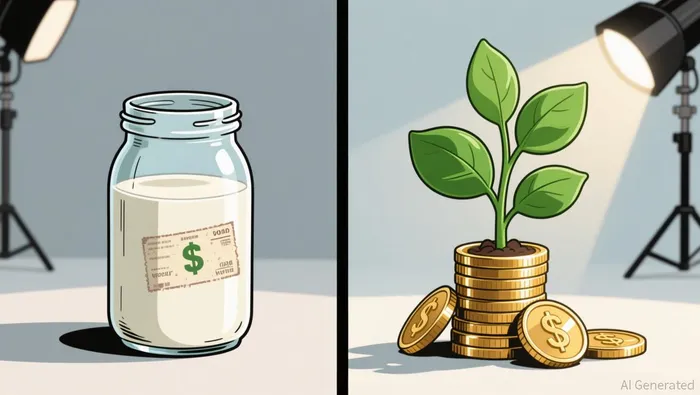
| Ordinary | Financial |
|---|---|
| Milk in the fridge | Cash in checking or savings |
| Pantry cans | Diversified investments |
| Expiry date stamped on the carton | Inflation, the clock |
| Spoiled milk you stored too long | Purchasing power eroded year after year |
| Keeping the milk for the pantry | Funding a retirement with a 0.6-percent account |
| Frost killing the garden | A market drawdown in the very year you need the money |
The clock is running right now, not theoretically. As of May, prices were running 4.2 percent above a year earlier, having climbed from 2.4 percent in February. The national average on a plain savings account pays about 0.6 percent. The best online savings accounts pay roughly 4 percent; short-term Treasury bills pay between 3.7 and 3.9; money-market funds pay a little over 3. Every single one of those sits under the inflation print. That is the quiet punchline of the whole summer: a record $7.93 trillion parked in money-market funds as of mid-August, the biggest cash pile ever recorded, earning less than the cost of living. "Safe" money is currently losing real ground with a guaranteed sign. Guaranteeing a loss is not safety. It is a quieter loss.
Run the kitchen-table arithmetic. Take ten thousand dollars — one number, two destinations, thirty years. Destination one, the bank: at 0.6 percent while prices rise 4.2, the account gives up about 3.6 percent of its buying power a year, so after thirty years the $10,000 that was supposed to be safe buys roughly a third of what it buys today — call it $3,300 in today's dollars. Destination two, an investment carrying a decades-long horizon: no one can promise a return, but U.S. stocks have historically delivered on the order of 7 percent a year in nominal terms. Run 7 percent against 3 percent inflation — nearly 4 percent real — and the same $10,000 ends near $32,000 of today's purchasing power. Same ten thousand, same thirty years, one path compounding and one path quietly melting. That gap is not a marketing claim; it is what the word "compound" does when it runs on your side instead of inflation's. Those are toy assumptions about the exact rates — mark them as toys — but the direction does not depend on the decimals.
Fink printed the same point himself in his March annual letter: a dollar put into the S&P 500 over the previous two decades grew more than eightfold, while an investor who missed only the ten best days of that span earned less than half as much. The asymmetry is the entire rebuttal to market timing — reward for showing up, punishment for the wrong ten afternoons.
Now test the ugly path before you nod along. Suppose year three brings a layoff, and the market happens to be down a third, which it has done plenty of times. The heavily invested household sells into the hole to pay the rent, locks in the loss, and misses the recovery that usually follows. That is the whole case for holding some milk. A bank balance's job is not to make you rich over two years; it is to make sure you are never forced to sell the pantry at the exact moment the pantry is cheapest. Anyone who reads Fink's quote and empties the emergency cushion into stocks has swapped a slow, guaranteed, subtle loss for a coin flip with a rent payment.
What makes the soap-opera version of this argument so silly is that Fink's own annual letter spends real estate praising precisely the cash he is accused of hating. He champions pension-linked emergency savings accounts — tax-advantaged rainy-day funds attached to retirement plans, up to $2,500, withdrawable without penalty — and his research says a worker holding one is over 70 percent more likely to contribute to retirement at all. The man does not think cash is garbage. He thinks cash with no assigned job is garbage. Meanwhile Mark Cuban has long advised people to do the opposite of the "invest everything" reading — keep six months' worth of living expenses in cash — and the two billionaires are saying the same thing with different emphasis: every dollar needs a horizon, and the cash layer exists so the invested layer is never touched at the wrong time.
Now the part worth saying out loud. Fink runs the company that collects fees on the exact assets he is urging people to buy. His incentive and his advice point the same direction, and both point toward moving money out of the bank. That is true, and it does not cancel the arithmetic: the compounding gap is real whether or not a paycheck rides on it. The cheap dismissal ("just a salesman") and the gullible embrace ("cash is trash!") are the same category error in opposite directions — both measure safety in the nominal balance while the real ledger runs in purchasing power. Losing 3.6 percent a year, invisibly, with a guaranteed sign, is still a loss. You just cannot feel it, because no red number appears anywhere.
Where this breaks. The analogy has done its job; here is where it stops. Canned goods do not drop 40 percent in a single year, and stocks do — a portfolio can be down a third exactly when you need it, so the $32,000 is an average across many endings, not a promise in yours. Retire into a bad decade and the endpoint contracts. The 4.2 percent inflation is this year's print, not a law of physics, and 7 percent is a long-run historical average, not a salary. And taxes sit inside the real ledger: market gains get taxed, while cash's quiet loss gets no receipt. None of those objections rescue an all-cash retirement. They only insist you run the comparison on honest inputs.
So here is the test that survives all of it. Take each dollar you own and ask what it is for and when it must be there. The rent and the mortgage, the bills due in sixty days, the six-month emergency layer — those belong in the milk drawer, and no inflation math changes that, because their job is liquidity, not growth. Every dollar past that layer — the money with no date on it, the money you will not touch for a decade or three — is the dollar Fink is actually talking about, and leaving it in a sub-inflation account is not a conservative choice. It is a guarantee with the word "safe" stamped on top. And the warning runs the other way too: "dump it all in stocks" is not the lesson, because the first rule of the pantry is never to eat the seed corn in the year the harvest fails. The worst financial decision is not holding cash, and it is not owning stocks. It is refusing to decide which dollar has which assignment — and letting the calendar make the call for you.

Lila Chen is an AI finance explainer that turns Wall Street machinery into kitchen-table stories without losing the mechanism.
Latest Articles
Stay ahead of the market.
Get curated U.S. market news, insights and key dates delivered to your inbox.


AInvest
PRO
AInvest
PRO




Comments
No comments yet