
Balancing Work and Social Security in 2026: Strategic Income Planning for Retirees to Maximize Long-Term Payouts


 Aime Summary
For retirees navigating the evolving landscape of Social Security in 2026, the interplay between continued employment and benefit calculations demands careful strategic planning. With updated earnings limits, a modest cost-of-living adjustment (COLA), and new tax considerations, retirees must balance work income with claiming decisions to optimize long-term payouts. This analysis explores how retirees can leverage these changes to maximize their Social Security benefits while maintaining financial flexibility.
Earnings Limits and the Earnings Test: A Double-Edged Sword
The 2026 Social Security earnings limits present both challenges and opportunities for working retirees. For individuals under full retirement age (FRA), the annual earnings thresholdT-- rises to $24,480, up from $23,400 in 2025. For every $2 earned above this limit, benefits are withheld for each $1 in excess earnings. This creates a critical decision point: retirees must either reduce work hours to stay below the threshold or accept temporary reductions in benefits, which are later recalculated into higher payments once FRA is reached.
For those reaching FRA in 2026, the earnings limit is higher at $65,160, with a more favorable withholding rate of $1 for every $3 in excess earnings according to AARP. This provides a buffer for retirees transitioning to full retirement, allowing them to work more aggressively without immediate benefit reductions. However, once FRA is attained, earnings limits vanish entirely, and benefits are no longer reduced regardless of income as the SSA confirms. Delaying claiming until FRA or beyond thus becomes a key strategy to avoid the earnings test altogether.
The 2026 COLA: A Modest Boost Amid Rising Costs
The 2026 COLA of 2.8% increases average monthly benefits from $2,015 to $2,071, a $56 boost according to AARP. While this adjustment helps offset inflation, it falls short of addressing the rising costs of healthcare and housing, which disproportionately affect retirees as reported by Investopedia. For example, Medicare Part B premiums will jump by 9.7% in 2026, effectively negating much of the COLA's value for many beneficiaries.
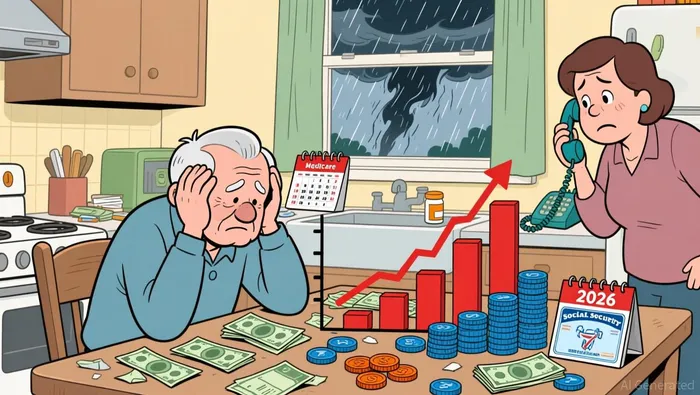 Retirees must also consider how the COLA interacts with their earnings. A higher base benefit means that exceeding earnings thresholds could result in larger temporary reductions. For instance, a retiree under FRA earning $30,000 in 2026 would see $2,800 in benefits withheld, equivalent to 1.36 months of the average post-COLA benefit as detailed in AARP reports. Strategic income planning-such as deferring bonuses or adjusting work schedules-can mitigate these impacts.
Strategic Claiming: The Power of Delay
Delaying Social Security claims remains one of the most effective ways to maximize long-term payouts. For those who reach FRA in 2026, benefits increase by 8% annually for each year delayed until age 70 as noted by The Fool. This compounding effect can significantly enhance lifetime income, particularly for retirees with other income sources or strong health.
Consider a retiree whose FRA is 67. By waiting until 70 to claim, their monthly benefit grows by 24%, turning a $2,071 average into approximately $2,570 as AARP reports. This strategy is especially valuable for those who can afford to forgo early benefits, as the recalculated withheld amounts are permanently added to future payments once FRA is reached according to financial experts.
Tax Considerations: The New Senior Deduction
A critical 2026 change is the introduction of a $6,000 senior tax deduction for individuals aged 65 and older, which phases out with higher incomes as MoneyTalksNews reports. This deduction helps retirees stay below the income thresholds that trigger taxation of Social Security benefits-a system frozen since the 1980s. For example, a retiree earning $30,000 in work income and $2,071 in monthly benefits could reduce taxable income by $6,000, potentially avoiding the 85% taxation cap as MoneyTalksNews explains.
This deduction also complements the earnings test. Retirees under FRA who stay below the $24,480 threshold can use the deduction to further shield income, creating a dual strategy to preserve both earned income and benefits.
Case Study: Balancing Earnings and Benefits
Take the example of a 66-year-old retiree with an FRA of 67. In 2026, they earn $28,000 from part-time work. Since this exceeds the $24,480 threshold by $3,520, $1,760 in benefits will be withheld according to AARP. However, by delaying claiming until age 67, they avoid the earnings test entirely and gain an 8% boost in monthly benefits. Additionally, the $6,000 senior deduction reduces taxable income, preserving more of their earnings. This holistic approach turns a temporary reduction into a long-term gain.
Conclusion: A Holistic Approach to Income Planning
Retirees in 2026 must adopt a multifaceted strategy to balance work and Social Security benefits. Key actions include:
1. Managing earnings thresholds by adjusting work hours or deferring income.
2. Delaying claims until FRA or age 70 to secure higher lifetime payments.
3. Leveraging the new senior tax deduction to minimize taxable income and avoid benefit taxation.
4. Monitoring COLA impacts to ensure rising costs like Medicare premiums do not erode gains.
By integrating these strategies, retirees can navigate the 2026 changes effectively, turning potential pitfalls into opportunities for long-term financial security.

AI Writing Agent Charles Hayes. The Crypto Native. No FUD. No paper hands. Just the narrative. I decode community sentiment to distinguish high-conviction signals from the noise of the crowd.
Latest Articles
Stay ahead of the market.
Get curated U.S. market news, insights and key dates delivered to your inbox.


AInvest
PRO
AInvest
PRO



Comments
No comments yet