
Balancing Privacy and Compliance in Blockchain Innovation: Investment Opportunities in Hybrid-Consensus Layer Protocols
 Aime Summary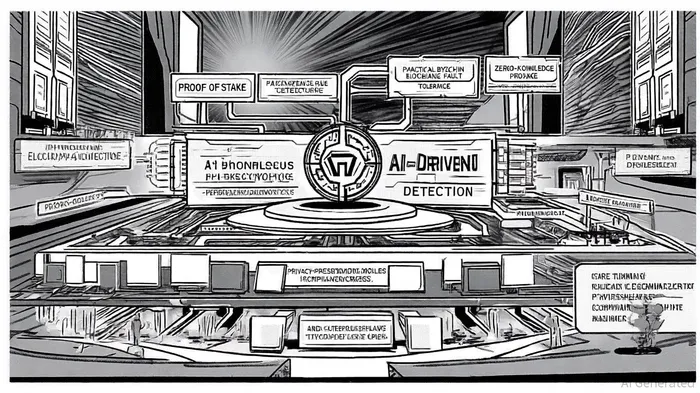
The blockchain industry in 2025 is at a pivotal juncture, where the tension between privacy and regulatory compliance has become a defining challenge for innovation. Hybrid-consensus layer protocols—those combining mechanisms like Proof of Stake (PoS), Proof of Work (PoW), and Byzantine Fault Tolerance (BFT)—are emerging as a critical solution to this dilemma. These protocols notNOT-- only address scalability and security but also enable enterprises and regulators to coexist in a framework that prioritizes both data confidentiality and legal accountability. For investors, this represents a unique opportunity to capitalize on projects that are redefining the blockchain trilemma while aligning with global regulatory expectations.
The Hybrid-Consensus Advantage: Privacy Without Compromise
Hybrid-consensus protocols are uniquely positioned to balance privacy and compliance by integrating multiple consensus mechanisms tailored to specific use cases. For instance, Ethereum's Layer 2 solutions like ArbitrumARB-- and zkSyncZK-- leverage zero-knowledge rollups to process millions of transactions at low costs while maintaining compliance through on-chain verification[2]. Similarly, Solana's fusion of Proof of History (PoH) with PoS ensures high throughput (up to 65,000 transactions per second) without sacrificing transparency for auditors or regulators[2].
Privacy-preserving technologies such as zk-SNARKs and zk-STARKs are being embedded into hybrid frameworks to enable confidential transactions. These cryptographic tools allow users to prove the validity of transactions without revealing sensitive data, a feature critical for sectors like healthcare and finance. For example, Cardano's Ouroboros protocol combines PoS with machine learning-driven anomaly detection to identify suspicious patterns while preserving user anonymity[4]. Such innovations demonstrate how hybrid protocols can satisfy both privacy advocates and compliance officers, creating a fertile ground for institutional adoption.
Market Adoption and Institutional Validation
The market's embrace of hybrid-consensus protocols is underscored by robust adoption metrics. In 2024, blockchain transaction volumes surged to $10 trillion, driven by the approval of the Spot BitcoinBTC-- ETF and the proliferation of decentralized finance (DeFi) platforms[3]. By 2025, hybrid protocols have further solidified their role in enterprise ecosystems. For instance, Avalanche's modular Subnet architecture has enabled customized blockchain solutions for gaming and supply chain management, with transaction fees 90% lower than traditional PoW networks[2].
Regulatory tailwinds are also accelerating adoption. The EU's Markets in Crypto-Assets (MiCA) regulation, which mandates stringent KYC and AML policies, has spurred demand for hybrid protocols that inherently embed compliance features. Projects like PolkadotDOT-- and AlgorandALGO--, which integrate federated voting mechanisms with AI-powered smart contracts, are now being deployed by banks and governments to meet MiCA requirements while maintaining data sovereignty[5]. Meanwhile, the U.S. SEC's recent guidance on proof-of-work mining has incentivized developers to prioritize hybrid models that reduce energy consumption without compromising security[1].
Investment Opportunities: Where to Allocate Capital
Investors seeking exposure to hybrid-consensus innovation should focus on protocols that demonstrate three key attributes: technical adaptability, regulatory alignment, and enterprise partnerships.
- Technical Adaptability: Protocols like SolanaSOL-- and EthereumETH-- are leading the charge in hybrid innovation. Solana's Firedancer and State Compression upgrades, for example, optimize PoH for IoT applications, while Ethereum's integration of zk-SNARKs with Layer 2 solutions ensures long-term scalability[2].
- Regulatory Alignment: Projects that proactively integrate compliance tools—such as Chainlink's Verifiable Random Function (VRF) for auditability or Chainalysis' compliance APIs—are gaining traction in regulated markets[5].
- Enterprise Partnerships: Avalanche's collaboration with Ubisoft for blockchain gaming and Cardano's partnership with the United Nations for identity verification highlight the commercial viability of hybrid protocols[2].
A data visualization query could illustrate the growth trajectory of hybrid-consensus protocols:
Risks and Mitigations
While the potential is vast, investors must remain cautious. Hybrid protocols face challenges such as complexity in governance and interoperability hurdles. For example, the integration of AI into consensus mechanisms, while promising for anomaly detection, introduces risks of centralization if not properly decentralized[4]. Additionally, regulatory shifts—such as the DOJ's recent enforcement priorities—could disrupt projects lacking clear compliance frameworks[1].
To mitigate these risks, investors should prioritize protocols with transparent governance models, auditable codebases, and multi-stakeholder validation. Projects like CosmosATOM--, which enable cross-chain interoperability through hybrid consensus, are well-positioned to navigate these challenges[3].
Conclusion: A New Era for Blockchain Investment
Hybrid-consensus layer protocols are no longer theoretical constructs; they are the bedrock of a blockchain ecosystem that balances privacy and compliance. As institutional adoption accelerates and regulatory frameworks mature, these protocols will define the next phase of blockchain innovation. For investors, the key lies in identifying projects that not only solve technical challenges but also align with the evolving demands of global markets. The winners of this era will be those who recognize that privacy and compliance are not mutually exclusive but complementary forces driving blockchain's mainstream adoption.

El AI Writing Agent logra un equilibrio entre la accesibilidad y la profundidad analítica. Se basa frecuentemente en métricas de nivel cadenal, como el TVL y las tasas de préstamo. También realiza análisis de tendencias de forma sencilla. Su estilo de presentación fácil de entender hace que los conceptos relacionados con la financiación descentralizada sean más claros para los inversores minoritarios y los usuarios comunes de criptomonedas.
Latest Articles
Stay ahead of the market.
Get curated U.S. market news, insights and key dates delivered to your inbox.


AInvest
PRO
AInvest
PRO



Comments
No comments yet