
Balancer Hack 2025 Reveals Systemic Risks in Crypto Exposure and Market Interconnectivity
 Aime Summary
The 2025 BalancerBAL-- Hack exposed vulnerabilities in DeFi protocols, underscoring systemic risks in crypto exposure and market interconnectivity. This event, occurring during a period of heightened volatility in the crypto markets, highlighted the fragility of decentralized financial systems and their potential to affect traditional financial systems. The hack took place as BitcoinBTC-- prices fell below $15,000, and it coincided with liquidations in Hong Kong-based hedge funds, which further amplified concerns about leverage and exposure in the space.
The interconnected nature of crypto markets means that vulnerabilities in one protocol can ripple across the entire ecosystem. The Balancer Hack demonstrated how a failure in a single decentralized finance (DeFi) protocol can impact stablecoins, trading platforms, and even traditional financial instruments like yen-denominated leveraged positions. These events illustrate the broader risks of a rapidly evolving and highly interconnected financial landscape, where DeFi failures can pose systemic threats.
Regulators and industry participants are now more focused on the need for robust security frameworks and clearer oversight mechanisms. The growing complexity of DeFi protocols and the increasing use of stablecoins as bridges between traditional and crypto markets mean that infrastructure vulnerabilities can have far-reaching consequences.
What vulnerabilities in DeFi protocols were exposed by the 2025 Balancer Hack?
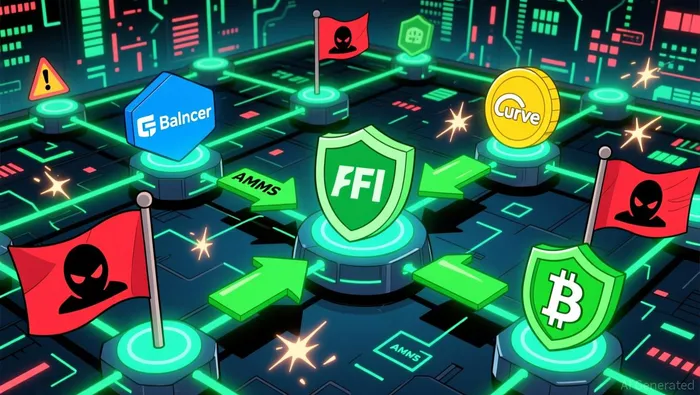
The 2025 Balancer Hack demonstrated a critical flaw in the implementation of swap-based code within DeFi protocols. These vulnerabilities can lead to significant financial losses when exploited. The hack exploited weaknesses in the design of automated market makers (AMMs), allowing attackers to manipulate liquidity pools and extract value. Past incidents like the 2022 Saddle Finance DEX hack and the $116 million Balancer protocol breach in 2025 have shown that these types of vulnerabilities are not isolated events but represent systemic risks.
Curve Finance has also raised concerns about the use of proprietary code without proper licensing, as seen in its recent dispute with PancakeSwapCAKE--. The Curve team emphasized the importance of deep expertise in implementing stablecoin swap infrastructure to avoid vulnerabilities. This underscores the broader issue of code reuse and licensing within the DeFi space, which can lead to security and compliance challenges.
How are regulators responding to the risks highlighted by the 2025 Balancer Hack?
Regulators are increasingly focusing on creating clear frameworks to manage the risks associated with DeFi and stablecoin ecosystems. In the United States, the GENIUS Act, enacted on July 18, 2025, introduced a regulatory framework specifically for payment stablecoin activities. This legislation aims to provide structure and oversight for stablecoin operations to ensure their stability and mitigate systemic risks.
In Trinidad and Tobago, the Virtual Assets and Virtual Assets Services Providers Act 2025 came into effect in late 2025, establishing a time-bound regulatory framework for virtual assets and their service providers. This framework aims to address money laundering and terrorist financing risks associated with virtual assets. Such regulatory actions reflect a growing recognition of the need for oversight in the DeFi and crypto space to protect investors and maintain financial stability.
What role do infrastructure issues play in DeFi vulnerabilities and hacks?
Infrastructure issues, such as inadequate licensing and implementation of proprietary code, are central to many DeFi vulnerabilities and hacks. The Curve Finance-PancakeSwap dispute illustrates how intellectual property and infrastructure implementation are becoming increasingly important as DeFi protocols grow more complex. Curve Finance highlighted the importance of deep expertise in implementing stablecoin swap infrastructure to avoid vulnerabilities.
The 2025 Balancer Hack also underscores the real-world risks of inadequate infrastructure in DeFi. Automated market makers (AMMs), stablecoin mechanisms, and liquidity pools all rely on robust and well-tested code. If these components are not properly secured or licensed, they can be exploited by malicious actors, leading to significant financial losses and systemic risks.
The interconnected nature of crypto markets means that vulnerabilities in one protocol can have cascading effects. As DeFi continues to evolve, ensuring the security and stability of the underlying infrastructure will be crucial in preventing future incidents and maintaining investor confidence.

Blending traditional trading wisdom with cutting-edge cryptocurrency insights.
Latest Articles
Stay ahead of the market.
Get curated U.S. market news, insights and key dates delivered to your inbox.


AInvest
PRO
AInvest
PRO



Comments
No comments yet